

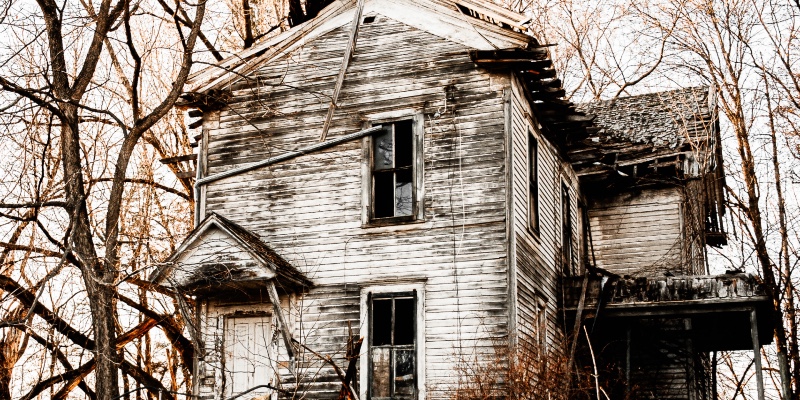
A Home Inspector's Guide to Haunted Houses, Courtesy of D.M. Pulley
Ten steps to approaching ominous abodes in lit and life from a licensed construction specialist
Stigmatized properties are among the hardest to sell on the open market and do not often come up for full appraisal or inspection. However, given the tremendous increase in the cost of housing across the country, more and more homes of ill repute are being seriously considered for purchase by investors and families with children alike.
Here are the top ten concerns a home inspector must consider when approaching a house rumored to be haunted.
*
No. 1: Is the house a Victorian?
Old Victorian homes are by far the most likely to be inhabited not only by ghosts but also by ghost hunters, goth teenagers, arsonists, and lost children that may or may not be possessed. Victorian homes were generally constructed in the U.S. between the years 1860 and 1910 and can be easily identified by their large size, ornate architectural detailing, castle-like forms, and asymmetric layout.
If it looks like the Addams Family could paint it black and move in, it’s a Victorian, so proceed with extreme caution.
No. 2: Did someone die inside the house or on the grounds?
Most old houses have seen their share of death, but not all them are plagued by lingering spirits. Gothic lore teaches us that the manner of death is of utmost importance when it comes to ghosts and ghouls clinging to an object like a doll without eyes or to the home where they died. Violent ends, including bloody murder, furious strangulation, or live burial, are most likely to result in a haunting.
A history of madness or mysterious illness should also be a red flag for restless spirits, so do your research carefully before stepping inside a subject property.
No. 3: Is there a record of any family curse, secret, or burial ground?
A haunted house invariably involves a terrible family secret, or worse, a cursed community. Find out whether the home or subdivision was built on top of a cemetery or Native American burial ground. A home’s dark past could be as simple as the mysterious death or disappearance of a child or as complex as a cult of Nazis communing with the dead. Review old newspaper archives, preferably in a dusty library, and talk to elderly neighbors with things to hide and axes to grind.
Pay special attention to lost family fortunes and rumors of incest.
No. 4: Is the setting Gothic?
Survey the site carefully before stepping inside the home. Proceed with extreme caution if the house is noticeably isolated from its neighbors or located near any of the following: a dark forest, a foggy mountain, the edge of a cliff, a cemetery, a network of caves, or a green-glowing lake.
Walk the site in ever-widening circles and keep a keen eye out for old wells, cisterns, dead trees, dilapidated greenhouses, and uneven ground that may conceal freshly dug graves.
No. 5: Are there signs of children in the house?
It’s a well-known fact that children, and Victorian children in particular, are easily possessed by demons and that old wooden toys, dolls, and moldering nursery books may harbor foul spirits. Scan the windows for little faces before stepping inside.
Beware of cribs, playrooms, old swing sets, and miniature musical instruments. As a rule, left-behind toys and effects should be hauled away and burned in a churchyard or other hallowed ground, and all children’s rooms should be gutted down to the studs.
No. 6: Is there an unfinished attic?
Starting at the top of the house, attic inspections should include not only chimneys, roof decking, and rafters but also the hollows under the floor boards, darkened corners, and the exact locations of all access doors. All, and this cannot be stressed enough, ALL contents of unfinished attics should be removed and burned, especially rocking chairs, sewing busts, and steam trunks (see notes about children’s toys above).
Pull-down access ladders should be secured with padlocks and alarms, and motion detectors and night-vision cameras are recommended for added security.
No. 7: Are there any hidden rooms, passageways, or doors?
In the process of inspecting windows, doors, electrical outlets, and plumbing fixtures throughout the home, be sure to survey the floors for irregularities (lift rugs), sound the walls for hollow caverns, and scan for unusual seams in the millwork. All artwork should be taken down from the walls and any grandfather clocks should be removed from the premises (see notes on burning above). A thermal camera may prove useful in detecting anomalies behind the walls and any hidden hatches, doorways, or stairwells.
Make special note of any doors or windows that do not stay open or closed and recommend removal. Flickering lights should be disconnected at the electrical panel, and all old wiring and/or fuse boxes should be removed.
No. 8: Is there a basement?
The full extents of an old home’s basement must be thoroughly documented and confirmed. Expand the survey to include possible root cellars, capped wells, and buried cisterns. Ground penetrating radar may necessary to detect sub-basements, hidden tunnels, and mass graves.
All basement doors should be equipped with locks and alarms and, in extreme cases, chains to allow the door to be fixed both open or closed as needed. All basements should also be furnished with burner phones, charging cables, flashlights, emergency rations, flare guns, and the basic hardware to make booby traps and improvised weapons.
No. 9: Are there any noxious gases, psychedelic spores, or glowing auras?
In addition to the standard radon and carbon monoxide testing, consider taking extensive air, paint, and wood samples to a lab for further analysis. This is where an old friend working in the basement of a museum or university would be particularly useful.
If there is enough evidence to warrant further data collection, consider staying a single night in the house with a motley crew of researchers to take samples and monitor conditions.
No. 10: Did you hear that?
Keep your wits about you as your perform the inspection and don’t go inside alone. If you’re able, hire a younger and less competent intern for support and comic relief.
If you find yourself feeling anxious or uneasy, rest assured: this is normal. A known hazard of inspecting a haunted house is experiencing some minor level of paranormal phenomena.
Be sure to remain skeptical and dismiss any of your own or your intern’s concerns about ghosts as ridiculous. Stop the inspection and leave the premises immediately if you begin to experience any of the following: an unhealthy fascination with the home or its past; a compulsion to solve any type of mystery; an affection for the home or its past inhabitants; or a certainty that the dead are talking to you.
*
Follow these simple guidelines to ensure your haunted house inspection covers all the known bases. Under no circumstances should you issue any kind of warranty or guarantee that the home is NOT haunted. Upon completion of your survey, obtain a full release of liability from the client before issuing your report.
Visit my website for more resources on haunted houses and what to expect when you step inside: www.dmpulley.com.
***

D. M. Pulley
D.M. Pulley is the author of No One’s Home (September 1, 2019; Thomas & Mercer), a Gothic thriller inspired by a vandalized house she toured. Her previous books are The Unclaimed Victim, The Buried Book, and The Dead Key (winner of the 2014 Amazon Breakthrough Novel Award). Before becoming a full-time writer, she worked as a Professional Engineer rehabbing historic structures and conducting forensic investigations of building failures. She lives in northeast Ohio with her husband, two kids, and a dog named Hobo. You can find her online at www.dmpulley.com and @DMPulleyAuthor.