"A woman's weapon": Maria Malone on the Tropes and Truths of Female Poisoners
The author of Killing in the Countryside explores the complex history and portrayals of women who wield toxins
A family meal, one on which much was riding, Erin Patterson determined it would unfold exactly as she planned. Erin was unused to hosting; she rarely invited people to eat with her at the home she shared with her two children in Morwell, rural Australia.
This was a special occasion, though. Her marriage had broken down, but she wished to remain on cordial terms with her ex-husband Simon’s family. And she had important news to share with her in-laws, Don and Gail Patterson, Gail’s sister Heather, and her husband Ian, a local pastor. Even Simon was coming, Erin believed, although on the day, in July 2023, he failed to show.
A shame, she had already prepared his meal.
They sat down to eat; individual beef Wellingtons, a side helping of vegetables, all carefully prepared by Erin from scratch. Large portions, expensive cuts of steak encased in mushroom and wrapped in pastry. They said grace—Heather struck that Erin’s plate didn’t match those of her guests. She wondered if their host was short of crockery.
In fact, there was another, less innocent, explanation for the mismatched plate.
After they’d finished eating, Erin broke some distressing news. She had cancer, she said, a bombshell no one had foreseen. Shocked and concerned, the two couples rallied round. A prayer was said.
Within hours of getting home, both couples were seriously ill. By the following day they were in hospital where despite the best efforts of medics they rapidly deteriorated.
Their organs were shutting down—a result of having ingested death cap mushrooms.
Erin had eaten the same food as her guests yet showed no symptoms. She went to hospital to be checked over and discharged herself against medical advice, doctors so concerned for her they alerted the police.
Soon, it would emerge that Erin had poisoned her guests. She had foraged death caps, dried them and made a deadly paste, which she served up.
As yet, no one knows why.
Her actions place her alongside the world’s most notorious poisoners.
For centuries poison in its many forms has been regarded as the weapon of choice for women bent on murder. Erin was simply playing to type. In the 1945 Sherlock Holmes movie, Pursuit to Algiers, Arthur Conan Doyle’s detective gives credence to the view. ‘Poison is a woman’s weapon,’ he asserts.
And in Agatha Christie’s first novel, The Mysterious Affair at Styles, where Emily Inglethorp falls victim to strychnine, one of the characters remarks, “murder’s a violent crime—I think of a murderer as a man,” to which another replies, “Not if it’s poison!”
Is it right to consider poison the sole preserve of the female killer?
Certainly, in literature and TV, it would seem so.
In Daphne du Maurier’s classic, My Cousin Rachel, Ambrose Ashley goes to Florence and marries his distant cousin Rachel, only to become ill, his letters home taking on an alarming tone. “For God’s sake come to me quickly,” he writes to his nephew in Cornwall. “She has done for me at last, Rachel my torment.”
The mysterious and alluring Rachel’s knowledge of herbs, her ability to make serums, remedies for indigestion and sleeplessness—”the best nightcap in the world”—hint that her concoctions may on occasion be deadly. Du Maurier plays with this idea throughout the book, cleverly causing us to wonder at Rachel’s motives—doubting her, finding her unsettling.
There are numerous examples of women who have committed heinous poisonings. In the UK, among the most infamous of these is Mary Ann Cotton, considered Britain’s first female serial killer. The gripping TV drama Dark Angel recounted the breathtaking catalogue of deaths attributed to her: three husbands, six children, four stepchildren, her mother, a friend, a lover. All went undetected.
Then, in 1872, while expecting another baby, Mary Ann let it be known she wanted rid of her stepson Charles. His subsequent death raised suspicions and a post-mortem was done, revealing he had ingested arsenic. The following year Mary Ann was convicted of his murder and hanged. Just one conviction, but she was likely a prolific and cold-blooded killer over many years, lacing her victims’ cups of tea with arsenic in order to collect on life insurance policies.
It’s easy to see why poison is deemed a woman’s weapon. Often, in a household, the female is the one predominately preparing food, administering medicine, and has ample opportunity to tamper with whatever she’s feeding to others. Just like Erin Patterson. Yet history shows there are as many male poisoners as female.
In London, in the early 1960s, Graham Young—the so-called Teacup Poisoner—claimed to have administered non-fatal doses of poison to a schoolfriend, his sister, and his father, all while in his teens. He claimed to have killed his stepmother by means of the highly toxic chemical thallium, odorless and tasteless, at one time an ingredient in rat poison.
Young was sent to the maximum-security Broadmoor Hospital and following his release nine years later promptly found work at a chemical plant where his colleagues knew nothing of his past. Soon, people started falling ill. Two died. Young was found to be in possession of thallium. He received four life sentences and died while incarcerated.
A woman who kills will almost always make headlines, yet the vast majority of murderers are men.
In the US, in 89.5 per cent of homicides the perpetrators are male. Female killers account for just 10.5 percent.
The appeal of poison is it’s a great leveler, requiring guile and deceit—not brute strength.
Erin Patterson’s guile in plotting the killing of her husband’s family with meticulous care was jaw-dropping. Going to locations where death cap mushrooms had been found and foraging them. Buying a dehydrator in order to process her toxic haul. Then, following the fateful family meal, dumping the hydrator—her movements captured on CCTV—and lying to police about ever having had such an appliance.
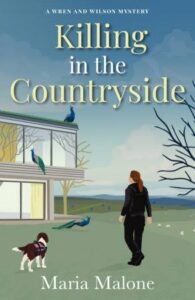
Her cold-hearted demeanor was staggering—a woman who calmly ate with her victims, watching them ingest death with every mouthful as she consumed her own “safe” meal, one she had served on a distinctive plate for the avoidance of confusion. I can identify parallels in my novel Killing in the Countryside, the second in the Wren and Wilson Mystery series.
Imagine what it takes to execute such a cruel plan, the degree of callous calculation involved. A poisoning is never a spontaneous act, a loss of control. It requires detachment. At various points—during the preparation of the food, the cooking, the serving of it, even the eating—there were opportunities for Erin Patterson to step back from the brink. And yet she persisted.
What possible motive could she have had? Nothing suggests her husband’s family were anything other than kind to her, yet she condemned them to a painful, lingering end. Of the four people poisoned, only Pastor Ian Wilkinson survived, emerging from a coma weeks later.
As for her ex-husband, Simon, who she expected to be there—his poison pie was plated up and awaiting him. The reason he failed to show, it later transpired, was because he’d suspected his former wife of trying to poison him for years.
Erin Patterson was one cool killer. While police searched her house she calmly wiped data from her phone before handing it over for forensic analysis.
She was jailed for life, with no chance of being considered for parole for thirty-three years.
At the end of her trial, demonstrating extraordinary compassion, the sole survivor of her killing spree, Pastor Wilkinson, urged people to be kind to one another.
It’s unlikely his words made any impact on Erin. She showed no remorse, nor did she offer any explanation for her actions. She simply lied and lied. Even her claim to have cancer was false.
Perhaps she believed she had plotted and executed the perfect murder.
Perhaps there is no such thing.
One thing is certain–she will only add to the widely-held belief that when it comes to poison, as Sherlock Holmes asserted, it’s a woman’s weapon.
***

Maria Malone
Born in the North-East of England, Maria Malone worked in print journalism and television news and features. She has written TV companion books, ghosted celebrity autobiographies, and is a former Yorkshire Press Awards Journalist of the Year and Feature Writer of the Year.