The Detective, in the Drawing Room, with the Monologue
Unmasking the denouements of Agatha Christie
Denouements are as fundamental to classic mysteries as detectives and the clues they detect. A synonym for “resolution,” or “outcome,” the term can be applied to stories outside the mystery genre, or even to the wrapping up of real-life scenarios. But given that its literal meaning is “unknotting,” it makes sense that the denouement has become associated with whodunits in particular, a subset of mysteries that require a thorough unravelling at story’s end. The detective separates the wheat of the clues from the chaff of the nonsense and red herrings: an intellectual winnowing that provides clarity, hence satisfaction, when the culprit is identified.
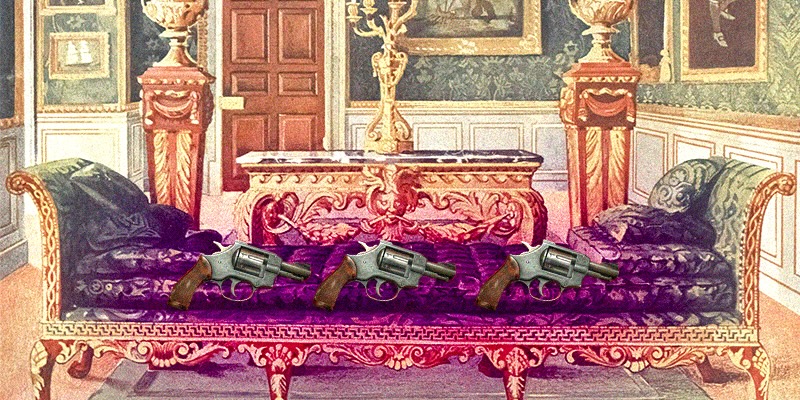
There are no rules governing the denouement. In the late 1920s, when mystery authors Ronald Knox and S.S. Van Dine concocted their famously facetious “commandments” for the Golden Age of detective fiction (Knox had ten, perhaps because he was also a priest, while Van Dine had twenty, perhaps because he was American and couldn’t help himself), they left the denouement untouched. But over time certain clichés creeped in, to the point where the “drawing room denouement” has become a recognizable trope of the genre. We all know how this goes. The detective announces he knows everything, gathering the major characters into one space—often a literal drawing room or its equivalent, though in my anecdotal experience a popular alternative is a theater: a neat externalization of the dramatics underlying this sequence. The case is summarized, side plots having nothing to do with the murder are elucidated (with extra points for fleeting moments in which it seems as though innocent parties are guilty), and then, at long last, the murderer is revealed. At this point there are a few options: the murderer could spontaneously confess, be led away by an officer of the law, or even take her own life. But one hopes at the very least that she will adopt the “evil voice” of the unmasked villain. (If you’re not sure what I mean here, behold this very entertaining parody of the final moments of the classic drawing room denouement.)
Agatha Christie is widely credited(/faulted?) with popularizing this stereotype, and for good reason. In her first novel, The Mysterious Affair at Styles (1920), the detective Hercule Poirot originally revealed the solution to whodunit from the witness box, during a criminal trial. Her publisher’s one big note was that this scene rang false, and so Christie nimbly altered her setting, placing Poirot and his assembled suspects in the drawing room of a country house. And voila: a bromide was born. To be clear, I’m not claiming that Christie invented the notion of gathering suspects together and revealing a mystery’s solution. My assertion is that no one else played as significant a role in the propagation of the drawing room denouement—first with Styles, and in many books to follow.
But how many? One of the pitfalls of being adapted ceaselessly for nearly a century (the silent film The Passing of Mr. Quin was released in 1928) is that the films and television shows based on Christie’s works have come to stand in for the works themselves. This is part of the joy of being a Christie fan. Not only do we have 66 full-length mystery novels and over 150 short stories, we have a bounty of adaptations therefrom: three versions of Death on the Nile and Murder on the Orient Express each, and five of And Then There Were None—and those are just the major versions in English! But all this screen watching runs the risk of eliding the texts. Because unlike their filmed counterparts, many of Christie’s best denouements are not of the drawing room variety.
[U]nlike their filmed counterparts, many of Christie’s best denouements are not of the drawing room variety.
Let’s start with some statistics. (As a person who chose to spend more than five years ranking all 66 of Christie’s novels with my friend Catherine Brobeck on the All About Agatha podcast, this is the sort of thing I love to do.) In preparation for this piece I revisited every novel, counting how many times Christie made use of a drawing room denouement—which we should really call an en masse denouement, since the location is immaterial. What matters is that the detective gathers the major characters/suspects together, and brings matters to a public conclusion. Believe it or not, such denouements occur in just 22 of Christie’s 66 books: a mere third of the canon. If we refine this breakdown by detective, we see that Poirot is the most frequent grandstander (quel surprise), making use of the en masse denouement in nearly half the full-length novels in which he appears, 15 of the 33. Miss Marple is involved in just two of these scenarios among her twelve novels, while Tommy and Tuppence Beresford never partake of the en masse denouement in their four. No surprise there: Miss Marple takes no joy or pride in being the center of attention the way that bombastic Monsieur Poirot does. And the Tommy and Tuppence novels are more thriller than whodunit, which means their resolutions don’t require a systematic reckoning. Also, it’s worth mentioning that the short stories, which I didn’t include in my statistical analysis, tend to play much looser with the conventions of the genre, featuring many a quiet, or outlandish, or otherwise unusual resolution outside the typical en masse trope. (In one story, the culprits die coincidentally in a plane crash.) It becomes clear that the en masse trope is not actually typical of Christie, whose writerly instincts pushed her to craft resolutions that played out differently across her many titles.
Just take a look at the books immediately following Styles. The next three eschew the en masse denouement entirely, and when she returns to it in The Secret of Chimneys (1925), she does so in a winking manner. Here is the plucky Lady Eileen “Bundle” Brent speaking on the topic at the start of the big scene in question: “everyone is assembled, and I have a feeling in my bones… that we are drawing very near to the moment when somebody says ‘James, the footman,’ and everything is revealed.” I find it remarkable that Christie was spoofing a convention she first employed a mere five years earlier. But this was how the Golden Age of Detective Fiction worked: suffused with gameplay, laden with irony.
The truth is that Christie’s denouements show as much range as all the other elements of her work, because she changed the nature of her resolutions to fit the requirements of each story. One of her most celebrated titles, And Then There Were None (1939), can’t possibly have an en masse denouement at the end of the story because, well, there’s no masse to be en. (If you know you know. And if you’re this far into my article, you almost definitely know.) And thank goodness for the intimate denouement between Poirot and the culprit that takes place at the end of The Murder of Roger Ackroyd (1926). What could be more exquisite? On the flip side, the en masse denouement fits Christie crown jewel Murder on the Orient Express (1934) like the proverbial glove a savvy murderer might use to obscure his fingerprints.
The truth is that Christie’s denouements show as much range as all the other elements of her work, because she changed the nature of her resolutions to fit the requirements of each story.
These are all extreme examples. Let’s turn to some mid-range instances for a sense of how brilliantly Christie manipulated the denouement. It’s notable that she managed to get her en masse denouement in a courtroom setting after all. No, not in “Traitor’s Hands” (1925) a.k.a. “The Witness for the Prosecution.” The denouement in that short story—and play—is not en masse at all, and it’s extremely untraditional. But Sad Cypress (1940) plays out much like those old Perry Mason TV movies I inhaled as a child, starring Raymond Burr. Perry always seemed to manage to prove the innocence of whoever was on trial, the courtroom scene ending with the real culprit being led away by the authorities. Christie does something similar here, with Poirot himself submitting evidence as the final witness. And because she had twenty years’ worth of experience by this point, she pulls off the scene with assurance.
In another early Poirot novel (I won’t say which for fear of spoiling), the notion of the en masse denouement is itself used as a red herring. Here is that doofus Hastings, narrating breathlessly once everyone is gathered together: “In the course of my association with Poirot I had assisted at many such a scene. A little company of people, all outwardly composed with well-bred masks for faces. And I had seen Poirot strip the mask from one face and show it for what it was—the face of a killer! Yes, there was no doubt of it. One of these people was a murderer! But which?” As usual, the joke is on Hastings because it turns out the murderer has already died. This book is not a favorite of mine, but the late little twist introduced in the unfolding of the denouement is one of my favorite things about it.
I believe the case of Death on the Nile (1937) is the most instructive. Every filmed version of this gem of a novel ends with an en masse denouement, because how could it not? The entire cast is stuck together on a Nile riverboat: the perfect conditions for a rousing game of J’accuse! (I particularly treasure the 1978 adaptation, in which Peter Ustinov’s Poirot singles out each suspect and imagines how they could have done it, the viewer getting a glimpse of all these “what if?” scenarios.) But this is not how the solution is revealed in Christie’s text. In a series of interviews conducted by Monsieur Poirot and Colonel Race, all the side-plots (so many romances!) and red herrings are stripped away, until Poirot reveals the final answer to Race and just two other characters among the large group. This small party allows him to recount the rather complex murder plot in the appropriate detail, but crucially, the absence of the ultimate culprit from this scene means that when Poirot confronts this person in the next chapter after some time has passed, the two of them are able to have a measured and meaningful conversation about everything that has happened. There is no “evil voice” here, and I’ve always contended that much of the magic of Death on the Nile as written by Agatha Christie lies in the intimacy that exists between Poirot and this person—who I should add goes on to die by suicide one chapter later, in the final pages of the book. Talk about having your cake and eating it too. Christie manages to get everything she needs out of this delicately crafted, long-form denouement: both clarity and pathos, but never at the expense of credibility or characterization. While the en masse denouement has its place in Christie’s fiction—and in the many adaptations based on her stories—we would do well to remember there is always more nuance and deftness to the Queen of Crime’s work, if only we examine it with the attention it deserves. Pince-nez or magnifying glass optional.
***
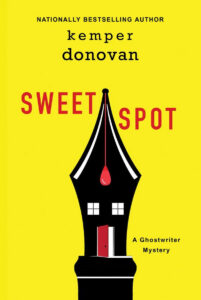
Kemper Donovan is the author of The Ghostwriter Mysteries from Kensington Books, the third of which, Sweet Spot, was released on June 30th of this year. [Include graphic.] No spoilers, but the denouement is of the intimate variety involving two people. He has his reasons….
You can find out more about him, his ongoing podcast All About Agatha, and his work at his website, KemperDonovan.com.

Kemper Donovan
Kemper Donovan is an acclaimed author and host of the podcast "All About Agatha." A graduate of Stanford University and Harvard Law School, he worked at the literary management company Circle of Confusion for a decade before transitioning to writing full-time. He is a member of the New York Bar Association, PEN America, and Mystery Writers of America. He lives with his husband and daughters in Los Angeles and can be found online at KemperDonovan.com. His new novel, The Busy Body, is now available.