
Aimee Pokwatka Never Thought She'd Write a Haunted House Novel. Then She Bought a Haunted House.
What happens when a novelist moves into a dream home, only to find it full of ghosts?
The first time I saw the house was on my husband’s phone. It belonged to his boss, who wasn’t the sentimental type. But he was sentimental about the house, this house where he’d brought his newborn twins home from the hospital. But those twins were heading off to college soon. After twenty years in the house, he was ready to sell it. And he wanted to sell it to us.
It wasn’t that we didn’t want to move. We’d outgrown our little ranch, where I could hear my young kids, constantly, through the walls, and the house would eliminate my husband’s nightmarish commute. But the community we’d built in our small Connecticut town was important to me. The connections I’d made there had sustained me as a young mother, and I loved that everyone knew my name at the local library. I loved having to stop and wait on my drive to the library because the cows from the local creamery were crossing the road. It was going to take something special to make me want to leave.
And then I saw the house. A pale-yellow colonial with green shutters inset with trees, and a wide screened porch with twinkly lights and a porch swing. Inside: a kitchen window seat, floorboards almost two feet wide, and ancient beams marked by the hand tools of workers who were long dead. The main part of the house had been built in the 1750s, with additions patchworked on over the years. Which meant that the house was weird. Off-kilter doorways, dramatically pitched floors, a stairway so steep we immediately dubbed it the Murder Stairs. The house predated the use of electric lights, and not a single light switch had been placed in a location that made sense. As a kid, my dad had been devoted to Bob Villa, This Old House our equivalent to Saturday morning cartoons. And this house, so old and wonky, so full of personality, was my dream home.
So we bought it.
As a horror lover, I’d consumed my share of haunted house stories. We all know the cliché—a writer moves into an old house, which may or may not be haunted. Slowly, they descend into madness as the maybe-hauntings escalate. Descending into madness, however, was not my intention when we moved. Nor did I bring my children into a house expecting a haunting. I didn’t believe ghosts, though I enjoyed the idea of them. So when my husband found a creepy doll in our front yard one afternoon shortly after moving in, we were gleeful. He hid it in my garden caddy; I screamed when I found it. And then it was my turn. This game went back and forth—I hid the doll in his car’s console or the grill; he hid it in the bathroom medicine cabinet or in my underwear drawer. We were having so much fun with our cursed object!
The story nearly wrote itself. A couple moves into an old house, finds a creepy doll, and are too busy with their doll-related shenanigans to notice the house is actually haunted. I started working on the novel in between unpacking sessions, in between making sandwiches for the kids, registering them at their new school, finding a new pediatrician and dentist and veterinarian. I’d written all my novels this way—when I could find time between more pressing domestic responsibilities. But this time the struggle was intensified. This old house needed my attention, as did my kids, who were going through a difficult transition. The first time we’d toured the house, my husband’s boss’s wife had described it as absorbent, and I used the same term when writing about it. My reality began to mirror my fiction—or maybe it was the other way around. The house was absorbing all my time for creative work.
As a writer, writing is the way I think, the way I process the world around me. I often don’t fully understand what I’m trying to say until I’ve written my way through it. When that writing time is limited, as it sometimes is, necessarily, there’s an estrangement. In shifting my attention toward the house and my family—and away from my creative work and ambitions—I began to lose sight of myself.
My relationship with the house became uneasy. I painted the garish orange walls of the dining room, but it took much more time and paint than I expected, because the textured walls seemed to drink the paint. But as the house drained my time and energy, it gave me small gifts in return. The radiators sounded like children crying; I saw light through the floorboards but couldn’t locate the source. I left a room and returned to find the ribbon on my bookmark untied. It felt like the house itself was offering me material, urging to me write about it.
Then one night on my way to bed, I saw a ghost. I’d stayed up late reading, my husband snoring away in bed beside me. I was on my way back from the bathroom, passing through the small living area between rooms. And there, in the space over our bar cart: a silhouette. A man-shaped head and torso, nothing below, as black as a void. My brain immediately tagged it as “ghost.”
I ran to the bed so fast the dog raised his hackles. With the covers pulled tight over my head, I tried to convince myself that a ghost couldn’t hurt me. Ghosts had no corporeal presence, I told myself. Ghosts only appeared when they had unfinished business, which had nothing to do with me. My mind spun out from the suddenness of this change in my reality, with the intensity of a religious conversion. In that moment, what I’d experienced felt completely real, undeniable. I’d seen a ghost.
In the days and weeks that followed: nothing happened. No new ghostly encounters, though when we ran out of napkins at the dinner table, the drawer in the buffet where napkins were kept slid itself open. Gradually, the realness I’d experienced that night started to fade. In the scraps of time I salvaged for my writing, the ghosts in my novel took a new, shadowy form. But the scarcity of that time, along with my growing isolation and frustration, made one thing clear: the ghosts were now the least of my problems.
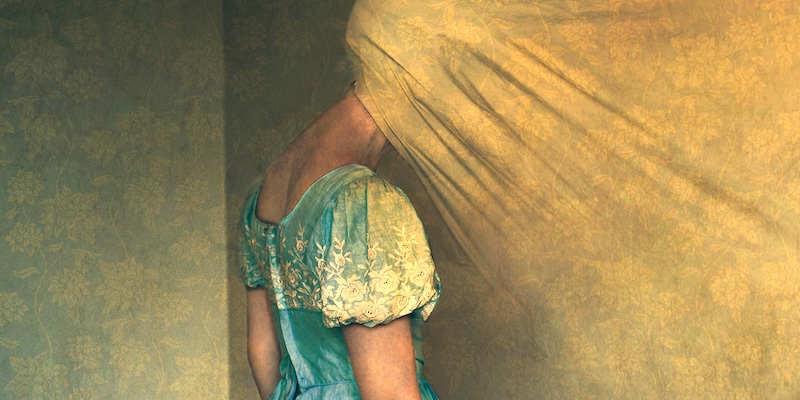
I didn’t plan to write a haunted house novel. The house all but insisted on it. But the deeper I got into the writing, the more clearly I saw the true source of what was haunting me. It wasn’t ghosts, not really. It was that I’d allowed my creative work to take a backseat to unceasing domestic labor. Like many women, I carried more than my share of the emotional labor and mental load. I’d become complicit in my own unhappiness, and it was up to me to find a way to break out. It was the process of writing my haunted house novel that allowed me to exorcize all those things that were haunting me.
One of the best parts of writing a haunted house novel is that people tell you about their own ghosts. I’ve heard stories about ghosts who offered gifts: a broom, a warning that a child was in danger. Just as I’ve heard stories about ghosts who were temperamental, ghosts that emptied coffee cups, ghosts who were only satisfied when the youngest daughter slept in the correct room. These days, I consider myself ghost-agnostic. I can’t explain what it was I saw in my house that night on my way to bed. I only know that I’m grateful for the gifts that my house and its ghosts have given me. Through writing a haunted house novel, I unhaunted myself.
***

Aimee Pokwatka
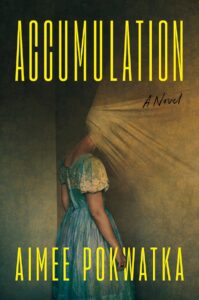
Aimee Pokwatka is the author of Self-Portrait with Nothing and The Parliament, as well as the new novel Accumulation. She grew up in Wheeling, West Virginia, and received her MFA in creative writing from Syracuse University. Her work has been published in Fairy Tale Review, Outlook Springs, Hunger Mountain, and elsewhere. She lives in New York with her family.