
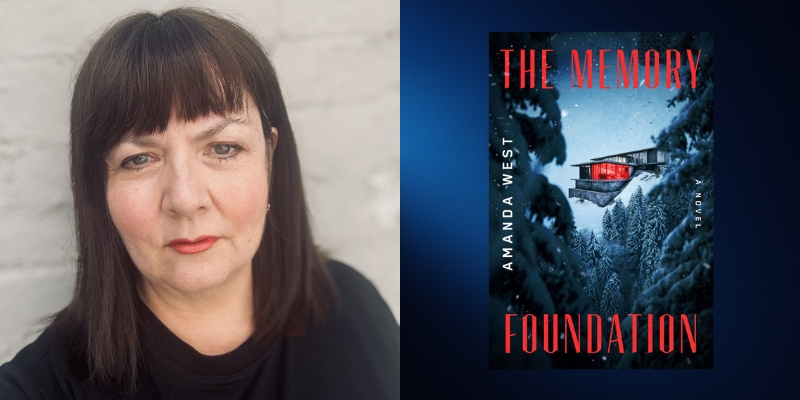
Amanda West on the Joyful Challenge of Changing Thriller Genres
The author of The Memory Foundation moves from psychological to speculative suspense
Genre is a weird beast, often hard to spot in the wild, let alone when you are devising a story. When I wrote the first of my six published psychological thrillers, Close To Me, I had no idea what genre I was writing, other than the broad strokes of a crime novel.
When it was marketed as a psychological thriller it made sense, as that was pretty much all I read. I loved The Girl on the Train, Apple Tree Yard, anything with a dysfunctional female protagonist breaking a few rules on her quest for the truth. Psychological thrillers were my first and are my continuing love. Examining domestic setups to peel back the closed blinds and see behind the façade of perfection is perennially appealing. I mean, who doesn’t love to do that?
So why change genre after six published novels when I could have continued my “brand.” I am a bestselling author of suspense with a TV adaptation behind me and multiple translation deals that have seen my books published around the world. I wouldn’t say I wasn’t tempted to continue, or that I won’t return to that genre one day, but then there was this book I’d always wanted to write, about destination travel with a twist….
I guess the simple answer to the decision to pause my Amanda Reynolds novels and try something new is that it was time to challenge myself. I was at a point in my almost ten year publishing career when I could try something different and I wanted to mix things up, be brave in concept and genre. Push myself into areas I knew little about, but which had fascinated me for many years.
So why speculative thrillers and what does that even mean?
Speculative thrillers ask a BIG question, one that may be in the near-future, far away, or just over the horizon. They search for answers, often centered around a high concept that poses a moral dilemma for the main character, one that hits home now.
Why do we love them?
We live in a constantly changing world, one that both fascinates and at times can be scary. Where better to make sense of that, than in fiction, where we are safe and yet able to enjoy the ride.
When I was growing up there was no internet, no mobile phones, and I thought that the advent of that tech would be the biggest change in my lifetime. Then along comes AI, a behemoth that could shake up everything and in ways we are possibly only just discovering.
It’s easy to be overwhelmed, terrified of the boundless technological innovations we are ushering in, or maybe resisting, but that’s where fiction creates another opportunity. To ask, What If? and see what answers come on that journey from the known to the unknown.
What if, for instance, we could recreate, maybe even experience again, treasured memories? This is how the idea for The Memory Foundation began, although my preoccupation with memory can be traced back to my debut where the protagonist, Jo, falls (or was she pushed?) down the stairs and loses a year of her memories.
Changing genre has meant I can push my ideas beyond the known, into foreseeable but unproven opportunities, good and bad. I can take readers into scenarios they too might have considered, not only in terms of the negative aspects but the opportunities they could bring. Medical breakthroughs, better care for survivors of brain trauma and an aging population robbed of their past, piece by piece, who could, maybe one day, benefit from therapies to return their dignity and personal freedom.
It’s all so relatable, and yet we’re not there yet, but what if we were? Would you go to a secretive facility in the Alps to take a memory flight? Would you put your loved ones forward for the volunteer program if it might give them, or you, a glimmer of their former selves? Maybe not if there are avalanches too, but it’s food for thought!
Speculative thrillers are certainly having a moment. From orbiting astronauts to time-travelling romance, we love the ideas they explore. The way they can transport us to mountain tops and into the minds of visionaries, from the ordinary to the extraordinary and beyond. We can live a thousand imagined lives. Go to places we would never dare to travel in real life.
I’ve had so much fun inventing a way to facilitate the memory flights, and to think about a world where one day it may be possible to be our best selves, over and over. I suspect it’s closer than we think.
I’ve also reveled in the freedom of being in a James Bond-esque mountain lair with a dodgy bridge across a ravine. Although I don’t ever want to walk over it myself. Maybe a moonlit tramp through the snow beneath the stars. That is a more appealing scene to replicate, but danger is never far away in such an inhospitable environment.
Speculative thrillers should be thrilling, but they also make us think, beyond the known and into a future where anything is possible. They ask how we might deal with those choices, what decisions we would make, given the chance. They take us to the heart of a moral question and the truth of that, which is often complicated and nuanced.
I hope you enjoy reading The Memory Foundation. I have loved writing it.
***

Amanda West
Amanda West is the pen name of Amanda Reynolds, whose debut novel, Close to Me, was published in 2017 by Headline and was adapted in 2021 by NENT Studios UK as a major TV series starring Connie Nielsen and Christopher Eccleston, which aired worldwide (Channel 4 in the UK and Sundance AMC in the US). Since then, she has published five more psychological thrillers as Amanda Reynolds, two more with Headline and three with Boldwood Books. Her Husband’s Lie, published in 2024, spent two months in the Kindle Top 100 and has hundreds of five-star reviews. Her books are translated into multiple languages with bestsellers in Finland, Brazil, and Poland. Amanda Reynolds lives in Cheltenham with her husband and their golden retriever. She is an author coach with the Novelry. The Memory Foundation is her first speculative thriller.