Filmmaker Kiyoshi Kurosawa on His New Locked Room Mystery, 'The Samurai and The Prisoner'
Radha Vatsal and Kurosawa discuss the heady new mystery set in 16th-century Japan.
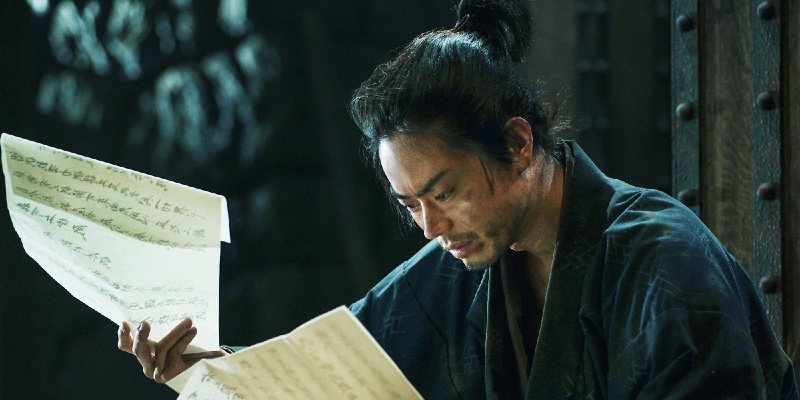
Kiyoshi Kurosawa’s The Samurai and The Prisoner (2026) comprises a series of locked-room mysteries nested within the broader context of civil war in 16th-century Japan. Based on Honobu Yonezawa’s prize-winning novel from 2021, Kokurojo: The Samurai and the Prisoner, it tells the story of Araki Murashige (Masahiro Motoki) who rebels against the warlord Oda and, when the film begins, is under siege in his fortress, Arioka Castle.
Oda sends an emissary, Kanbei Kuroda (Masaki Suda) to broker a surrender, but Murashige will hear none of it, and instead of beheading Kanbei as custom dictates, takes him into custody as a prisoner. That’s when a series of puzzling murders begins to occur within Murashige’s castle—one each season over the course of the year. Not knowing whom to trust, Murashige turns to Kanbei for help solving the mysteries; and to his wife, Chiyoho (Yuriko Yoshitaka), who has her ear to the ground but was traumatized in the past by the massacre of unarmed Buddhist civilians.
In the film, the customs and expectations of samurai culture play off against the mystery sub-plots producing an unusual and enigmatic tension. I sensed that there were things being said and also that much was left unsaid and up to the viewer to pick up on. It was these unspoken elements of the film that I wanted to explore with the director Kiyoshi Kurosawa (no relation of Akira), who also adapted the novel for the screen. Kurosawa has directed several films previously, including the serial killer film, Cure (1997), Tokyo Sonata (2008), and Cloud (2024).
We met in New York City and spoke through a translator. Our conversation has been edited for length and clarity.
Radha Vatsal: In the past, you’ve said that Murashige, who is both the protagonist of the novel and the film, and is also a historical character, interested you because his behavior is quite un-samurai like. At one point in the film, Murashige says, “I use tea for warfare.” Could you comment on that and also more generally on what interested you about his character?
Kiyoshi Kurosawa: So, as you said, Murashige is someone who is very much unlike the typical stereotype of the samurai, and in fact, he intentionally veers away from the customs of the samurai and escapes in a sense. So, that attracted me to him as a historical figure.
It’s hard to say what makes a samurai and truthfully, historically the way of the bushi or samurai is something that was more established during the [subsequent] Edo period. So what we think of as samurai or bushi in the time of The Warring States period, which is the period that this film takes place in, it was really about warlords establishing a kind of value system or their morals and ethics through the art of war.
But the issue was that the authority and those in power began to incorporate the way of the bushi and the samurai, and incorporate it into an authoritative system to establish a kind of hierarchy. And I think that what makes Murashige interesting as a character is that he was trying to resist or remove himself from the ways in which the samurai were being folded into a kind of system of authority.
[As for tea], I think I lack a bit of the research to understand why, but he clearly was drawn to the art of tea and the tea ceremony as a means to maybe pursue a kind of aesthetics, a moral, an ethics. And I don’t know how similar that is to the way of the samurai, but that’s my speculation as to why he was drawn to tea.
RV: Apart from the character of Murashige, is there anything else that drew you to the novel and made you want to adapt it into a film? For instance, the historical or the mystery angle?
KK: The novel is such an interesting book in the sense that it is a detective novel. It’s a very legible mystery novel in the sense that there’s a murder and much like in the form of a detective novel, the protagonist is pursuing the method and who the killer is. And so it’s very legible as a mystery, but the protagonist is also neither a private detective nor a police detective. He must solve these mysteries as a way to maintain order in the castle.
So in a sense, he doesn’t have the same types of motivations as a typical detective, and he doesn’t even have to figure out who instigated these murders. But he’s put in a position where he can’t progress in his journey without solving for these murders. So to have a protagonist who is burdened with that responsibility is what makes this a very clever story.
RV: Thank you. You’ve spoken about mysteries as having taken place in the past, and the difference between adapting a mystery for the screen as opposed to filming a thriller or horror film. Can you talk about that a bit?
KK: When a detective is solving a mystery, the incident is something that happened in the past. And so the filmic depiction is simply watching the detective trying to solve for something that [has already] happened—and I don’t find that to be particularly interesting cinematically. It might be interesting in its novel form, but I was challenged with how to create interest in these moments where the protagonist is having to solve for these murders. And I think that watching someone try to explain or struggle through a mystery is probably the most boring thing to watch. So that’s why I don’t typically go for stories like this in my films, but with this one, the novel was so well made. And watching the protagonist solve for the murder actually became very central to the drama of the film.
So, we are witnessing Murashige in front of his retainers, explaining the process of events and explaining how he has come to a conclusion about the incidents that happened in the past, while also trying to maintain order in the castle and maintain a kind of power over his retainers. All the while, they’re watching him with a sense of suspicion. So making this film and also the source material allowed for me to really challenge myself to try to create the greatest moments of drama in those scenes where he is solving the incident.
RV: And this brings me to a related question, which is that the film combines two genres that we think of as distinct, which is the war film and this kind of locked room mystery. And one usually is a physical type of a genre, with lots of action scenes and things, and the other is very cerebral, and in your head. How do those genres complement each other?
KK: So, you’re absolutely correct. It’s a drama in which these disparate genres coexist. But I was very limited in my depictions of the actual battle or war. You won’t see very many scenes that depict a lot of vicious fighting because this is a story about the siege of a castle and this moment where the people are in a stalemate. And of course, depicting battle, it requires a lot of labor and a large budget. So, of course, I wasn’t able to depict these battle scenes in the way that, for instance, someone like Akira Kurosawa would have. But it’s really about the war that is happening outside of the confines of the castle, and in a sense, they are surrounded by war. But the central story is a locked room mystery.
RV: We have five minutes left, and I have three questions, which I would like to try to get to. Can we go through them quickly? The first is that the physical setting that Kanbei is in, it looks like a desert with undulating floors. I was curious about that choice of that visual setting for him, which really struck me.
KK: That’s something very intentional, very period specific, and realistic. People of today assume that a ground is something that’s meant to be flat. But back then, unless there was a highly trafficked area, it was very rare for places to be completely flat, and so the prison being a place where very few people actually enter, it was important that the ground be very uneven.
RV: The other question is about Murashige’s wife, Chiyoho, who is such an enigmatic character. I was wondering about the choices that were made in the way she appears on the screen. For instance, she’s always sitting a little bit behind her husband. She’s always talking away from him.
KK: As for the distance between Murashige and Chiyoho, in my direction, I would say that that distance was not only with her character, but also with how he interacted with his retainers. There was always a sense of distance between him as a lord and the others around him. Whether it’s trying to depict a certain hierarchy with Murashige standing and those around him kneeling—I think that was just reflective of the reality of that period.
But with Chiyoho, in particular, it had so much to do with building the drama around their dynamic. Of course, initially, there’s this distance, but then there are moments where that distance contracts, and those are the moments of drama. And by the end, you see Chiyoho grab him by the arm and drag him, and that is this big moment of drama. of course,
RV: The phrase “Advance to paradise, retreat to hell” is a central phrase in the film. Is there way in which the film is a commentary on issues facing contemporary Japan, or, larger contemporary issues?
KK: That’s a Buddhist phrase and reflects very old values, but if you change the words just a little bit, I think that it resonates today and not just with Japanese society, but overall. If we were to say that profit is what we’re advancing towards, then certainly that reflects our state of a capitalistic society—that gaining or profiting from money is a kind of paradise, and that not to have money is completely meaningless. That’s something that is reflective of Japanese society, but also society globally. Also to gain power being a kind of paradise and to not have it being a kind of hell. So certainly that is supposed to be reflective of our contemporary times.
RV: And one last question, if we can—for people who are new to your work, is there a film that you would recommend them to see next?
KK: Wife of a Spy [2020] is a period film depicting a time just in the past. While the story is very different from The Samurai and The Prisoner, it is also about people that are trapped in a world of war, and it shows how people are trying to escape the system of war in order to gain their own fate.
And I also want to add that I make a lot of different kinds of films. So another film that I’d like to recommend is Journey to the Shore [2015] which is about a dead man who returns as a ghost, and he and his wife go on a journey together. So it’s kind of a horror film in some respects, but also a love story.

Radha Vatsal
Radha Vatsal is the Film/TV Columnist for CrimeReads. She is the author of No. 10 Doyers Street and the Kitty Weeks mysteries, and her essays have appeared in the The New York Times, The Atlantic, the Los Angeles Review of Books, and elsewhere. She holds a Ph.D. in Film History from Duke University. You can find her on Instagram or email: rvatsal@lithub.com