

Amy Bloom on the Imperfect Protagonist and the Wabi-Sabi of Us All
How Poirot, Wimsey, and all the rest reveal a powerful side of our humanity.
Is there any other kind? Depending on how you like your protagonist and your humans, there are faults enough for every reader. To enjoy the Golden Age of mysteries and the princely protagonists therein (which shaped me and which I still love), you gotta kiss an awful lot of politely (and less so) racist and antisemitic frogs, whose smallest sin is their contempt for all oily foreigners and the working class.
You’ve got your stuffy and smug (Hercule Poirot, love him), your snooty, excessively chatty and vain (Lord Peter Wimsey, love him), your blunt, rude and self-righteous (Karen Pirie, love her) and your nosy, judgmental and mistrustful (Blanche White, adore her).
Poirot is a paradox: absurd and formidable, vain and deeply moral, outraged by a bad meal, unexpectedly compassionate. He is also a figure of moral certainty and clarity, barely troubled by self-doubt or self-destructive impulses. And his (Agatha Christie’s) mastery of the drawing room reveal is what most of us long for, at least sometimes: order restored, symmetry re-gained, darkness illuminated.
Wimsey is another wonderfully imperfect detective: brilliant, of course, but we feel the human cost. He plays a particular kind of fool: wealthy, titled, foppish and fussy—but we, the readers, know better. We see his conscience and moral awareness and the way he evolves and becomes not only someone to admire, if you do, but a man one would want to have dinner with (NOT how I feel about Poirot or Holmes).
Pirie, although not Golden Age, is not herself grimly modern. She is not alcoholic or a recovering junkie, not deeply damaged emotionally, not miserable and she is, for her fans, a fresh, sharp breeze: wildly tenacious, inevitably astute and intelligent, and also a woman who enjoys her job and her own sense of self.
Blanche White is the real deal: funny, observant, morally grounded, and she navigates this difficult world, brilliantly and stealthily, while it consistently fails to see and appreciate her, with a wry, practical, and unsentimental voice. Although she cares about solving the case, her deeper motivation is justice. She is believably brave and clear-eyed, even among her family and friends.
What all of these people have in common is curiosity and intelligence and an impressive, sometimes awkward, perseverance. Some of them are self-aware (to make any monster no longer a monster, give him or her some self-awareness) and some are not and some pretend not to be but we see that they know who they are, or at least, what they have done, in the quiet moments and the musing after the event, whether the event is homicidal or sexual.
You can’t make a perfect protagonist … and you shouldn’t. You can create a scene of transcendent and flawless beauty (dull but pretty, because it’s the imperfection that makes it beautiful) or a perfect weapon (perfect in its usefulness—frozen leg of lamb) or in its artistry (various scimitars, swords and pearl-handled whatnots) but a perfect person is boring as hell.
Some people might wish for the perfect protagonist but it’d be hard to get any of those people to agree on what the perfect protagonist should be. Do we all want beautiful or genius? Beauty or extreme handsomeness can be off-putting (which is why our PIs are often rumpled or dowdy). Endless, force-of-nature brilliance can be entertaining, but there are those of us who prefer a bit of a plodder (what Kinsey Millhone said was essential in a PI: “a plodding nature and infinite patience”), given to rare lightening-like leaps of intuition. I like the texture of variety.
I don’t know how to write perfect people, because I never met any and also because if they existed, after twenty minutes of rapt attention, I’d be bored.
And, for storytelling purposes, you just can’t beat imperfect people. (Who’s gonna kill someone? Rob someone? Blackmail someone? Misunderstand someone? Not the perfect!)
The imperfect offer the reader (and the writer) realism and relatability, so readers connect emotionally. The imperfect help the writer lean into conflict and tension: personal weaknesses create internal obstacles and complicate investigations. Imperfection raises the stakes and offers vulnerability: human flaws (not just over-the-top villainy) make danger plausible and outcomes uncertain, increasing suspense. The imperfect protagonists can and do justify bending rules, making moral choices richer, bad decisions worse, and themes deeper—and action more fun. If you’re already perfect, there is no growth; flaws allow growth (or decline), giving satisfying emotional payoff beyond the puzzle-solving solution.
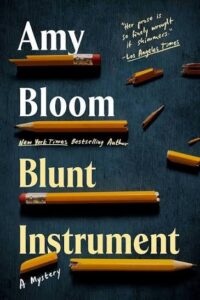
I do tend to give my characters, in all my novels, some of my faults (since I know them so well) and some of the qualities I’d like to have (I have a real soft spot for cool-nearly-cold, deeply reserved WASPY women because I am none of those things, except a woman). In Blunt Instrument, my first mystery, my imperfect protagonist is Dell Chandler, failed (spectacularly fired) professor turned PI (after years of helping her Uncle Luis run Martinez and Associates, she inherits the firm) and talented amateur. Dell is handed the job of discovering who murdered Professor Bullfinch, finding out who bludgeoned him to death with a bronze bust of Nathaniel Hawthorne.
I gave Dell Chandler, my impulsive, authority-defying character, some of my qualities (see the previous two just mentioned) and I also made her a recovering alcoholic, a runner, and quite tall: three things I am not. I gave her some essential qualities: curiosity and doggedness (both of which I share) and I made her good with a gun (I did get a blue ribbon in Riflery at summer camp but I think Dell is better equipped) and gave her a blind spot about danger.
I think there is no story and no twist, without character and I think the best characters, for me as a reader and a writer, are truly human, and therefore, perfectly imperfect.
***

Amy Bloom
Amy Bloom is the New York Times bestselling author of novels, short stories, memoir, and nonfiction. She has written for magazines such as The New Yorker, New York Magazine, The New York Times Magazine, Vogue, Elle, The Atlantic, Slate, and Salon. Her work has been translated into seventeen languages. Blunt Instrument is her first crime novel. Amy resides in Connecticut and recently retired as Wesleyan University’s Shapiro-Silverberg Professor of Creative Writing, while continuing to work as a psychotherapist and a novelist.