
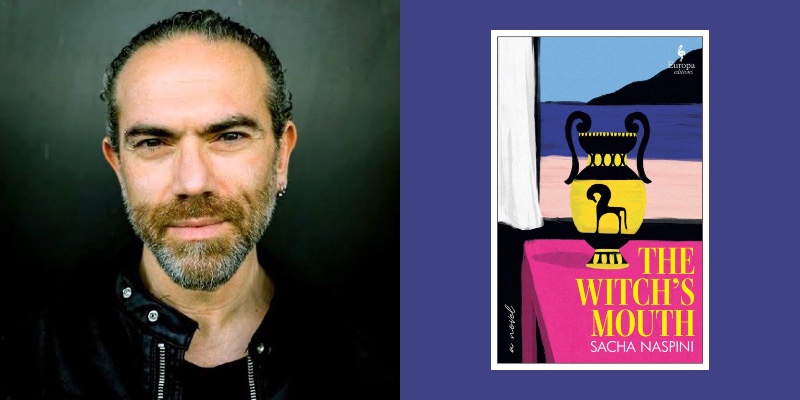
Sacha Naspini on the human stories behind Italy's tomb-raider subculture.
In his new novel, 'The Witch's Mouth', the author explores a hidden economy in the Italian countryside.
Tuscany, 1972. Bardo Sacchetti has the people of the Val di Cornia wrapped around his little finger. Thanks to him and his band of tomb raiders, locals in the impoverished region can now buy fridges for their homes or give their kids an education. He asks for nothing in return except for gratitude.
When Bardo suddenly disappears, his son, Veleno, takes over the family business and old relationships between the gang and the milieu in which it operates begin to fray. Former alliances fall apart and Bardo’s empire looks like it might be destroyed by violence. Veleno has some big decisions to make.
Sacha Naspini’s compact and suspenseful new novel, The Witch’s Mouth (2026, Europa, translated by Clarissa Botsford), drops you in the midst of the action, and creates a world peopled with crooks and cooks, a prostitute, heir-apparent, fishmonger, marquis. The story unfolds from their perspectives.
I sent written questions to Naspini, and Edoardo Andreoni translated his written responses from Italian into English. The interview has been edited for length.
Radha Vatsal: Let’s start with some background. Tuscany, where the novel takes place, seems to be littered with antiquities. Is this more the case in Tuscany than in other parts of Italy? Can you describe some of the types of antiquities that have been found there in recent years?
Sacha Naspini: Actually, that’s true of pretty much all of Italy. It’s a country where history has accumulated over millennia, layer upon layer. Here, even a routine excavation can turn into an archaeological discovery.
Tuscany is no exception. In fact, it’s one of the regions where this historical layering is particularly evident, largely thanks to the Etruscan civilization, which preceded Roman rule. Discoveries are still being made today. Take the recent finds at San Casciano dei Bagni, near Siena: extraordinary bronzes, along with coins, crowns, jewelry, votive arms and heads…
As for The Witch’s Mouth, the novel is set in a specific part of Tuscany, the Val di Cornia. It’s an area I know well, one that plays an important role in the fictional universe of some of my novels. This was once home to Populonia, one of the most important Etruscan cities and the only one built directly on the coast. In the Gulf of Baratti, you can visit Etruscan necropolises, monumental tombs, burial chambers carved into the rock, and the remains of Etruscan and Roman settlements.
RV: The events in the novel occur in the early 1970s. Was there a particular reason for choosing this time period?
SN: Yes, there is. Choosing this period was an exciting challenge, and one that felt necessary. The Witch’s Mouth was born out of long conversations with tomb raiders and smugglers who were active during that time. Suddenly I came across some truly extraordinary, almost unbelievable stories. That’s when I began thinking about using this material as the basis for a novel.
There were also three aspects that I found particularly fascinating. First of all, the “fever” I always noticed in the people who told me about their adventures. That’s the expression they would use: “digging fever.” It went beyond money or swashbuckling adventure—a special light would sparkle in their eyes. As these small-town Indiana Jones recalled those times, that almost addictive excitement was rekindled— the excitement of the moment when, after devising a plan, they would finally manage to break into a burial site, the first people to set foot there in millennia. And then reach out and touch the objects… Part of my job was to try to capture their passion.
The second aspect was even more intriguing and had to do specifically with the Val di Cornia. The trafficking of archaeological artifacts was already underway in other parts of Italy—for instance in the Tuscia region—but in this small corner of Tuscany, people were late to the game.
I heard crazy stories of farmers whose cellars were filled with bronzes that had turned up when they were plowing the land, and who would give them to their grandchildren to play with, like toy soldiers. After storms at sea, amphorae would wash up on the shore at Baratti. Kids would place them on top of low walls and throw rocks at them. Women would show up at Mass on Sunday wearing earrings and necklaces found in the fields…
So I wondered, what would happen if an entire community, largely made up of people who struggle to make ends meet, suddenly realized that their homes were full of objects they considered worthless but that could fetch millions on the black market?
As I was researching the historical archives of the Italian newspaper Corriere della Sera, I came across a news story from 1971 about a twelve-inch bronze artifact seized by the Carabinieri. It was about to be sold to an American collector for half a billion lire (roughly $5 million in today’s money). People in that region had piles of similar bronzes, tossed aside in a corner.
Finally, a purely personal aspect. I spent part of my childhood and adolescence in that region. Other kids and I would form our own little gangs and sneak out of the house in the middle of the night armed, with ropes, shovels, and spades, and head off into the woods. We imagined we were living in The Goonies, but instead of searching for One-Eyed Willy’s treasure, we were searching for Etruscan artifacts. Thinking back on it, what mattered wasn’t so much finding something as the adventure itself. Entering the woods at night was a big challenge. And then the thrill of digging, without really knowing where to look… In a way, I think I experienced some of that same fever the “professional” tomb raiders talked about.
RV: The Witch’s Mouth is an ensemble novel with a lot of different characters, but it revolves around Bardo. He’s almost a godfather-type figure in the way he involves so many different kinds of people in his activities and spreads the wealth he earns. Tell us about your inspiration for creating him.
SN: Everything that happens in the novel is inspired by the interviews I mentioned earlier. But the characters are entirely the product of my imagination, as are the main plot and the various subplots.
When it comes to Bardo, I did a little “plundering” myself. Based on the stories I heard, I imagined this guy who, even as a kid, recognized the value of these artifacts, which everyone else treated like useless old junk taking up space.
But Bardo is also a man of action, and a pretty clever one. He knows how hard life is for the families of Populonia. He starts getting them to hand over their “pieces,” as they call them in the trade, and then sells them to the more experienced tomb raiders in the Tuscia region, returning with the money. Real money, not a few pennies.
Before long, everyone starts looking at Bardo like a sort of saint. Everyone is knocking on his door with an artifact in their hand. And Bardo is extremely good at weaving a network built on trust and gratitude. That means protection—Bardo is untouchable. This is something else that fascinated me: at least in the beginning, there wasn’t a gun in sight. But then the operation grows exponentially. Billions of lire start pouring in. And where there’s that much money, guns usually follow.
RV: Of the novel’s many great characters, I was fascinated by Elisa, Bardo’s wife; Silvana, the prostitute; and the Marquis. As you write, do you have favorites? Do some of the characters come more easily to you than others?
SN: Obviously I love them all, not only because of the role they each play in the story—a character is always an opportunity to explore different points of view, different lives and legacies… What I mean is, how does a particular character, with their own history, react to certain events? That’s part of the magic of writing. Especially when we explore uncomfortable aspects of human nature and relationships.
That said, among the characters you mentioned, Silvana and the Marchese have a special place in my heart. Silvana truly is the queen (I should say, the Principessa) of the novel. The Marchese, for his part, embodies a desperation that is part of the landscape and is compounded by his broken dreams, a desperation that still moves me. Although in the end… but I’d better stop here.
RV: In many ways, this is the story of a gang of tomb robbers but it’s also the story of an ecosystem of stolen goods and people.
SN: I had some interesting experiences in this respect during the promotion of the book in Italy. Together with my Italian publishers, we had the wonderful idea of organizing some events in archaeological museums. Some of the events were fantastic. In other cases, though, for instance in Vetulonia, the director of the magnificent local museum declined to participate. He didn’t want to celebrate, right in a place designed to house Etruscan artifacts, a story about thieves who had deprived everyone of the opportunity to admire works of art and experience the sense of connection we can feel with the people who lived in distant times.
But I’m not an educator; I’m a novelist. I try to make sense of the world through stories. Even if these stories are unsettling—in fact, all the better. What I’m saying is, “Hey, look, this happened too.” I’m saying, “Hey, look at how these people lived. How they reacted, what they dreamt about, what circumstances led them to make certain choices.” And I know very well that it’s wrong to prevent the public from viewing a work of art, locking it away instead in some billionaire’s safe.
I’ll go further. For me, the real damage inflicted by tomb raiders is not the sale of a particular artifact to a private collector. The real theft—and maybe it’s the novelist in me talking—has to do with removing a clue (the artifact itself) from the place where it was found, thereby interrupting a story. Otherwise, archaeologists would be able to tell us how people loved, what clothes they wore or what food they ate, what gods they worshipped, what stories they passed down in that very place. This is what they rob us of, to make a few million dollars. I hope that somehow, between the lines of my novel, this message comes across. But according to some museum directors, I’ve missed the mark.
RV: Are there other novels or writers you draw inspiration from in your work?
SN: The list would be endless, stretching from my formative years to the present, now that I’ve just turned fifty. It would comprise all the different kinds of writing I’ve sought out, explored, and measured myself against. And yet I feel like I’m just starting out.
To mention some writers that have a place in my heart, in no particular order: Italo Calvino, Stephen King, Albert Camus, Joyce Carol Oates, John Steinbeck, Chuck Palahniuk, Beppe Fenoglio, Ágota Kristóf, Mikhail Bulgakov. If you asked me again a minute from now, the list would be completely different. I’m thinking of John Fante, or the fantasy novels I adored as a teenager. And what about Dumas and his Count of Monte Cristo?
Seriously, I never know how to answer this question. But I think that each of these writers has given me a great gift: they “gave me permission” to be brave. To let my imagination spill onto the page, for what it’s worth. And all the voices that come with it.
RV: What are you reading and/or working on at the moment?
SN: On my nightstand are books by David Szalay and Ernest Jünger—the latter a special gift I received, a book that I’ve already read but want to reread. Recently, I returned to John Fante’s Wait Until Spring, Bandini after many years—what a knockout. I don’t think it will ever get old. I also really loved Tiffany McDaniel’s The Summer That Melted Everything.
On my computer is a novel forthcoming in Italy, Il ronzio (“The Buzzing”), which is in the final stages of editing. Of course, I’m also working on another novel. And I’m having fun writing the treatment for a TV series, which is due soon. And listen to this: after twenty years of writing books, for the first time ever, there’s a police inspector in one of my stories. I never would have imagined it.

Radha Vatsal
Radha Vatsal is the Film/TV Columnist for CrimeReads. She is the author of No. 10 Doyers Street and the Kitty Weeks mysteries, and her essays have appeared in the The New York Times, The Atlantic, the Los Angeles Review of Books, and elsewhere. She holds a Ph.D. in Film History from Duke University. You can find her on Instagram or email: rvatsal@lithub.com