
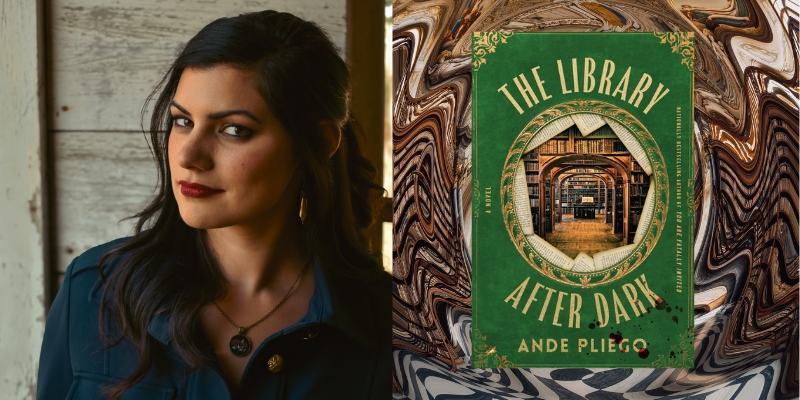
Ande Pliego on the Marvelous Libraries That Inspired Her New Novel
The author of The Library After Dark treks through the Wren, the Hofbibliothek, and other bookish buildings
I have a fairytale snapshot in my head of one moment where as an eleven or twelve-year-old, I stood in the incredibly dark and moody Art’s End of the Bodleian Library, staring at a perfect scintillating beam of golden sunlight falling across the timber cages encasing the stairwells. Something about that moment felt purely magical, and has lived with me ever since.
I’m a creature fueled by atmosphere and vibes, and with The Library After Dark, I tried to capture in a bottle the wonder I felt as a child wandering through Duke Humfrey’s Library in Oxford, the reverence staring up at the dizzyingly detailed ceiling of the Vatican Library in Rome. But a sprinkling of candle wax and the sniffing of leather-bound books wouldn’t be enough—I wanted this darkly whimsical location to be grounded in reality.
Many of the rooms in the Daedalus Library are inspired by places I’ve visited, or long to visit, and I fell further down the rabbit hole of research than I have for any other book I’ve written—which is saying something, considering I wrote a story based around Chaos Theory in mathematics. By George, I fear I will never have as much fun researching again.
In my quest to create an authentic building, I steeped myself in the history of library architecture, and one such library that impacted The Library After Dark is the Hofbibliothek in Vienna—the lavish Rococo space is an extraordinary feat of deception, using a dizzying layout of arches that hide various parts of the room from every angle, making it impossible to predict the library’s size. Since the Daedalus Library is set in New York City and would be limited in its footprint, I borrowed this architectural element from the Hofbibliothek to keep the characters off-kilter on where exactly they were—and where the killer could be hiding.
I also discovered the mastery that is the Wren Library at Trinity College in Cambridge, which inspired the Daedalus’ Classical Literature section. The Wren is a majestic affair of dark wood alcoves, like smaller rooms running along the sides of a rectangular room, and massive windows set above them that pour light down over the checkerboard floor—but the neatest feature is that the floor is actually set quite a bit lower than appears on the outside. This enabled the architect to set the windows above the alcoves of books, rather than take up space in between them, and achieves that magical effect of washing the room in light—light that could, theoretically, in a fictional library, be moonlight glinting off a seventeenth-century guillotine’s blade.
The list of inspiration goes on: the George Peabody Library’s towering foyer of stark white iron served as the main inspiration of the Daedalus’s foyer. Though it’s not a library, the Natural History section is based off a magnificent navy-and-wood room in the Monaco Maritime Museum, which floored me when I first walked into it as a bug-eyed ten-year-old.
I am also pleased to report that I’ve learned far more than I’d ever imagined about hermetically sealed rooms, as well as the fire suppression systems libraries have used over the years to protect their books, such as the Beinecke Library at Yale.
But when I first began researching for The Library After Dark, one library in particular won my heart: the Morgan Library and Museum in New York City. For nearly two years, my desktop picture was of the library’s magnificent East Room, and I became a J.P. Morgan nerd. At one point, I took a research trip alongside two dear author friends to the Morgan.
Please understand, I could not have been more excited if I’d been a child first entering Disney World. We sniffed each room and brainstormed how to describe the smells, and debated what size of manuscript would be easiest to conceal on one’s person as they ran through a library.
As part of my research, I’d hoarded every piece of information I could about the different kinds of secret doorways, and I was determined to root out some in the Morgan. I was unable to confirm it, but I believe we did indeed discover at least one.
I’d be remiss, though, if I didn’t mention the librarians who assisted my research; I visited several libraries and inevitably peppered their guardians with questions, which they so kindly took in stride. Librarians are magnificent people, armed to the teeth with knowledge and information.
In the New York Public Library, I made the tragic error of arriving during study-only hours, sealing me out of the magnificent Rose Reading Room I’d been desperate to see for research purposes. I threw myself at the mercy of one of the lovely librarians, explaining my plight and how I was due on a plane shortly.
Incredibly, she took pity on me, and sent me through the Rose Room to the librarian’s desk, to apply for a library card—a magnificent loophole that still ensured we would all be following the rules. I may have taken the world’s most leisurely stroll through the room, marveling at the gilded crown molding and shades of blush and periwinkle making up the ceiling’s fresco.
At the librarian’s station, my attention immediately snagged on the slim train track of the book delivery system behind her—bless her, the librarian answered as many questions as she could about how it worked to ferry books up from the stacks that ran several stories down beneath the library. Learning about the stacks inspired much of the Daedalus’ subterranean levels, including the infamous Vault where the final showdown takes place.
Speaking of these subterranean levels, did you know that the New York Public Library’s underground stacks have an emergency stairwell that travels under Bryant Park, and leads to an escape hatch disguised as a black-and-gold plaque? There’s a delicious number of things an author can do with an underground escape route….
So much of The Library After Dark was born out of my reverence for libraries, for how so many of them were crafted to be elaborate fortresses of knowledge and beauty that would stand the test of time. It’s my hope that library lovers and history aficionados alike will savor the bits and pieces of library lore, and enjoy a glimpse into the fascinating past of books.
***


Ande Pliego
When not reading or writing, Ande Pliego can usually be found dabbling in art, scheming up her next trip, or making constant expeditions to the library. Born in Florida, raised in France, and having left footprints all over the globe, Ande is settled in the Pacific Northwest with her craftsman husband and little son. You Are Fatally Invited is her debut novel.