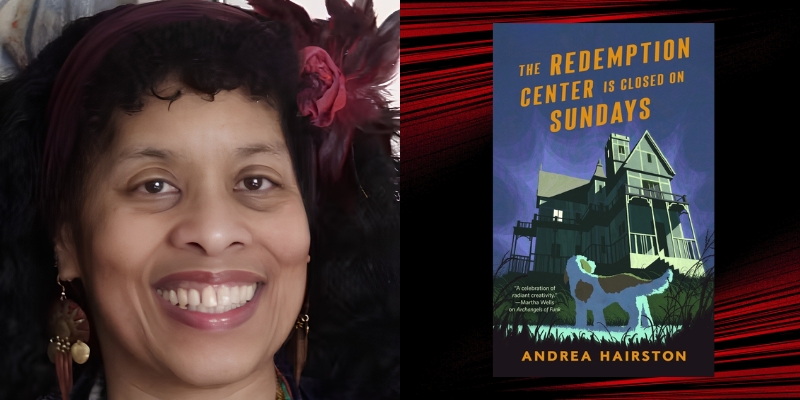
Andrea Hairston on Crossing Genres, Science Fiction, and Taking Romance Seriously
The author of The Redemption Center is Closed on Sundays shares her peripatetic genre journey
When I describe my recent novel, The Redemption Center is Closed on Sundays, as a SFF mystery romance, people frequently ask, “Wasn’t it difficult writing a murder mystery?”
Yes, it was.
As science-fiction author Howard Waldrop regularly told the Clarion West speculative fiction workshop I attended in 1999: Writing is hard. Given Howard’s inflection of English, the a in “hard” went on for several beats. Writing any fiction is “hard.” There are no “easy” genres. Yet nobody has asked me, was it difficult to write a romance?
The questions people do pose make me wonder: Do we suspect that writing mysteries is harder than writing romance? Or that writing science fiction is harder than writing fantasy? Do we think that crafting realistic fiction is more demanding than creating speculative works? Is writing a mathematical proof harder than writing a short story?
For me, murder mysteries are like algebra, teasing out the unknown from the known. So much of storytelling, no matter the genre-mapping, relies on the drama of mystery. You set the stage for conflict and lay out the clues, frequently in plain sight. The setting, props, and costumes are dynamic elements of the story, of the action, not just decoration or atmosphere. As characters interact with their world, they reveal themselves, often reversing audience expectations, surprising us and themselves.
When I was young, my family, teachers, and community determined that I would be a scientist/mathematician. This was an honorable, heroic challenge for a young Black woman growing up in the 50s and 60s in Pittsburgh, PA. My community also encouraged me to enter any realm that intrigued me and ignore the border guards and/or keep-out signs.
I was a voracious reader, devouring several books a week, nonfiction and fiction—Jane Austin, James Baldwin, C. S. Lewis, E. B. White, Dickens, Tolkien, and the Brontë sisters. I also read my older brother’s vast comic book collection. I loved Star Trek, Perry Mason, The Twilight Zone, and any movie my wise/nerdy brother wanted to see. We feasted on Kurosawa, Hitchcock, Truffaut, Bergman, Ousmane Sembène, and Satyajit Ray.
In 1969 my mother and I watched Alice Childress’ play, Wine in the Wilderness, on PBS. Childress dramatized intersectionality before we had the word for it. Her play featured a working-class Black woman refusing to accept the “messed up chick” negative image foisted on her by the mainstream and by a middle class Black male artist and his friends. Childress’ character declared herself to be the Wine in the Wilderness.
My mother and I were dazzled. Childress’ comic romance was fortification for my future, for dreams without boundaries. I just knew I was going to end up a physicist/mathematician who loved literature and the arts. I had no idea I was on a journey to science fiction and fantasy novelist by way of theatre artist.
When I was six years old, I got my first role in a play—a weeping willow tree. I don’t remember the title of the play or much of the story, but I remember the thrill of trying to become something/someone else. At six, I already loved trees. Chasing my character gave me reason to indulge this tree passion. I hung out with trees. I asked my brother and parents endless tree questions. I pestered the children’s librarian about willow trees and she found lots of tree books. I talked to strangers about the trees growing in their yards
After study, consultations, and rehearsals, I did weeping willow tree moves for my brother, our friends, and the cousins. At first, they weren’t impressed. My mother and I made the costume—a trunk with willowy branches for arms and branches coming out the top too. My face was visible in a hollow.
Rehearsing in the costume was incredible. I stood still, barely moving, as if a breeze was at my back, ants running up my legs, and birds nesting in my hair. Occasionally, I fluttered a strand or two of feathery leaves. It was hard work, but eventually, I could stand tree-still for thirty minutes, fluttering in the rare breeze. I paid attention to what was going on onstage around me, but nothing anyone did broke my concentration.
Andrea doing a willow tree was not type casting. I was a rowdy, motormouth, whirlwind of a child, so this transformation was miraculous. I put my great stores of energy into being rooted, holding to the dirt, and reaching for the sun. To make this journey from self to other, I had to cross boundaries, shift realms, and use all of myself to discover what at first I could not imagine. I had to shift from one genre of being to another. This was very hard, and a lot of fun! Challenge + Delight is a winning formula.
From age six on, I did theatre continuously, along with agitating for justice and peace, and headed to college, still assuming that I’d be that scientist/mathematician my community hoped for. But surprise! Despite my passion for science, mathematics, and nerdy research, the second semester of my junior year in college, I shifted my major from Mathematics and Physics to Theatre with an emphasis on playwriting and directing.
My first full-length play, Einstein, which I directed for the Black Theatre Workshop at Smith College in 1973, was a mystery. Like The Redemption Center is Closed on Sundays, the play features a black cleaning lady as the detective. It was what I termed a sci-fi carnival jam and what twenty years later would be called Afrofuturism.
Eventually I became a Theatre professor at Smith College and started a theatre company, doing Afrofuturists plays. In the 1990’s, theatre people and others familiar with my work pointed me to SFF novels. Kym Moore, who directed my play, The Black Woman’s Survival Kit, said I should read Octavia Butler’s Kindred. When I directed “Late Bus to Mecca,” by Pearl Cleage, Pearl gave me her copy of Butler’s Parable of the Sower. Brenda Allen, a colleague from Africana Studies, said I should read Tananarive Due’s The Between. Dramatic irony—they knew where I was heading before I did.
In 1999, crossing another divide, I decided to write sf & f novels and headed to Clarion West to study with Octavia Butler, Howard Waldrop, and others. The workshop turned a drama queen into a novelist. My study of math and science, my work in the theatre, my experiences ignoring the border guards and/or keep-out signs—all of this informs my work as a novelist.
In her essay “The Critics, the Monsters, and the Fantasists,” Ursula K. Le Guin insists that writers and readers of science fiction and fantasy are fluent in the particular “standards, expectations, devices, tropes, and history” of that genre. This she argues is also true of the writers and readers of mystery, romance, realistic fiction, or any particular genre.
In theatre, the big genre divide beyond comedy and tragedy is between “straight” plays and musicals. Will the actors have to sing and dance the story? Into the Woods (fantasy), West Side Story (tragic romance) and Maybe Happy Ending (comic-tragic robot romance) are musicals. Caryl Churchill’s A Number (tragic clone sf), Susan Glaspell’s Trifles (feminist murder mystery), and Douglas Turner Ward’s Day of Absence (Twilight Zone sf mystery comedy) are straight plays.
Luckily, I was trained as a dramatist. Playwrights, directors, actors, and designers must be fluent in romance, fantasy, mystery, and science fiction.
Fluency means training the intuition, feeding the cognitive unconscious—the muse, the creative spirit. It also means knowing what doesn’t work for you and what you love. Playwright Jean Anouilh said, “Creativity is failed imitation.” After watching Devil Girl From Mars, Octavia Butler said, “Geez, I can write a better story than that!” By internalizing structures, possibilities, visions, solutions, a writer trains their intuition.
Chasing my story gives me reason to indulge my nerd passions. The thrill of becoming something/someone else has not dimmed. I write to know. I indulge in dreams without boundaries.
***

Andrea Hairston
Andrea Hairston ran away from the physics lab to the theatre when she was a young thing and has been a scientist, artiste, and hoodoo conjurer ever since. She is a novelist, poet, playwright, and L. Wolff Kahn 1931 Professor Emerita of Theatre and Africana Studies at Smith College. She is the author of Mindscape, a Carl Brandon Award winner and finalist for the Phillip K. Dick and Otherwise Awards; Archangels of Funk, shortlisted for the 2025 Ursula K. Le Guin Prize for Fiction; Will Do Magic for Small Change, a New York Times Editor’s pick and finalist for the Mythopoeic, Lambda, and Otherwise Awards; Redwood and Wildfire, a Washington Post Best Book of 2022, Otherwise and Carl Brandon Award winner; The Redemption Center is Closed on Sundays ; and Master of Poisons on the Kirkus Reviews 2020 Best Science Fiction and Fantasy. Andrea bikes at night year-round, meeting bears, multi-legged creatures of light and breath, and the occasional shooting star.