
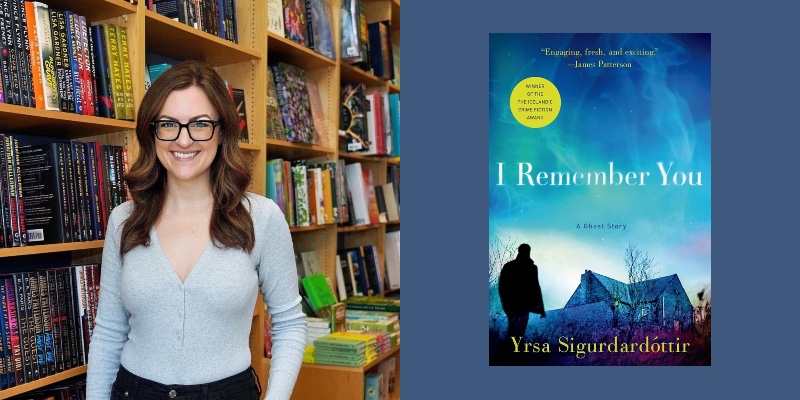
The Backlist: Reading Yrsa Sigurdadottir’s 'I Remember You' with Crime by the Book's Abby Dunn
Polly Stewart and Abby Dunn are talking all things Nordic Noir.
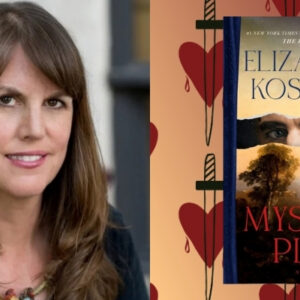
Novelists aren’t the only ones with strong opinions about what makes a good crime novel. Digital creator (and all-around crime fiction advocate) Abby Dunn (@crimebythebook) has been one of my favorite follows for years, not the least because of the way she blends the enthusiasm of a fan with a deep knowledge of the genre. As anyone who follows her already knows, Dunn is particularly well-versed in Scandinavian crime fiction and Nordic Noir, and I recently got a chance to chat with her about Yrsa Sigurdadottir’s I Remember You (and how it helped both of us overcome our skepticism about novels that blend crime and horror).
Why did you pick I Remember You by Yrsa Sigurdadottir?
I chose it because this is one of the few books I’ve read in recent years that actually scared me. I read so many thrillers, and people are always asking me, “Are you easily freaked out? Are you easily scared?” and the answer is, “No, not really.” I think I’m a little bit desensitized at this point, but I was reading this novel alone in a hotel room late at night, and I will never forget how truly creeped out I was. It takes a special book to have that effect on me, so it stands out for that reason.
I also chose this novel because it pushes the boundaries of one of my favorite crime fiction genres, Nordic Noir. I am a huge fan of all things Nordic Noir, and this novel contains a lot of the hallmarks of that genre, but also weaves in some really spooky supernatural horror elements.
Tell us about the genre of Nordic Noir. What writers and characteristics are associated with it?
Absolutely, and I will try to stay off my soapbox here even though this is one of my favorite things to talk about. At its most basic, Nordic Noir is Scandinavian crime fiction, but it’s more specific than that. As with American noir, the mood is dark, gritty, atmospheric, but the weather and climate are so essential in this context. When you think about the visuals you’d get in noir film, there’s no place better suited to evoke that kind of atmosphere than Scandinavia with its dark winters and dramatic weather. The characters are morally ambiguous, and the protagonist may be a bit of an antihero—maybe they’re very cynical, or they’re wrestling with demons from their own past. And then of course Nordic Noir is also typically set in cities in Scandinavia. There’s a lot of other really fantastic fiction from Scandinavia that focuses on rural communities, but your typical Nordic Noir novel is peeling back the surface and revealing the underbelly of some of these cities that we might consider so idyllic: Stockholm, Reykjavik, Oslo, Copenhagen.
In terms of the history of the genre, it grew out of a series of novels written in the Sixties by the Swedish husband and wife writing team, Maj Sjöwall and Per Wahlöö. Their work delves into societal issues that were affecting Sweden at the time, and I think that’s probably another reason why we see a lot of urban settings in this genre. A lot of Nordic Noir focuses not just on relationships between characters, but on larger social issues plaguing a community or a society. As a genre, it has a really interesting history of revealing the underlying issues in places that we think of as looking perfect on the surface.
I know you live in Houston, and I’m just curious to know if Nordic Noir is also a way of escaping the heat for you!
I’m actually from Connecticut, and I fell in love with Nordic Noir back in high school. Now it certainly can be a way of escaping the heat, but even back then, it was a kind of armchair travel for me. I’ve been really fortunate to do a lot of traveling to Scandinavia after falling in love with this genre, but before I visited those places, I got to imagine them through reading about them.
With a novel with multiple points of view, there’s always a risk that one will grab the reader more than the others. This novel has two point of view characters, Katrin and Freyr, who alternate chapters. Which storyline was more compelling to you, or were they equal?
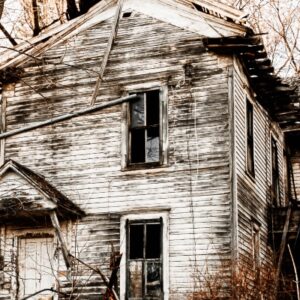
I was originally hooked by Katrin’s story. In the first pages, Katrin, her husband Gardar, and their friend Lif are dropped off at this dramatic location on an isolated fjord. They’ve decided to buy a house and work together to renovate it and open it as a B&B, but it quickly becomes clear that staying alone in this creepy house in a deserted village wasn’t the best idea. The author drops off the reader the same way she drops off the characters, and you find yourself stuck in this situation that you can tell from the beginning isn’t going to go well. That piqued my interest, but I think the storyline that has stuck with me the most is Freyr’s story, about a psychiatrist mourning the disappearance of his young son. There’s a real emotional undercurrent there that grounded the novel for me, and I think that’s one of the reasons that the story has stuck with me years and years after I first read it.
It’s such an accomplishment the way she blends the two stories, because at the beginning it seems like they could be completely separate books. With the sections from Katrin’s point of view, you have this potentially-haunted creepy house situation, and also the domestic drama unfolding among this group of people who don’t seem like they like each other all that much, and then with the sections from Freyr’s point of view, you have a more traditional mystery plot about the father of a missing child. They give the reader different entry points into the novel, and it’s a testament to the writing that they weave together so well.
I feel like any novel is enhanced by a creepy house. What makes this trope work so well?
I spend an inordinate amount of time thinking about how much I love creepy house stories!
I think we love them because home is supposed to be the safest place. Of course we know that in real life, that’s not always the case, but still, in its most idyllic form, home is supposed to be where you can let your guard down and be safe and cared for. To me, the success of this trope comes from the tension between that underlying assumption about what home should be and the reality of horror in the domestic space, and different writers will each put their own spin on that idea. You could take it in the direction of a domestic thriller, or you could take it in the direction of a haunted house, but in either case, what’s thrilling is that contrast between home as a safe place and as a place of fear and danger.
I think what you’re saying here points to how these two storylines integrate so well in this novel. In both points of view, home has been destroyed, either literally or figuratively, before the novel even begins.
It does go together so well, and it really changed my mind about the place of horror in crime fiction. For a lot of readers, it’s easy to say, “Oh, I’m not into supernatural stuff, so I’m not going to like that story,” but this book to me is a great example of how there’s always so much more going on than the back cover can tell you. This is a story about relationships; it’s a story about family; it’s a story about grief. There’s so much there to love, even if you’re someone who thinks that ghost stories aren’t for you.
I do want to be clear that supernatural elements aren’t typical of Nordic Noir. Traditionally, they tend to be police procedurals. I’d read some of Yrsa’s earlier work before I picked up this novel and I trusted her as a storyteller, so even though I wasn’t a fan of the supernatural, when I picked this up, I thought, “Okay, I’ll give it a try.” Then I loved it so much that it made me much more open to horror elements and how they can enhance or complement crime fiction. I have this book to thank for making me more openminded in that way.
Also, the setting, in the fjords of northern Iceland: I think most people have at least heard of Reykjavik, but this is a part of Iceland I didn’t know anything about. What do you think the setting adds to the story?
I go to Iceland almost every year now, and it’s the most stunning landscape. I don’t think there’s anywhere else quite like it. I love a novel where the setting itself creates a kind of dread, and that’s what happens here. When the characters are dropped off by the boat captain, nothing bad has even happened yet, but you have this chilling feeling right from the outset. A few years ago, I was staying at this hotel with Yrsa out in the middle of nowhere on the end of this peninsula, and suddenly I could see where these stories come from. Being immersed in that beautiful isolation creates a kind of tension all by itself, and then there’s the extremity of the weather too. Right now I’m here in my air-conditioned apartment, and yeah, it’s hot outside, but I’m totally fine. For these characters, they’re put in an environment where the weather is inherently dangerous, and it just adds another layer of menace to the story.
It sounds like you know Yrsa pretty well. Who is she outside her novels?
She’s so accomplished. I met her in 2016 at the Iceland Noir Festival, which she cofounded. It’s an amazing festival that takes place every November in Reykjavik. I was just starting out in kind of the crime fiction community and didn’t know anyone, and she was so welcoming. She’s written multiple traditional crime fiction series and she also has a number of fantastic spooky Nordic thrillers like this one, and incredibly, she also works as a civil engineer. She’s a woman of many talents, and she’s done so much to shine a light on other crime writers from Iceland.
Since you mentioned that she’s an advocate for other writers in the genre, can you mention some writers or novels that readers might want to check out if they’re interested in learning more about Nordic Noir?
There are so many! If you’re interested in reading something from Yrsa that is more of a traditional Nordic Noir story, her book The Legacy is one of my favorites. It’s the first in a series following a police officer and child psychologist, and if you love those kind of dark, gritty procedurals, you will love this book. You should also check out Ragnar Jónasson, who’s the cofounder of the Iceland Noir Festival and probably the other really big name in Icelandic crime fiction right now. He has some standalones that lean a little bit creepy—there’s one called The Girl Who Died that is absolutely fantastic, and he also has a great series featuring a police officer named Ari Thor. He’s also translated a number of Agatha Christie’s novels into Icelandic, and he’s an expert on her work, so if you like a Golden Age vibe in your crime fiction, you will love his books.
I’m also a huge fan of Lars Kepler. Like Maj Sjöwall and Per Wahlöö, they’re a Swedish husband and wife writing duo. They write more traditional Nordic Noir, and they’re amazing. You can pick up any of their novels and read it as a self-contained mystery, but if you read the whole series in order, you’ll get this epic story about the central character. The first novel, The Sandman, is fantastic and very scary.
If you want something that leans a little bit more literary and unusual, Silje Ulstein is a Norwegian crime writer who wrote a book called Reptile Memoirs that Grove Atlantic published a couple of years ago. It’s the most unusual and amazing psychological thriller. One timeline deals with a missing child and the other timeline follows a woman who has just gotten a pet snake, and that is all I’m going to say! There’s so much great work out there in this genre, and I hope readers will seek it out.

Polly Stewart
Polly Stewart is the author of The Good Ones. She grew up in the Blue Ridge Mountains of Virginia, where she still lives. Her short fiction has appeared in Best American Mystery Stories, and her nonfiction has appeared in the New York Times, Good Housekeeping, and other publications. She writes the monthly Backlist column for CrimeReads.