Carolyn Marie Wilkins on Historical Fiction, Cults, and Writing Psychic Characters (as a Psychic)
Alex Dueben interviews the author of Let the Murderer Say Amen
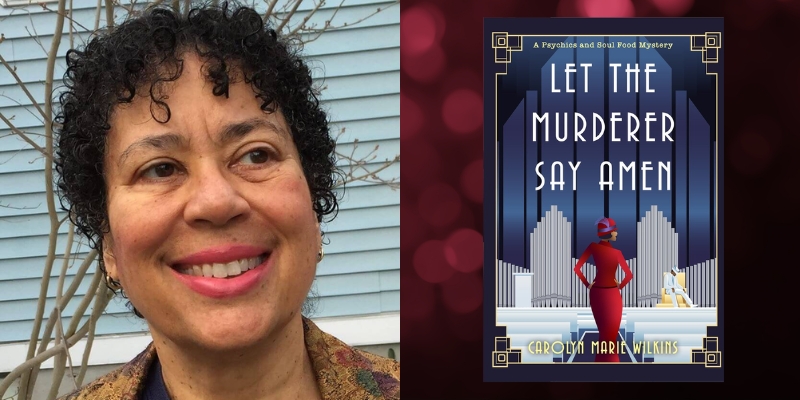
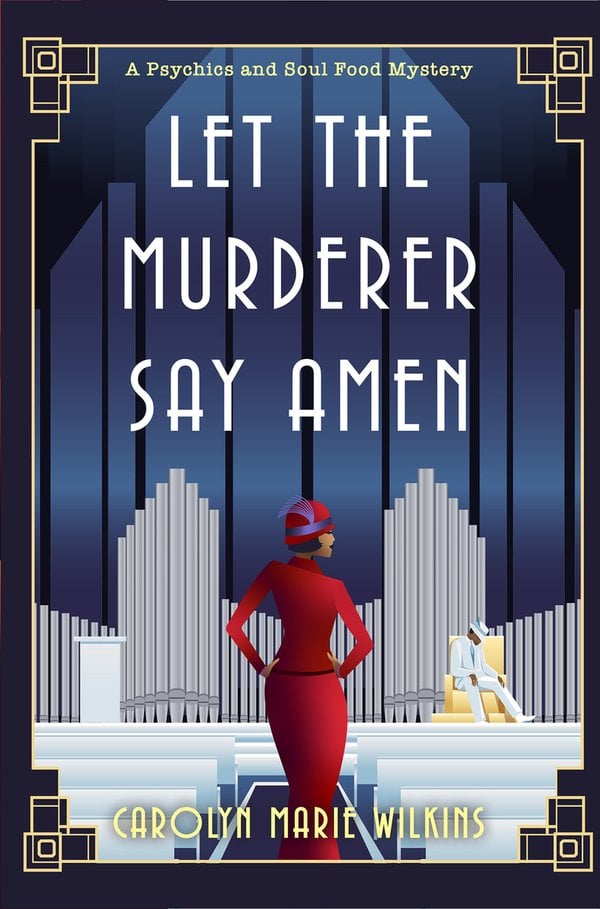
Carolyn Marie Wilkins is a jazz pianist and vocalist, a professor at Berklee College of Music Online, and a psychic medium. She is the author of multiple books including a family memoir, and many mysteries including the Bertie Bigelow mysteries and Death at a Seance. Her new book, the second in her Psychics and Soul Food series, is Let the Murderer Say Amen. This series takes place in a small fictional city in Southern Illinois, and stars Nola Ann Jackson, who has returned to her hometown after her husband’s death to live with her aunt.
The second book is set two years after the first and involves Bishop Ra and his church that has arrived in town. After being shot at in a parade, one of the church’s most prominent white members is killed, before the Bishop himself is stabbed to death.
In both books Wilkins crafts a vividly textured historical tale of ministers and gangsters, the KKK and the police, bookies and businessmen. Whether one believes in psychic abilities or not, Wilkins crafts a mystery tale with vivid characters set in a city that may be fictional, but is deeply textured and alive and we spoke recently about teaching, historical research, and being influenced by real events.
*
Alex Dueben: Carolyn, I’ve really enjoyed reading both books more or less back to back and getting to spend time in Agate, Illinois, which is a small city in the Southern part of the state, and I kept thinking about where my uncle lived in Kentucky where it’s not quite North, not quite South.
Carolyn Marie Wilkins: Exactly. The personality of the setting felt very important to my story. Before I wrote these murder mysteries, I did two memoirs of family history, and it turns out that on both sides of my family, people had lived in Evansville, Indiana, and so in curiosity to see what their lives were like in 1920, I’d actually done quite a lot of research on Evansville. Although I chose not to set my books in Evansville, there’s definitely that vibe to the place.
And it’s a fascinating history. It’s not a big city. It’s not Chicago. It’s not New York. It’s not Mississippi. But there are elements of all of those things all mixed together.
AD: You clearly enjoyed and are fascinated by the period and I loved the lived-in texture of the place that you captured.
CMW: I’m glad you enjoyed it. That was something that felt very important to me to include in the story, because the setting, as you know, is basically another character that helps to drive the plot and helps to drive what happens.
AD: It sounds like the setting was one of the places where these books started for you.
CMW: Absolutely. As I say, I did extensive research and there are a couple of characters in the book that were real life people, or based very closely on real life people. It was just fascinating. I kind of moved Evansville to Southern Illinois, but it has that same vibe. These small cities were experiencing growing pains. There were all these people moving into them from the South. This huge influx of African Americans, but also other ethnic groups and people moving in, all looking for work and all competing for opportunities. And also Prohibition.
So it was an incredibly corrupt era. These places were amazing hotbeds of criminality and corruption. I haven’t even mentioned the Klan! There was all of that going on. You couldn’t imagine anything better for writing a murder mystery.
AD: It’s such a rich period. Also setting the book in a small city means that it’s larger, there’s more people than a village, but even if people don’t know each other, everyone is very interconnected.
CMW: Absolutely. By placing Nola, my protagonist, in her job as a caterer, she’s going in and out of all these different social settings of both the wealthy and the not-so-wealthy and all the various levels in between. That also enabled me to share something more about the history and truths, actually, about the history and the environments at that time.
Maybe if there’s one “cozy” aspect of my story, in the Black community, because of segregation, people had to all live in the same area, and shop mostly in the same places, and because of all that, people did know each other. Even into the 50s, 60s, and 70s, when I was growing up in Chicago, which is a much bigger city, a certain circle of people all knew each other, they all went to the same schools, they intermarried with each other. And all of that creates that little English village that you need in order to have an effective murder mystery, where it’s a little bit confined, and people know each other.
AD: Talk a little about Nola. Where did she as a character come from, and how were you kind of thinking about her?
CMW: People ask that, and to be honest, things just pop into your head. I can’t honestly say I thought to consciously construct a character.
I had written some murder mysteries before for a different publisher. The last one that I wrote also had a psychic heroine. I wanted to write this kind of book about a psychic. Why? Because I’m a psychic, right? And so I could imagine how a beginning psychic could receive information from elsewhere, but because they’re a beginner, maybe it’s right and maybe it isn’t and all of that, which is the truth of being a psychic.
That definitely had something to do with creating Nola. Of course, I wanted her to be curious and feisty, and maybe a little bit recovering from grief in the first book. Her husband has been killed and her sort of entering the dating pool, and what that is like. I guess the way any writer constructs things from scraps of your own experience, but then you recombine into a whole person that is not you, but someone maybe who you’d like to be, or something like that.
AD: As you say, she’s young, she’s psychic, and it can be easy to dismiss. Because of a lot of bad novels where it’s very helpful and the character knows so much and learns it at just the right time. You’re portraying something very different and more complicated.
CMW: This is the challenge of writing about a psychic. Her aunt, as you know, is much more of a master psychic, as well as being very schooled in the African American folk medicine tradition of hoodoo, and healing, and all of that. But there are certain doors that are closed to her that she is not able to see.
As an actual psychic, I’m aware that this actually is the process. You receive information, you receive hints, you receive intimations, you get glimmers, but rarely do you get the whole thing soup to nuts laid out exactly.
Even in my work as a medium, where I am communicating with spirits from the other side, they don’t tell you everything. They just don’t. There’s some things they don’t feel like talking about. They’re going to tell you a small nugget that is going to have relevance for the person that you’re sharing with. This felt to me much more real.
If I have a beef against many mysteries that do have psychic protagonists, it’s that sometimes that psychic piece, or the ones that have ghosts for friends, that kind of thing, doesn’t jibe with my personal experience. I wanted to make something that did connect with what I personally know to be true.
AD: You present it as another sense. Similar to when Nola hears a snippet of conversation, she still has to follow up and investigate, and it may not mean what it appears.
CMW: Exactly.
AD: Nola’s Aunt Sarah has a modest, quiet approach to life and to what she does, and this extends to how she is with Nola. She will help with anything, but is very careful to say, I’ll let you figure this out.
CMW: She’s very strong. She’s very wise. She loves her niece very much, but she respects Nola’s ability as an adult to figure things out. As a writer, that makes a helpful plot tool as well, because if the aunt knows everything, if the aunt knows that the boyfriend is cheating or not cheating or whatever, why even bother to write the story. I think by making the characters more human, they’re more interesting. Also it increases the possibility for suspense in the story, which is very important, obviously.
AD: There’s also Maybelle, who has a new job in this book working for the police, and who we learn is a very good detective. Possibly better than Nola or anyone else.
CMW: I had a lot of fun with Maybelle. As you know, in most all these kind of stories, there’s always a sidekick or someone who helps. Nola is not someone who is going to be going out and physically clobbering people, or arresting them. Maybelle is this fearless, tough girl. What is the thing they say now, Ride or die? She’s that kind of best buddy. She’s also just another sort of sneaky character, because when you look at her, you think she’s one way.
But as you know, in the next book, she turns out to have a softer side and a little bit more to her. I’m glad you enjoyed her. She’s one of my favorite characters in it.
AD: The first book is centered on a honky tonk and it involves gangsters and corruption and a lot of the elements we associate with this period. For this second book you took a different approach.
CMW: Yes, I did. Thank you for noticing. The challenge is you need to use the same setting and many of the same characters, but you don’t want to just have them doing the same thing over and over again. They need to have different experiences. Also I believe from book to book, they need to grow. They need to expand. Their relationships need to evolve. So Nola and her off again on again kind of boyfriend, can’t just stay the same.
I have always been very curious about different religious—I don’t want to say cults exactly, but in the 1920s and thirties, there were several of these enormously popular charismatic preachers who had huge followings. In the Black community, you had Father Divine was one. That was interracial. He even married a white woman from Canada or somewhere, and people lived together in separate, almost dormitories. The women here and the men here. They gave up all their belongings and money to do.
There was another guy, Daddy Grace, who was also incredibly charismatic. He wore the flamboyant robes and the jewelry and all that. He did believe that he was the second coming of Moses. So the character that I created to be the bishop is based in a historical fact, although I did tweak him significantly to make him more interesting as a character.
AD: There are aspects of the church which are so bizarre, but also, this happens today.
CMW: It totally happens today. You don’t have to look far. We can come up with many things today, very popular groups in which people surrender their everything to follow a charismatic leader. Who, at least in the case of this book, actually has psychic powers.
These are not just idiots. They’re people who have gifts, but they don’t always use them in the morally highest and most responsible way.
AD: Are you writing another one? What are you thinking about next?
CMW: Thank you for asking. The truth is I’ve already written another one. Book three in the Psychics and Soul Food series is coming out this time next year. It will have the same characters, but adding some new ones and throwing in some new wrinkles. Also hopefully they are evolving. The town is evolving, the people is evolving. It’s a year later. But the answer is yes, there’s a third book in the works coming next year.
AD: This book is set two years after the first book is set.
CMW: That’s right. And the next one is going to be the next year. We don’t want to age them too much, but I find if people are just ageless, then it’s kind of boring. I feel the characters need to evolve. The story needs to evolve. If you’re going to keep writing about Aunt Sarah, or you’re going to keep writing about Ben Langford, he needs to change and flesh out a little. Everybody.
AD: I will say that I gave the first book to a friend who said, I don’t like Ben, but I like that she’s dating a younger man. [laughs]
CMW: [laughs] Yes, he’s quite a character. I will say, as an artist myself, and having spent many years in the music business, I’m very familiar with a certain kind of persona of the creative artist male. I worked at Berklee College of Music for several decades. I met many, many genius musicians, and there’s a certain kind of personality. I hope that that rang true for people, because it’s certainly been my lived experience.
AD: I felt a little called out. [laughs]
CMW: [laughs] Hopefully not too bad.
AD: Are you still teaching?
CMW: I retired from teaching at the physical bricks and mortar Berklee, but these days, as you know, we live on in our afterlife online. Berklee has an amazing online school. I teach a course there, which is called Developing Your Artistry. It’s all about helping students figure out who they are as artists and how to talk about themselves in that way, and also to prepare themselves in a practical way. But other than that, I’m blessed to be retired.
AD: One thing I did want to mention, I think it’s possible to read the first book and see he psychic powers as a metaphor if you want. That Nola is just empathic and sees things in color. In the second book, with the Bishop, you seemed to be saying, no, that’s not what’s happening.
CMW: I felt that I wanted to go deeper into the whole psychic mystery without turning it into a fantasy book. I wanted it to be in the real world, but these people do have psychic ability, which coming from where I live, is in fact the reality. We do have psychic ability. We do know how to influence other people. We can send vibes to other people. Some very powerful people who work at this can send either helpful or harmful vibes.
But that’s not the whole story. There’s also the material world in all of its aspects.
AD: We have terms now like energy vampire or other ways of describing people or phenomenon, which speak to how we find it to be both supernatural and not.
CMW: That’s right. Exactly.
AD: Again, people can read that as metaphor, if they want.
CMW: If you’re not into that whole psychic piece, you can just enjoy the mystery. I think that the mystery works. The psychic thing is not necessarily a hundred percent essential that you believe that in order to enjoy the story. I place real world clues and real world things that happen that people figure out. Maybelle, for example, is not at all psychic, and she figures a lot of this out.
AD: I kept thinking that how the Bishop and how he is explained a little more about Aunt Sarah, and how she lives and her perspective. Also, this isn’t a fantasy. Just because you’re psychic, someone can still stab you in the back.
CMW: Otherwise, I would be writing a different kind of story, and then it would be more like a fantasy or a science fiction kind of story Which are great and fun. I love reading that kind of stuff.
But I wanted to keep this within the realm of a traditional mystery. There are clues. Things happen. Little breadcrumbs are dropped. You can follow them. The ending should be one that satisfies. And now if you turn back to page twelve, you’ll see so-and-so said something that led to this. As well as the psychic piece.
AD: The mystery makes perfect sense. It works thematically and emotionally and how it’s structured.
CMW: That makes me happy. I grew up reading murder mysteries. Agatha Christie and P.D. James and Dorothy Sayers and all of that. That is my lane. Whether people are psychic or not, whatever razzle-dazzle is involved, there’s going to be a puzzle that has to be solved at the heart of the story.
***

Alex Dueben
Alex Dueben has written for The Believer, Vulture, The Millions, The Los Angeles Review of Books, The Brooklyn Rail, and many other publications. He is the writer and editor of the artist monograph Hurricane Nancy, and his debut novel is forthcoming.