

Catherine Ryan Howard on Murder Houses, Strange Science, and Finding Inspiration for Her New Novel
If These Walls Could Scream...
“Could you live in a house that had been the scene of a murder?” asked the headline of the article my agent had sent me, presumably in a bid to inspire a future book idea. As a single woman who makes her living in the creative arts and rents in Europe’s fifth most expensive city – Dublin, Ireland – my initial reaction was, well, does it have parking?
Anyone with even a passing interest in true crime or Ryan Murphy-scented TV shows will be familiar not only with the concept of a murder house, but probably the addresses of a few, too. Like 25 Cromwell Street, Gloucester, where Fred and Rosemary West murdered at least twelve women. 230 Second Street, Fall River, once home to Lizzie Borden and now a macabre bed-and-breakfast. 122 Ocean Avenue, aka the Amityville Horror house, where six members of the DeFeo family met their deaths. I was intrigued by the concept but I was far from the first; discovering your dream home has a horrible past that is now threatening to bleed all over your future is already the plot of countless thrillers. And yet…
A number of my book ideas have been sparked by newspaper or magazine articles, but never by the piece’s main focus. I tend to snag on some small detail, allotted just a sentence or two, which then sends me down an internet rabbit-hole where, if I’m lucky, I’ll eventually find the shapes in the mist that will become my next book idea. Here, it was a single word: chemosignals.
I don’t believe in anything that science hasn’t sanctioned, but I have had experiences I can’t explain. I once spent a terrible night in what I can only describe as a haunted hotel room, with drinking glasses moving unaided, phantom party noise and the distinct impression that I wasn’t alone. (If you’re wondering why I didn’t flee, it was 1:00am and as a former front-desk agent, I knew exactly how reception would react. I’d much rather be terrorised by a poltergeist than embarrass myself in front of strangers, thank you.) We’ve all stood in spots we’d describe as having ‘bad vibes’ or, while visiting a site we know bore witness to tragedy, felt the chill of an invisible icy finger as it traces a line down our spines. But under the rules of my personal CRH cinematic universe, this can’t be because of anything supernatural. What might a more rational explanation look like?
Enter: chemosignals, a type of pheromone, and the science of what’s known as ‘emotional residue’. In one study, sweat was collected from 144 people during their first skydive, while sweat was collected from people running on treadmills as a control. What you’d hope were a very well-compensated group of participants were then asked to smell both sweat samples while having their brains scanned. Results indicated that the amygdala, the brain’s threat-detection system, was activated by the skydivers, but not the runners. What if that sweat – or tears, or saliva – had been absorbed by wallpaper or carpet? Could physical places hold a person’s feelings? Could other people detect them as they leaked back out later, like a kind of emotional radiation? What if, instead of being scared, those skydivers had been depressed? Angry? Enraged? If you touched your hands to the walls of the room where these feelings had reached a crescendo, would you feel that way, too?
Well, now I was all in. I visited websites like DiedInHouse.com where, if you have a credit card, you can check addresses for crimes, hauntings, drug activity and even proximity to sex offenders and graveyards. I learned that some murder houses have followings. Imagine a kind of Starline Tours, only instead of celebrity homes, it’s infamous crime scenes. The numerical address of the house in Boulder, Colorado where six-year-old JonBenét Ramsey died was reportedly changed to deter these so-called ‘dark tourists’. I ordered a copy of On This Site by Joel Sternfeld, a collection of eerie photographs of places where ‘violence has stained the American landscape’, but taken long after the events, highlighting ‘the ordinary site that remains after the tragedy’. These include the seat in the Texas Theatre that Lee Harvey Oswald was sitting in when he was arrested, the motel balcony in Memphis on which Dr Martin Luther King Jr. was assassinated, and the Morton Thiokol Rocket Testing Facility in Utah which certified the solid rocket booster whose subsequent failure would kill the Space Shuttle Challenger’s crew.
I also cast my mind back to an, ahem, unspecified number of years ago when I worked for a real-estate agent. It was my job to take the mutterings on his little Dictaphone cassettes and spin them into glossy brochure copy. A bedroom too small for a bed became the luxury of a home office. A house standing on the side of a highway that promised a soundtrack of horns and sirens 24/7 was conveniently close to major transport links. A leaking roof, faulty wiring and mould-infested walls? Why, you’re in luck! That’s a rare opportunity to dream, design and build your ideal home.
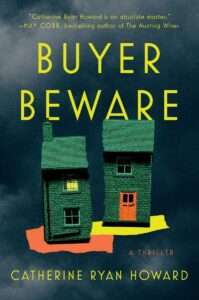
Finally, it was time to start writing a novel. Buyer Beware begins with a woman moving into the first home she’s ever owned, alone, with only her secrets, a single suitcase and the hope that this will be the fresh start she desperately seeks. What she doesn’t know is that the house has secrets too – and their keepers are watching. It also features a real-estate agent character that I had a criminal amount of fun writing, a Lone Gunmen-esque group of enthusiasts called The Murder House Club, and a scene inspired by my greatest fear.
By the time I typed THE END, I was more grateful than ever that I am the first person to live in my apartment; the complex was newly built when I moved in. But, fun fact: it’s directly opposite a graveyard. The earliest readable tombstone in there is from the late 1700s, but it’s also home to Viking burial slabs that are over a millennium old. I didn’t need DiedinHouse.com to tell me that – it’s the view from my living-room window.
The past isn’t going anywhere. We have to live with it. The only question is how?
***

Catherine Ryan Howard
Catherine Ryan Howard has been a finalist for the Edgar Award for Best Novel, the CWA’s Ian Fleming Steel and John Creasey (New Blood) Daggers, and Irish Crime Novel of the Year multiple times. The Nothing Man, her mix of true crime and crime fiction, was a no. 1 bestseller in her native Ireland. She is currently based in Dublin, where she divides her time between the desk and the couch. Run Time is now available from Blackstone.