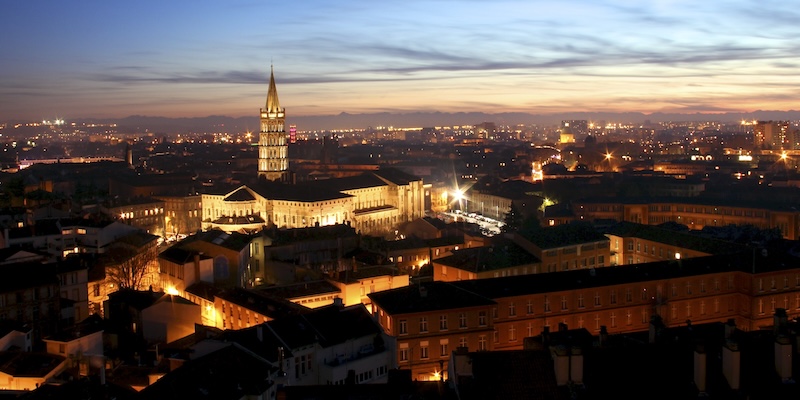
Charles-Henri Lavielle on Toulouse, Settings, and Seeing Cities Anew Through Noir
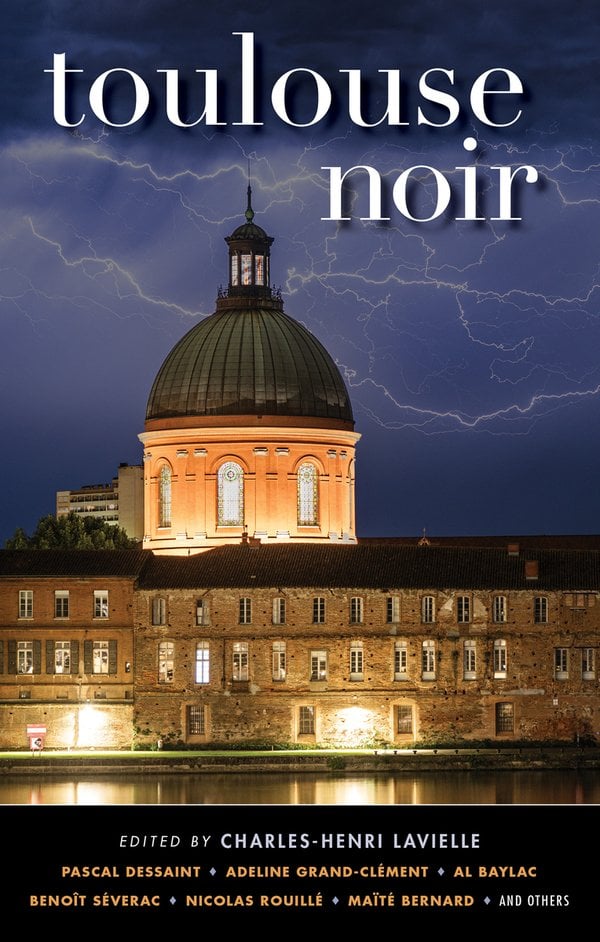
From the introduction to Toulouse Noir, edited by Charles-Henri Lavielle
An Attempt at Exhausting the Color Pink*
(A Tribute to Georges Perec and Gaspard Chauvelot)
(Dedicated to Alban Bensa)
Like many book lovers, I read my Dashiell Hammett, my James Ellroy, Tony Hillerman, and a lot of others. On the French side, my Georges Simenon, Jean-Patrick Manchette, and Fred Vargas. I have my required quota of Scandinavian crime novels and I’ve enjoyed the company of Manuel Vázquez Montalbán and Aníbal Malvar. But none of this makes me an expert in the genre.
In crime novels and in many other types of fiction, I have often been struck by a troubled feeling, as if the stories could not exist outside of their specific locations; that the writing provides a way for the reader to physically feel a place. For me, selfishly, this was probably the main reason I agreed to edit this collection of short stories.
It’s fairly common for a reader to have the experience of seeing a city as a setting, even as a whole character in a novel. But in 1996, just after it came out, a friend put Pascal Dessaint’s La Bouche d’ombre (Mouth of Darkness) in my hands, a very good novel by all accounts.
However, what left an indelible mark on me was that for the first time, I was reading a noir novel whose action was taking place in the city where I was currently living. I was reading the description of neighborhoods and places that were familiar to me, and Dessaint’s way of describing them made me rediscover their smells, sizes, colors, and ambience.
As I read, I could physically feel what I experienced as I walked through them, usually at night. Stranger still, when I passed through the same streets or frequented the same places as the characters in the book, I would see someone coming out of a doorway or turning a corner, begin to run, or put up his hoodie, or raise his collar while hunching his shoulders, and I started to imagine that something was up. I was creating movies for myself.
There are a few other circumstances that might justify my place in this adventure. I’ve lived in Toulouse for more than thirty-five years. I went to the university here, I’ve walked around its streets at night, have gone to bars, nightclubs, and concert halls.
My only connection to the aeronautic industry is having been on a plane, but I’ve played rugby in this city for twenty years, which gives me one of the two indispensable criteria for the tacky identity card invented by the municipal marketers. I also founded the publishing house Anacharsis with my friend Frantz Olivié over twenty years ago. After all this time, I’ve become sufficiently settled here to have a large network of acquaintances, friends, and enemies.
There’s nothing particularly obvious in learning about a city through noir literature, nor about soliciting fiction au-thors to write a guide, even an alternative one, rather than going to geographers, historians, sociologists, or anthropolo-gists. But the question of the link between literature and the social sciences is not totally foreign to me, and it’s even likely that part of the Anacharsis catalog comes from that. In fact, using different types of writing to express reality had already been a preoccupation of mine in another context, actually a rather similar one.
In 2012, in Terrains d’écrivains (Writers’ Terrains), François Pouillon and Alban Bensa, both anthropologists, posed a somewhat provocative question:
How do writers, particularly the greatest writers, succeed in being so convincing and relevant in the way they talk about people and things, so much so that in comparison, anthropological writing of-ten seems…how to say it? Out of touch?….It is rather troubling to observe that without the methods and concepts we think we have in our arsenal, these authors went further and faster than we did in rendering events, characters, living conditions, and so on.
Of course, I have no intention of denying what the social sciences can teach us, but I do wonder why good writers often express the world better than established re-searchers. Perhaps, to put it differently, why is fiction—here, noir literature—sometimes able to put its finger on a reality that the academic world has difficulty rendering?
Urban decor is much the same in many of the cities around the globe. You see the same signs, the same brands, people dressed the same way, to such a point that sociologists have coined the phrase “global village” to speak of that homogenization of the world. So cities, in noir literature, given a few distinctive features—an Eiffel Tower here, an Empire State Building there—could very easily be nothing more than Western movie sets, identical resorts to various locations, the tools of an affordable exoticism offered to readers.
The hypothesis is all the more likely as one may have doubts about a part of the production. And yet, like rock music, noir literature is both standardized and paradoxically able to produce the uniqueness of atmospheres, behaviors, the ways of life specific to the locations where the action takes place.
In Polarville, Jean-Noël Blanc examines a link that seems so tight that the words “urban” and “noir” end up fusing. The fusion is quasi-organic. “The city is sick; it is the place of moribund urban living. The fundamental question is thus always: who is responsible for the negation of the city in the city?”
And Blanc goes on: to find the responsible party for this denial, you must
raise the veil that masks reality, find the truth under the illusions, and finally, read the city from underneath and turn it over. Crime fiction is fundamentally a trip. It digs into the city. Once the secret has been discovered, the crime novel reveals it. It brings it to light. It shows the underside of the cards. It denounces. Hence its reputation for realism.
This analysis does not concern the crime novel only, it is perhaps one of the characteristics of all noir literature. But realism is not the real; it may even be the sign of its absence.
As with the architectural description of standardized cities, it is fairly easy, with access to the Internet (or even, for the most analog among us, to a library), to show realism in the symptoms of sickness in a city: violence, racism, sexism, extreme poverty. Fairly simple, too, to imagine their causes. On the one hand, an economic and a mechanical model: lil-ism and finance; on the other, the inherent traits of so-called human nature: thirst for power, greed, corruptibility, etc.
Thus, noir literature, like social sciences, is not immune to a mortal pitfall, an accumulation of generalities: the writer or researcher’s barroom talk, a hodgepodge, the literary equivalent of world music, in a sense.
Alban Bensa also advocated for the necessity of always returning to the terrain to observe and listen. Describing before writing is the only way to give a credible account. A good description often does more than any theory, hence the necessity in one’s discipline to work on language, to concentrate on the quality of writing.
Conversely, at the end of the day, the writer must not neglect the terrain in order to render the real, realistic. Of course, you don’t have to “be from here” to write about a place, just as you don’t have to be French to work on the Collaboration, or Black to write about the slave trade, or a contemporary of Vercingetorix to write the history of the conquest of the Gauls. You can study and learn.
That ability to observe is what guided my choice of authors for this collection. I tried to bring together a variety of people, of various ages, backgrounds, genders, with different life experiences, who all have a strong connection to Toulouse and to writing—in an attempt to attach the atmosphere of the city to your future steps; and if you never come, to make you feel what you would have found here.
We must eventually realize that history is not linear and the preoccupations of the men and women of today are often the same as the men and women of yesterday. In the eighteenth century, the castrati sued the Church for the right to marry; the only thing new about gentrification is its name—the chaotic extensions of cities, the persecution of artists, the place of nature in the city, the dirty dealings of bigwigs, hatred of foreigners, and sexual violence are not new questions that we have to deal with, like so many stages of humanity on its way to a predetermined future.
Generations build or endure their habitats, try to shape their spaces, wage collective wars, and always, in the midst of it all, individuals struggle to survive. The history of its generations and its stratifications give its face, its color, and its tone to an era, a place, or a city.
*
An enclave in the heart of Toulouse, which, here as elsewhere, attracts the voracity of city planners, Belfort is one of the last working-class neighborhoods in the city center. Hafid Saïdi, author of “The Star of Belfort,” has been a keen observer of its daily life for the past thirty years; he takes us into a place with a nefarious reputation but also with a strong sense of community.
As for city planners, we’ll talk of them with Nicolas Rouillé, who measures, with his “Ploc-Ploc” ticking like a clock, the slow death of avenue de Lyon on whose ruins the “Greater Matabiau” project and its obligatory greenwashed high-rise will be built. A building from which, no doubt, we’ll still be able to see Gaspard Chauvelot wandering through the fringes of the city, a galactic traveler out of The Hitchhiker’s Guide to the Galaxy—in the story “Ridgeline,” the fruit of the chaotic conquest of the suburbs.
However sprawling cities may be, nature tries to reclaim its territory. Regardless of whether you try to lock it away in the Botanical Garden or in the Grand Rond gardens, as in the classifying compulsion of “The Man Who Counted Flowers” by Tanella Boni; or whether nature tries to survive in the interstices of the sidewalk or the cracks in the walls, as in Pascal Dessaint’s “Asphalt Beauties,” even around avenue de l’URSS—the USSR, whose ability to cover things up is well known.
Nevertheless, Adeline Grand-Clément is here to remind us, with “The Uprisings in Terre Cabade,” that de-spite our arrogance, we’ll all end up pushing up daisies in one cemetery or another. So, let’s begin with Terre Cabade—the view is just breathtaking from up there.
During the time we have, our actions provide a specific color (not pink, thanks!) to the place we live in. Fostering collectivity, fighting for equality, or for creativity, transforms our environment. When you put something out into the world and find a way to project who you are and what you think into the future, you add color to your surroundings.
The Canal du Midi crosses the city. A foreigner or a traveler can walk along it without stopping or decide to settle there for a while or forever. This choice depends on the welcome we give them. But make no mistake, says Manu Causse in “Noir Canal,” our attitude is not neutral, it will transform the face of the city.
And just like Al Baylac is followed by the night as (s)he roams through the center around Esquirol, Sarah Grall is not far from place du Capitole. Whether it’s a place for women in “The Pack” or a place for artists in “Who Stoned the Bear?” one must organize to live together. Articulation or arthritis!
Individual destinies and small lives sometimes reveal the path that men and women take when in the grip of a disjointed reality. The following three stories tell us, each in their own way, stories as old as the world: stories of love, of patriarchal or class domination, of vengeance too.
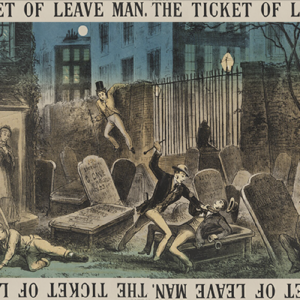
Maïté Bernard, in “Love Love Love,” evokes the shattered life of a student victimized by the power of a teacher she admires, and who drags her vanished dreams through Blagnac’s commercial areas. In “Ovaloid Skulls,” Benoît Séverac embraces French president Emmanuel Macron’s “start-up nation” initiative with the tale of a resurrectionist specializing in selling skulls from the Rapas cemetery (yes, another one)—you can’t make this up—between Saint-Cyprien and Fer-à-cheval.
Finally, Francis Émourgeon, like a noir Chabrol film, explores the bourgeois neighborhoods between Saint-Étienne and rue de la Colombette in “Cold Buffet,” to slake a thirty-year-old, mad, unquenchable thirst for vengeance.
*
If the stories in the Akashic Books Noir Series are rooted in cities—Toulouse in this case—even reduced to their spec-ificity, they also speak to our common humanity. “Nothing human is foreign to me,” Alban Bensa said repeatedly. And that’s probably enough of a reason to read this collection, even if you never set foot here.
And yet, at the moment you enter the neighborhoods of this city, you feel an absence, a vacuum. Like what an amputee who feels the presence of their absent limbs might experience. Even if a guide is never complete, I have the vague impression of having fooled you.
Toulouse is not Toulouse without its working-class neighbor-hoods: Le Mirail, Les Isards, Empalots, Bagatelle, La Farouette, La Reynerie. True, they’re not neighborhoods for tourists, but the people who live there contribute to making this city what it is, and for the better, too. It’s not that I forgot those places. It may be even worse because I looked for people who might be able to write about those neighborhoods. Despite my asking, none of them wished or felt qualified to do so. I can only regret this and blame myself for not having pushed hard enough.
* Toulouse is known as “the pink city” (“la ville rose”) because of the color of its bricks.
–Charles-Henri Lavielle, Toulouse, France, May 2026
***

Charles-Henri Lavielle
Charles-Henri Lavielle has been a construction worker, a bad bassist in punk bands, a parachutist, a history teacher, rugby player and coach, union activist, sales representative in publishing, and cofounder of Éditions Anacharsis and L'histoire à venir festival in Toulouse. Lavielle has lived in Toulouse since his twenties, which gave him a few years to roam the city and its neighborhoods day and night, with some variations depending on his age and the seasons. He is the editor of Toulouse Noir.