Clare Edge on Using Small Town Settings to Create Locked Room Mysteries
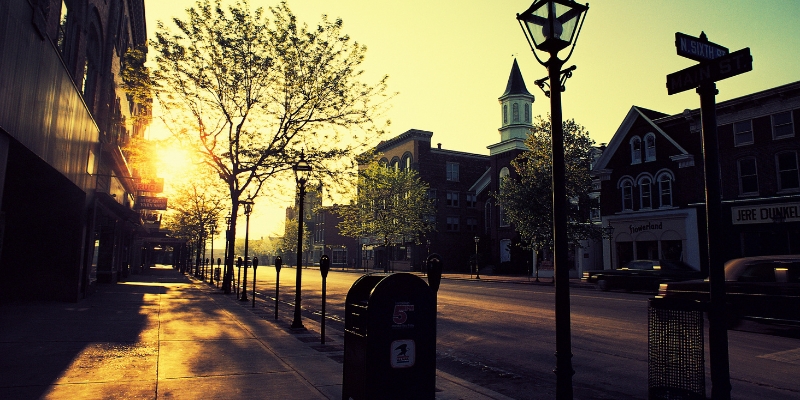
The author of Natural Selection deromanticizes the image of the safe, quaint town
When someone mentions they’re from a very small town, I can’t help but ask, “How small, exactly?” I understand this makes me sound like an asshole, but often people reply with something like “There were a hundred and fifty kids in my graduating class” or “No, it was tiny—there were only 6,000 people.”
And yes, compared the suburban and urban upbringings of most Americans, those towns definitely qualify as small. But when I say I grew up in a small town, I mean small. I mean, under one thousand year-round residents. I mean, I was the top ten percent of my graduating class. There were ten of us and I was (barely) valedictorian. The competition was unreasonably stiff given there were only three of us truly competing.
And though I ran to New York City the second I graduated from my 200-student K–12 school and have lived in major metropolitan cities most of my adulthood, I know a thing or two about small-town America. I did my time. I survived. And I have opinions. And feelings.
I like to say that I was raised to be “bear-aware” before I learned about “stranger danger.” And though I’m not certain that’s entirely accurate, I did learn bear safety very early. I was taught to respect and fear the apex predators that roamed the Montana wilderness. And I’m confident that I was able to identify the difference between a black bear and a grizzly before I understood how dangerous the teen boys at the bonfires in the woods could be.
Which is why I chose a “postage-stamp-sized hellhole” of a rural Montana town as the setting for my horror-tinged feminist revenge thriller, Natural Selection.
The quaint, quiet, and—most importantly—safe small town occupies a very particular position in the mythos of American culture. It’s the site of so many quirky and heartwarming stories, from the cultural bulwarks of Hallmark movies to the millennial-generation-defining phenomenon of Gilmore Girls.
But for many of us raised in those supposedly idyllic spaces, the truth of small-town America is far from picture perfect. Sure, my childhood involved lots of unlocked bikes and unsupervised playing in the forest. You knew everyone’s name and what church they went to. Because church was required. But behind the façade of safety and acceptance, something else lurked, something that determined whether you qualified for the type of belonging (and safety) on offer: conformity.
There is a persistent nostalgia for a version of the American small town that never really existed. And though it’s not always literal, the wounds not always physical, it’s hard to escape a small town psychologically unscathed. Especially the small towns of the American west, where guns are likely to outnumber residents by a significant margin. The rose-colored glasses that gaze back toward the one-stoplight-town are streaked with the blood of anyone deemed different.
The men (and occasionally women, but let’s be honest, it’s mostly men) who proudly tote those guns fancy themselves as protectors. They perform a rugged masculinity “earned” by their capacity to “protect.” But protect whom from what? Who is deemed worthy of protection?
This idea of protection—of who is being protected and to what ends—is one of the central questions that inspired Natural Selection. The small town not as safe space but as locked room.
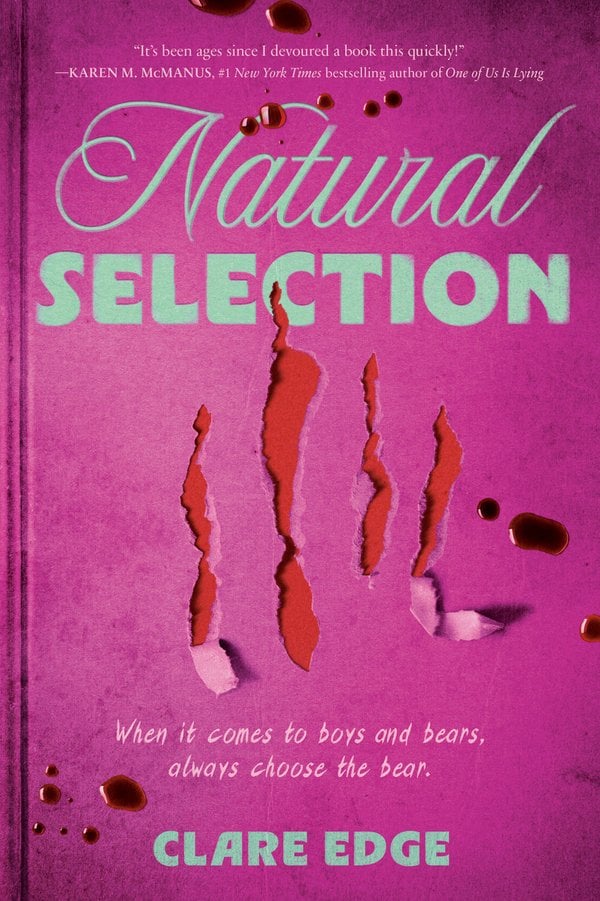
Natural Selection follows three girls—all named Megan—who bond in unsettling ways when a grizzly starts picking off abusive men in their tiny rural town. The bear starts with the town’s golden boy: Kevin Johnson. Football star, son of the coach, and utterly impervious to anything resembling a consequence. Kevin, of course, believes he is a protector.
The setting of Riverside, Montana, is not my hometown. It’s not a real place. But it could be any number of small towns in the western United States. And it’s inspired by very real memories. In the author’s note that concludes the novel, I wrote: “Natural Selection is not based on a true story. But it’s based on a truth. It’s my attempt to capture the emotional truth of growing up in a place that felt ruled by guns, God, and, most of all, men.”
I wrote because I needed to poke my own memories, confront my own fears, and entertain my readers. But most of all, to provide a much-needed catharsis that we very rarely have in life.
I chose to include a speculative twist in my novel in part because it further removes it from my own reality, my own childhood, my own complicated and fallible memories. But I also believe speculative horror provides an often-necessary distance for a reader to truly revel in the catharsis of satisfying consequences. There is an undeniable satisfaction in the terrible man getting eaten by a bear. To watch some man—any man, even if he’s fictional—get what he deserves.
I’ve long gravitated toward stories that deromanticize the circumstances in which I grew up. That tear down the romantic veneer of rural America and poke holes in the mythos and let us engage with the reality of what these small, rural communities are like for those growing up in them. Especially for those of us who can’t and won’t conform.
Natural Selection is my contribution to this much-needed genre, already populated by the likes of Gillian Flynn’s Sharp Objects, that cuts through the pleasant smiles of small-town culture with exacting precision. And Compound Fracture by Andrew Joseph White, which unflinchingly explores the resilience of trans youth in rural Appalachia with a gruesome speculative edge. And a recent favorite, Xan Kaur’s exquisite YA horror novel When Devils Sing, which brings nuance and chills to an examination of being a Punjabi immigrant in the rural South.
As I’m writing this in the middle of 2026, small-town America feels even more dangerous than in the ’90s of my childhood. We can’t afford to wax nostalgic about a version of safety that only protects a very particular kind of person, which isn’t safe at all and comes at too high a cost.
And we’ve made progress—we have! Most obviously, we have the internet now. We’re interconnected in ways I couldn’t have dreamed of with my dial-up connection and landline phone as a teen in 2001. There are openly trans elected officials in some of the most liberal corners of Montana. But at the same time, we are facing national book bans, librarians are being fired, bullying has gone online and become even harder to curtail. It’s almost unfathomable to me how much it feels like we’ve regressed.
I had hoped when I started writing the book that it would be less relevant when it finally hit shelves. Unfortunately, “choosing the bear” and desperately wishing for consequences for terrible people who perpetuate hateful beliefs seem to be more relevant than ever. Which is exactly why I refuse to wax nostalgic about a kind of peace that never truly existed, not for everyone. And it’s the perfect moment for a bit of bloody, fictional catharsis.
***

Clare Edge
Clare Edge is an author (and witch) who was raised in the Rocky Mountains, where she learned to be "bear-aware" before she was taught about "stranger danger." She’s a huge theater nerd and a recovering academic and is rarely found without a tarot deck nearby. Clare’s cozy middle-grade fantasy series Accidental Demons was a New York Public Library Best Book for Kids and a Cybils Award finalist. Natural Selection is her debut novel for young adults.