Rory Cormac on the Mavericks of Britain's Cold War Era Forgery Empire
Excerpted from Fakers: A Top-Secret Tale of Phantoms and Forgeries on the Disinformation Front Line
t appeared a perfectly ordinary scene. With Christmas approaching and the trees of Hampstead losing their last leaves, a figure entered the local post office to send a batch of New Year greetings cards to Nigeria. The clerk would barely have looked up.
Weeks later, in early 1968, British diplomats in Lagos opened the package with surprise. The card was anything but ordinary; what lay inside was no greeting. Sandwiched between an angry black skull and crossbones on the left and an ornate red hammer and sickle on the right was an ominous message:
“Arms For All Opportunities”
The USSR Arms Bazaar
sends you
New Year Greetings
And the Seasons’s Best Wishes
For War, Violence, Death & Destruction
The stark absurdity of the message made even seasoned diplomats double take. Their first thought was that this bizarre card must have been the handiwork of the British Foreign Office’s own top-secret fakes and forgeries department. They wrote back, begrudgingly impressed:
If so, you will be amused to see from the enclosed cutting from the Nigerian Tribune that it was taken by the leader writer to be a propaganda item by the Russians, attempting to capitalize on their willingness to supply weapons to the Federal Government. It seems incredible, but I suppose our particular brand of humor is not understood here.
Distribution was not limited to Lagos. Other copies of the mysterious card had reached Accra in Ghana, where local staff thought it “pretty poisonous.” Could it have been authored by a shadowy nationalist movement known as the Loyal African Brothers who had form in exposing Soviet encroachment into sub-Saharan Africa? Perhaps they were drawing attention to trigger happy Soviet arms sales. Unbeknownst to most, the Brothers were an entirely fictitious creation of Britain’s fakes and forgeries department—though this time, they were blameless.
The cards continued to appear. More copies, expensively printed, had also been sent from Vienna to British embassies in Warsaw and Belgrade, leaving the ambassadors similarly perplexed. If ‘the card is by any chance “one of ours,” I would much prefer not to receive such things in the future’, Duncan Wilson complained from Belgrade. More arrived in Ankara, Rome, and Paris. Worryingly, one reached the British ambassador to Athens at his private address.
Inside, the card boasted of Soviet arms having killed more than one million people since 1960: “this amounts to about 70000 rubles per killed person which is far cheaper than all our competitors!!! HAPPY NEW YEAR!”
Clearly, someone was trying to discredit the Soviets. But who?
Back in Whitehall, Britain’s secret team of fakers and forgers were as puzzled as anyone. They did not recognize it at all; it was not one of theirs. Besides, why would they post from Hampstead?
“Any suggestions?” asked their boss. “CIA?”
Hans Welser, the enigmatic special operations adviser to the Foreign Office, shook his head. It could not be the Americans; apparently, they had received it too. Same card. Same message. He paused, eyes narrowing. Could it be far right Russian émigrés? The West Germans had received one too. Either way, Britain’s expert in forgeries was professionally unimpressed: “a rather silly and expensive exercise.”
“This ludicrous operation was not our work or the work of the CIA,” one colleague sniffed. “We do not know who was responsible for it.” Ultimately, the card’s authors would remain a mystery with the authors still at large; it was just the latest skirmish in a relentless global battle with many mysterious elements and hidden actors: the Cold War’s disinformation front line.
*
Fakers is the true story of a small group of mavericks and misfits, of oddballs, irregulars, and pioneers within what was called the Information Research Department. British diplomats of the early postwar years still possessed, fairly or not, a certain reputation: reserved and refined, graduating from the same elite schools and universities.
But this is the story of Britain’s undiplomatic service: the voluble, hard drinking, journalists; the trailblazing women, scruffy graduates and glamorous society types alike; and the licentious literary sorts operating from the diplomats’ annex—in the most sensitive part of the Foreign Office’s secret department.
With an almost religious zeal, this peculiar cast, part Alice in Wonderland, part P. G. Wodehouse, created what the regulars came to see as a piratical empire, a fiefdom in equal measures frustrating, infuriating, and bemusing. But, working closely with the spies south of the river in MI6, the team navigated a world of deception to provide a secret service where typewriters became agents and foreign journalists became assets to be covertly cultivated.
Espionage history currently falls into several overfamiliar categories. Much of it focuses on the great and the good, with presidents and prime ministers appearing on alternate pages. Many accounts focus on a single officer or agent who is presented rather improbably as “the spy who saved the world.” Not a few are bureaucracy-heavy regimental histories of the secret world.
Fakers goes far beyond the usual suspects to embrace a new approach which celebrates the social texture of hidden lives, highlighting the role of those often overlooked in previous histories of intelligence, such as women and refugee writers. The secrecy of the IRD allowed many staff to be taken on who would never have otherwise been allowed to enter the regular Foreign Office, and extraordinary declassified files finally allow their story to be told from the bottom up, and even, as far as possible, in their own words.
Perhaps Britain’s most politically controversial secret service, the Information Research Department was created in 1948 to counter communism using unattributable propaganda and energetically continued these pursuits for three decades. Its work covered a range of sensitive activities, including off-the-record briefings for trusted contacts, confidentially writing material for journalists, and secretly sponsoring the publication of books.
With unprecedented access to the characters, their plots, and their ploys through around 8,000 IRD files—which their creators never thought would see the light of day, Fakers focuses on the most sensitive part of this secret activity: what its creators called black productions, or fakes, forgeries, and phantom groups to everyone else.
The U.K. conducted a remarkable program of fakes and forgeries: at least four hundred separate operations between the late 1950s and early 1970s, as well as countless articles placed in covertly controlled press agencies. Those involved have long denied using such methods.
Tommy Tucker, longtime head of the IRD’s Editorial Section, recalled after the department shut down that it “has been accused of all sorts of sinister methods, of waging black propaganda, of misleading people and so on, all of which—and I can speak of this as an insider— are false.” Similarly, Christopher Mayhew, an architect of the department, accused critics of failing to provide evidence of a single lie or fabrication. Hugh Mooney, a journalist turned propagandist working in Northern Ireland, insisted under oath that black operations stayed firmly in their scabbards.
Perhaps taking their lead from such testimonies and early batches of bland declassifications, historians have played down accounts of black propaganda as sensationalist.
The real story is rather different and now can be told for the first time.
***
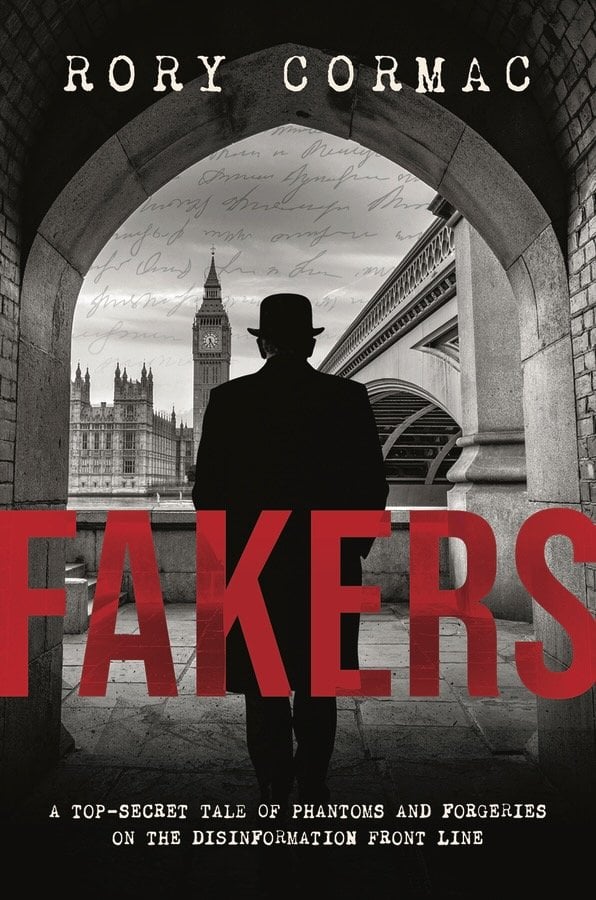
Excerpted from Fakers by Rory Cormac. Copyright 2026. Published by Oxford University Press. Reprinted with permission. All rights reserved.

Rory Cormac
Rory Cormac is a Professor of International Relations at the University of Nottingham and a Fellow of the Royal Historical Society. He writes about covert operations and secret statecraft, and is the author or co-author of six books, including How to Stage a Coup (2022), Disrupt and Deny (2018), and The Secret Royals (2021). He has presented television documentaries aired in the UK, US, and Australia, his research and commentary writing have featured in media outlets worldwide including The Spectator, and he has testified before UK and Australian parliamentary inquiries on subversion, disinformation, and electoral interference.