
Andrew H. Murray on thrillers, the Booker, and taking comedy seriously in literature
An ode to embracing humor from the author of Everything Happens So Much
The UK has just recovered from Booker Prize Fever—alright, not so much a fever as a very, very slightly raised temperature–but in the last week there was a fair bit of interest in this massive and prestigious book award, mainly because the winner’s sales always go right to the moon.
My favorite of the books on the shortlist and the one I hoped would win was the terrific Black Bag. It’s a mad story about a young out-of-work actor who is paid to wear a huge black bag and attend university lectures as part of a psychological experiment. Things rapidly get very weird; it’s a very funny book. But when awards night rolled around, in my opinion the jokes in it were far likelier to kneecap its chances than to help it over the line.
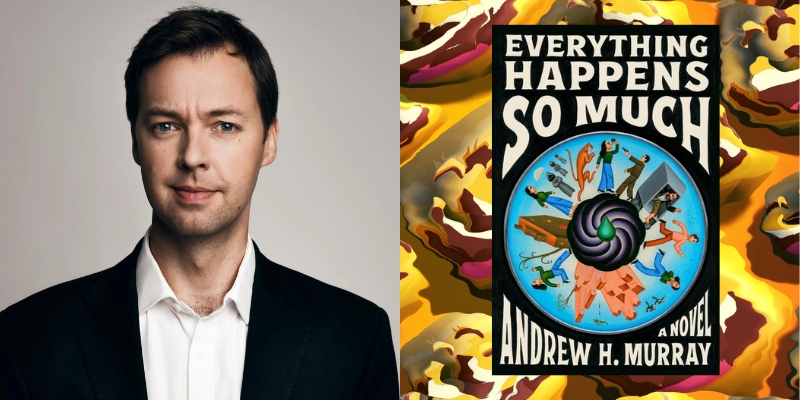
I wanted Black Bag to win because I myself make my books funny as well as serious—I can’t help it—and my characters have senses of humor. My new book, Everything Happens So Much, is a story about why life feels so strange and difficult, and about why we’re all spending our one wonderful life comparing ourselves to strangers online who are supposedly having much better lives than us.
The main character of Everything Happens So Much, Esme, goes to hell and back. She’s put through the wringer. And yet, despite all the Deep Trauma she undergoes, the story has jokes in it, and the jokes are some of the bits I’m proudest of.
No matter. Across the board in mainstream culture, there is a feeling that if you put jokes in, you can’t possibly do the serious stuff as well. Comedy shows are written off as trivial, lightweight, split off into their own genre at the non-award-winning end of the room. When did a really funny film last win Best Picture?
As a result, many writers who do comedy but aspire to mainstream success try to hide the fact. Black Bag has been sold on its chin-stroking lessons about masculinity, rather than its very good one-liners about life as an unemployed actor.
Another of my other favorite authors currently writing is Mick Herron, author of the terrific Slough House set of thrillers. The Slough House books are set in a crew of failed spies, the agents who’ve wrecked their careers by leaving a secret document on the bus or screwing up a training exercise or simply being too unpleasant to work with.
In the hands of an unfunny author the books could have been an unremitting trudge through concrete canyons under grey skies. But Herron, and his characters, are funny. They are biting and cynical and everyone talks like they’ve been written for Apple TV. It’s not unconnected to this that they have been turned into umpteen series for Apple TV.
And is this comedy element of the books made obvious to the casual viewer? It is not. The covers are serious, the straplines are serious, they’re sold on their thrills. There aren’t many blurbs from other authors about how hilarious the books are. But when you read them, as well as being swept along by the plots, you laugh.
In my own case, I can’t help it. I started out writing for QI, the British panel show, where the aim is to tell people the most interesting facts in the funniest possible way. The whole show is an exercise in ‘education by stealth’, on the principle that if you’re laughing, you won’t realize you’re learning.
I then cofounded the podcast No Such Thing As A Fish, which has the same aim. I write for Private Eye magazine—imagine The Onion, but topical. I’m well aware of what you have to do to sell a book these days, though, and it’s this: lie your head off about whether you’re trying to be funny.
Why is there this snootiness towards comedy? In my view comedy is much harder to write than the serious stuff. Pathos is simply a matter of making things sadder, which any fool can manage. Just give Tiny Tim one more disease or make Anna Karenina’s life that smidge worse: instant tragedy!
What’s hard is doing a good tight one-paragraph about life as a nineteenth-century serf which will have your reader laughing until they can’t breathe. (This, incidentally, is why Tolstoy was never given his own HBO special.)
But the myth persists that funny can’t coexist along with serious, despite all the evidence from our lives that it is in the most serious moments that we are most in need of our senses of humor. When I talk about Everything Happens So Much—to remind you, my new book which is available now—even I fall prey to this terrible effect.
I shouldn’t even be admitting this to you. I should be amping up the elements of existential angst. But, honestly, the book contains jokes interwoven with the existential angst, and there’s nothing I can do about it.
Maybe this defensiveness about comedy in most media is because everyone is aware that it yields rewards. Comedians sell out stadiums, they get specials, the clips of their crowd work or their sketches absolutely saturate most media. Why the hell should they have the book market stitched up too?
But I think the real reason is that jokes are binary—you either get them or you don’t—and the truth is that it’s almost impossible to write a book which will appeal to everyone. All our lives are different, and so all the things we laugh at will be slightly different too. We can all agree that the ending of Of Mice And Men is a tearjerker; if it had ended with Lenny and George doing a tight five at a local comedy club, only about half the readership would have found it funny.
The real truth, though, is that funny is the caramel which only heightens the salt. We live in this world, with all its absurdities and tragedies, and yet we know that life is a comedy even if sometimes we watch it through tears. Comedy and tragedy prop each other up and help each other towards the finish line. A novel of pure comedy would be far too light; a purely tragic novel would be too grim to finish. (Thomas Hardy, I’m looking at you.)
So if you yourself write funny, if you can’t help it, if a sense of humor keeps breaking out despite your best intentions, then for goodness’ sake embrace it. Know and appreciate your amazing power.
But my only advice is this: don’t let on. And don’t, whatever you do, write an entire article confessing your new book, which is available now, is extremely funny as well as poignant and thought-provoking. It will do sales no good whatsoever.
Everything Happens So Much is available to buy now.
***


Andrew H. Murray
Andrew H. Murray is an author, broadcaster and comedian. He cohosts the award-winning podcast No Such Thing As a Fish, which is one of the top 10 podcasts in the UK and has been downloaded 500 million times, as well as BBC Radio 4's satirical news program The Naked Week. He writes jokes and journalism for Private Eye (think: a hybrid of The Onion and The Nation). He is the author of Everything Happens So Much. Murray lives in London.