
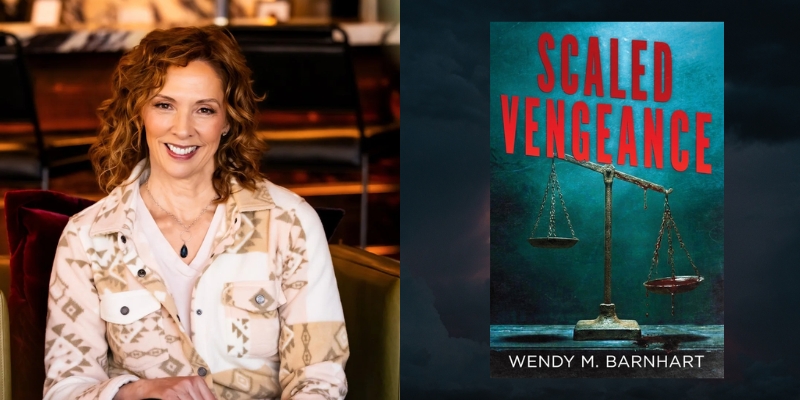
Wendy M. Barnhart on our enduring fascination with female serial killers
How women who kill chafe against societal norms, from the author of Scaled Vengeance
A question was presented to me: Why do female serial killers fascinate us? I count myself in that fascination camp—my latest novel, Scaled Vengeance, focuses on a female serial killer, and I admit that the research I did for the novel enthralled me.
But is it just female serial killers who intrigue us? Or serial killers in general?
The obvious answer is that all serial killers pique our interest. The act of murdering another person is shocking. But to kill and kill and kill again is outrageous. And intense. And next-level-frightening. It’s tough to understand how one person could repeatedly want to do such a thing. Even with all of the articles written, and documentaries produced that touch on childhoods, motivations, objectives, and any other manner of revelation, I’m not sure we still “get it.” I definitely don’t.
There are some theories that, like true crime in general, audiences want to learn about serial killers so we can better understand threats. I’m not quite on board with that idea. There’s no signal in my brain telling me to be prepared should I ever encounter a serial killer, but I admit I do find them interesting nonetheless.
A little factoid to share: A friend of my mom dated Ted Bundy while he was doing his serial killer thing in Salt Lake City. She lived across the hall from him in a house that had been converted to apartments. Thankfully, she was not one of his victims, nor did he hurt her physically. (Emotionally is another thing entirely.)
But did that story give your brain a little “eek” moment? Me too. Even this many years later.
So, serial killers intrigue us. But female serial killers are next-level fascinating.
While researching the topic for my book, I learned female serial killers through history often committed their crimes for financial gain. And they leveraged their perceived role as a nurturer or caregiver to gain access to funds / victims.
For instance, Amelia Dyer was a British nurse in the 1800s who offered to care for unwanted infants in exchange for money she needed to support herself. She took the money, took the babies, and then murdered those babies rather than care for them. Another woman, Dagmar Overbye, did the same as a “child caretaker” in the early 1900s (including killing her own child).
Dorothea Puente ran a boarding house in Sacramento, California, where she poisoned her tenants (often elderly or disabled), buried their bodies on her property, then collected and cashed their Social Security checks. Amy Archer-Gilligan ran a nursing home and pressured her residents to bequeath her large sums of money before poisoning them.
But by no means is money the sole motivation of female serial killers. Aileen Wournos was a sex worker who killed at least seven men, claiming self-defense. Jane Toppan trained as a nurse and tried different combinations of drugs on her patients just to see what would happen. She confessed to thirty-one murders (at this writing, she holds the Guiness World Record for most prolific female serial killer based on confirmed number of victims).
And Elizabeth Bathory, born in the 1500s, is said to have murdered hundreds of women. Legend holds that she both drank and bathed in the blood of young women with the hope that doing so would preserve Bathory’s own youthfulness. (Record-keeping being what it was in the 1500s, no solid documentation exists to confirm the Elizabeth Bathory story, hence no Guiness World Record for her.)
Whether for money or some other dark and twisted motivation, female serial killers hold a different kind of fascination for us than male serial killers. One of the most obvious reasons, in my humble opinion, is their rarity. Serial killers are uncommon, and female serial killers even more so. Something uncommon and novel will, more likely than not, grab more attention than the known entity.
I think female serial killers also captivate us because they break the social norms that women are the nurturers, the caretakers, the safe place. Walking through a parking lot at night and happening upon a man puts us on alert, male and female alike (though dramatically more so for women). Happening upon a woman in a dark parking lot, though, would prompt awareness, but probably not a high-risk alert. Women are deemed safe.
(Until you learn they want to bathe in your blood….)
It’s this same perspective that enables female serial killers to carry on undetected as long as they do, before being caught. She’s a nurse, she’s a healer, she wouldn’t actively kill someone. She’s a mother, she’s a child caretaker, she would never harm a baby. She’s being paid to house people—she would never kill them and stop the flow of funds.
As time goes by, female suspects don’t move up the list, the killings continue, the body count rises. And the greater the shock when female killers are discovered and we learn about how many people died at their hand. It’s believed Amelia Dyer killed over 300 babies. (Was that another “eek” moment for you? Me too.)
Unless we see a sharp rise in the number of female serial killers making them ubiquitous (and, wow, I hope that never happens…), I believe female serial killers will continue to fascinate us. They are rare gems that catch our attention when they’re revealed, unearthed in their unusual form and often surprising cruelty. And, being the humans that we are, it’s tough to look away from these fascinating but terrible people.
***


Wendy M. Barnhart
International bestselling and award-winning author Wendy M. Barnhart (formerly Terrien) is the author of Scaled Vengeance, The Rampart Guards, The League of Governors, The Clan Calling, and The Forge of Bonds. Wendy graduated from the University of Utah (go Utes!) and moved to Colorado where she completed her MBA at the University of Denver. Learn more about Wendy by visiting her website: wendymbarnhart.com.