Counting Down the Greatest Crime Films of All-Time: #15
Sunset Boulevard (1950)
Otto Penzler ranks, analyzes, & celebrates the 106 greatest crime films of all-time. Catch up on the series and find new installments daily here.
__________________________________
Sunset Boulevard (1950)
__________________________________
TYPE OF FILM: Noir
STUDIO: Paramount
PRODUCER: Charles Brackett
DIRECTOR: Billy Wilder
SCREENWRITERS: Charles Brackett, Billy Wilder, and D.M. Marshman, Jr.
SOURCE: Original
RUNNING TIME: 110 minutes
PRINCIPAL PLAYERS:
William Holden…………………………………………………………………………..Joe Gillis
Gloria Swanson…………………………………………………………………..Norma Desmond
Erich von Stroheim……………………………………………………………Max Von Mayerling
Nancy Olson…………………………………………………………………………Betty Schaefer
Fred Clark………………………………………………………………………….…….Sheldrake
Jack Webb………………………………………………………………………………Artie Green
Lloyd Gough…………………………………………………………………………….….Morino
Franklin Farnum…………………………………………………………………….…..undertaker
__________________________________
DID YOU KNOW?
__________________________________
Sunset Boulevard opened the door to a large number of dark films about Tinseltown itself. There was a rash of mea culpas in Hollywood in the early and mid fifties with the release of In a Lonely Place, The Big Knife, A Star is Born, The Bad and the Beautiful, and The Barefoot Contessa, the best known of the exposés of Hollywood. Never before had an industry worked so hard to show itself in the worst possible light. Perhaps the attempts at self-immolation were a result of the investigations of the House Un-American Activities Committee; perhaps it was the breakup of the studio system that kept actors and writers under long-term contracts; perhaps it was the government-forced divestment of studio-owned theaters; or perhaps it was the rise of television’s popularity; but whatever the reason, the bright lights and glamour of Hollywood would never again be as appealing to mass audiences.
__________________________________
THE STORY
__________________________________
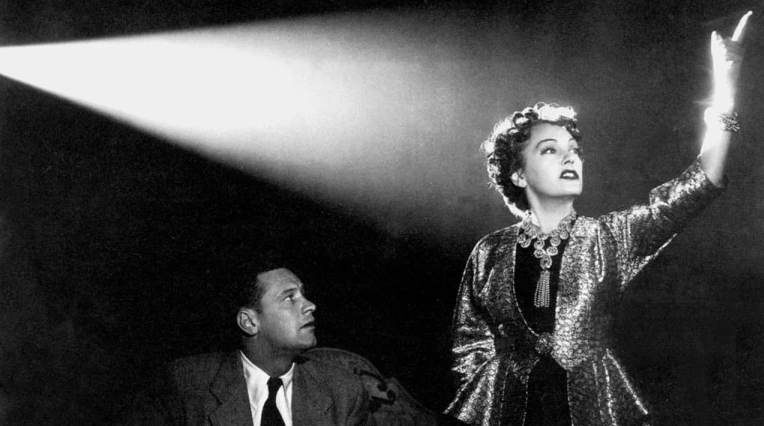
Out-of-work screenwriter Joe Gillis, broke and on the run from repo men who want to take his car for nonpayment, pulls into the driveway of a huge but desiccated mansion owned by the former silent-screen star Norma Desmond. He is brought to Desmond by the butler, Max Von Mayerling, who also happens to be her former husband. After a brief conversation, she hires him to write the screenplay that will be her vehicle back to the top of Hollywood stardom. She insists that he move into her house, where he falls uncomfortably into the role of gigolo. He tries to get away from her possessive clutches, but when a New Year’s Eve party she has thrown just for him goes awry, she tries to kill herself, bringing him back. While working on her comeback movie, Gillis meets another young screenwriter, Betty Schaefer, and inspired again, begins a new screenplay that he believes will be his best work to date. They fall in love and Desmond becomes enraged with jealousy. She calls Betty to tell her that Gillis lives off her, in the clothes she buys for him, in her house. When Betty comes to the old mansion to see for herself, Gillis cruelly admits exactly what he is, sending her off to the man she used to love. He then packs to leave, and Desmond breaks down and shoots him. As his corpse is pulled out of the swimming pool, the police and media swarm over the estate. As news cameras roll, Desmond, believing them to be movie cameras, regally descends her staircase and, chin held high, announces, “All right, Mr. DeMille. I’m ready for my closeup.”
***
Famously, the film opens with the star, William Holden, floating dead in the swimming pool. With voice-over narration, the entire story unfolds in flashback.
Film historians have often described the great era of noir films as being bracketed by two of Billy Wilder’s motion pictures, starting with Double Indemnity (1944) and concluding with Sunset Boulevard six years later. There were exceptions, of course, notably Touch of Evil (1958), but the time in which every studio had two or three dark crime dramas a year in production had largely ended with this Gothic masterpiece.
The grand old mansion in which most of the film was shot belonged to the Getty family, and Wilder thought it would be perfect as a location. Unfortunately, it did not have a swimming pool—clearly a necessity—so the studio built one for the movie and removed it after the film was completed.
Academy Award nominations went to the film for Best Picture, to Wilder for Best Director, to Holden for Best Actor, to Swanson for Best Actress, to Von Stroheim for Best Supporting Actor, and to Olson for Best Supporting Actress. All lost. Altogether, the film had eleven nominations and won three, including Best Story and Screenplay by Charles Brackett, Billy Wilder, and D.M. Marshman, Jr.
Billy Wilder initially offered the role of Norma Desmond to Mae West, who turned it down. He then considered Mary Pickford but decided she would be wrong after all. He then offered it to Pola Negri, who also turned it down. He finally settled on Swanson, who got an Oscar nomination.
Cecil B. DeMille played himself, and there were cameos by Hedda Hopper, Buster Keaton, Anna Q. Nilsson, H.B. Warner, Ray Evans, and Jay Livingston, all of whom played themselves.
__________________________________
BEST LINE
__________________________________
Screenwriter Joe Gillis recognizes the silent-film star: “You’re Nora Desmond. You used to be in silent pictures. You used to be big.” “I am still big,” she replies. “It’s the pictures that got small.”

Otto Penzler
Otto Penzler is the founder of The Mysterious Press and The Mysterious Bookshop. He has written and edited several award-winning books and is regarded as the world's foremost authority on crime, mystery and suspense fiction.