Counting Down the Greatest Crime Films of All-Time: #17
The Public Enemy (1931)
Otto Penzler ranks, analyzes, & celebrates the 106 greatest crime films of all-time. Catch up on the series and find new installments daily here.
__________________________________
The Public Enemy (1931)
__________________________________
TYPE OF FILM: Gangster
STUDIO: Warner Brothers
PRODUCER: Darryl F. Zanuck
DIRECTOR: William Wellman
SCREENWRITERS: Kubec Glasmon and John Bright; Harvey Thew (adaptation)
SOURCE: “Beer and Blood,” story by John Bright
RUNNING TIME: 83 minutes
PRINCIPAL PLAYERS:
James Cagney…………………………………………………..……………………..Tom Powers
Jean Harlow…………………………………………………………………………….Gwen Allen
Edward Woods………………………………………………………………………….Matt Doyle
Beryl Mercer……………………………………………………………………………Ma Powers
Donald Cook………………………………………………………………………….Mike Powers
Joan Blondell………………………………………………………………………………..Mamie
Mae Clarke………………………………………………………………………………….…Kitty
Leslie Fenton………………………………………………………………Samuel “Nails” Nathan
Robert O’Connor………………………………………………………………………Paddy Ryan
Murray Kinnell………………………………………………………………………….Putty Nose
Frankie Darro……………………………………………………………….….Matt Doyle as a boy
Purnell Pratt…………………………………………………..……..Officer Powers, Tom’s father
__________________________________
DID YOU KNOW?
__________________________________
The role of Tom Powers, which made James Cagney one of Hollywood’s biggest stars, was originally cast with Edward Woods in the role. After a few days of shooting, director William A. Wellman recognized the power of Cagney, who was playing Matt Doyle, and had the two actors switch roles. Producer Darryl F. Zanuck was opposed to the switch because he believed that the diminutive Cagney didn’t have the strength to play the vicious psychopath. Furthermore, Zanuck was afraid of making an enemy of Woods’s mother-in-law, the hugely powerful Hollywood gossip columnist Louella Parsons. However, once Zanuck saw Cagney in the role, he relented, and the song-and-dance performer would be forever associated with the toughest of tough-guy roles.
__________________________________
THE STORY
__________________________________
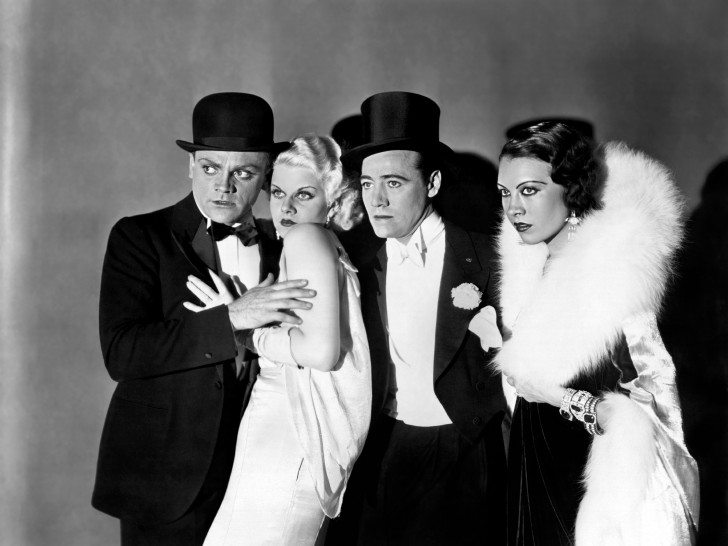
Tom Powers and Matt Doyle, friends as teenagers in Chicago, engage in petty crime and commit a robbery set up for them by their fence, Putty Nose. Although he has promised to protect them, Putty Nose turns his back on them when it goes wrong. As adults, the two friends run a brewery during Prohibition for Paddy Ryan. They progress to working for the big boss, Nails Nathan, as strong-armed men forcing speakeasies to carry only Nathan’s beer. Tom’s ruthlessness is prized by Nathan and he gains power, but a horseriding accident kills Nathan (Tom later shoots the horse), beginning a gang war. Ryan tells his gang to hide out until things cool down but Tom refuses, and he and Matt are attacked by rival gang members, who kill Matt. Tom goes berserk and single-handedly takes on the gang, killing several of the thugs, but is wounded himself. Taken to a hospital, he survives, only to be kidnapped and killed by the gangsters. His dead body, swaddled in bandages, is dropped on the steps of his mother’s house.
***
The Public Enemy was a tremendous success, breaking the box-office records set the previous year by Little Caesar. Cagney was so well-liked by audiences that they found themselves rooting for him against their will, even though the movie showed him to be an amoral psychopath.
While the story of Tom Powers follows the traditional gangster movie arc of a criminal’s life—starting out poor, being ruthless and determined enough to rise, and ultimately being killed—it is somewhat different from Little Caesar and Scarface in that Powers never becomes the big boss; he remains a powerful and loyal soldier for the head of his gang.
Cagney, like George Raft, grew up in the Hell’s Kitchen section of New York, so he learned a good deal about scuffling at the edges of the law as a kid, and a fair amount about the behavior of the hoodlums as an adult.
After the success of Little Caesar, William Wellman wanted to make a gangster movie based on the life of the Irish mobster “Deanie” O’Bannion, but Zanuck initially tuned him down, fearing that nothing new could be made in the genre after Little Caesar. When Wellman promised him a film that would be tougher, more violent, and more realistic, Zanuck relented but gave Wellman only $151,000 and twenty-six days to make the movie.
Failure is an orphan, but success has many fathers. In this case, the notorious scene in which Cagney pushes a grapefruit into the startled face of Mae Clark (she really was startled—Cagney was supposed to fake it but actually smashed it into her face) has been claimed to be the idea of several people. In Wellman’s autobiography, he wrote that during an argument with his wife he fantasized about doing it. Another source claims that the mobster “Hymie” Weiss shoved an omelette into his girlfriend’s face. Zanuck, too, claims to have conceived the scene. Whoever was responsible managed to produce one of the most iconic moments in the history of Hollywood and one of the most shockingly violent acts against a woman at a time when this was uncommon behavior in film.
The scene in which Tom shoots the horse is based on events surrounding the death of real-life gangster Samuel “Nails” Morton.
__________________________________
BEST LINE
__________________________________
Tom Powers, shot numerous times, rasps, “I ain’t so tough.”

Otto Penzler
Otto Penzler is the founder of The Mysterious Press and The Mysterious Bookshop. He has written and edited several award-winning books and is regarded as the world's foremost authority on crime, mystery and suspense fiction.