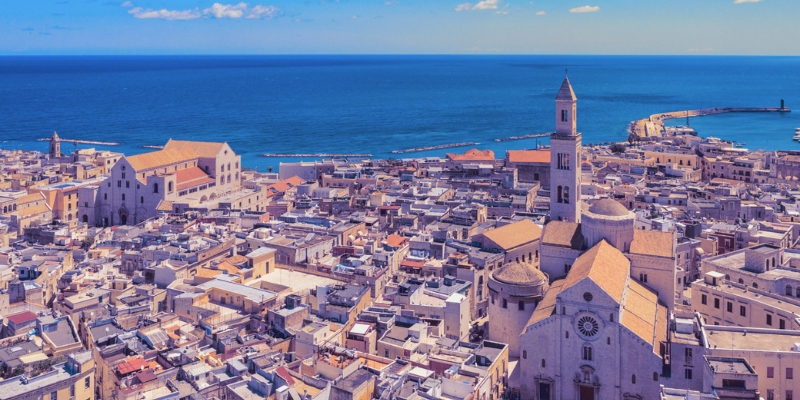
Crime and the City: Bari, Italy
A tour through a Puglia port city with a storied history of smugglers and crime syndicates
Bari doesn’t get as much publicity as it should. A port city on the Adriatic, and the capital of southern Italy’s Puglia region (aka Apulia). Its mazelike old town, Bari Vecchia, occupies a headland between two harbors. Bari Vecchia is beautiful but underappreciated compared to many of Italy’s other hot spots.
Bari is also interesting for a few other reasons—it’s a center of immigration into Italy and so, like all across Europe, quite fraught on the subject at the moment; it has a historic relationship across the Adriatic with the former Yugoslavia and its smuggling gangs; and there are a number of domestic organized crime syndicates/clans operating in the area—mafias that have been well-chronicled in Bari crime writing.
Any look at Bari’s modern criminal history as well as crime fiction has to start with Gianrico Carofiglio. Carofiglio is an amazing man—a former anti-Mafia judge in Bari at the time when famously it was a dangerous profession—remember Sicilian anti-mafia judge Giovanni Falcone’s assassination in 1992 that really became a tipping point in Italy for public distaste for organized crime. Carofiglio took up the gauntlet in the wake of the Falcone outrage.
He worked as a prosecutor specializing in organized crime before being appointed as an advisor to the anti-Mafia committee in the Italian Parliament in 2007 and served as an Italian senator from 2008 to 2013. To be honest crime writers don’t come better qualified than Carofiglio. During his years running Bari’s anti-mafia squad local crime bosses apparently planned to kill him with a bazooka. I don’t think that’s ever happened to Lee Child or Ian Rankin to be honest!
Then Carofiglio made his crime fiction début in 2002 in a series of books featuring defense lawyer Guido Guerrieri, living and working in the city of Bari. There are six books in the Guerrieri series starting with Involuntary Witness (2005) through to The Measure of Time (2021) all translated and published by the excellent international crime publisher Bitter Lemon. The series is a good introduction to Bari’s underworld—Senegalese beach peddlers, the Catholic Church, drug smuggling into Bari, the trafficking of poor southern Italian females and drug gang wars. Italian TV network RAI has adapted the Guido Guerrieri books for TV.
Also now on TV (as Cold Summer in English and also from RAI) is classical-music-and-literature-loving Officer of the Bari Carabinieri Pietro Fenoglio. He appears in Carofiglio’s novels A Shifting Truth (2014), The Cold Summer (2016), and Fenoglio’s Version (2019).
The Cold Summer, which unusually for a crime novel was shortlisted for the 2020 STREGA prize, Italy’s most prestigious literary award, is set in the summer of 1992, which was an exceptionally cold in southern Italy and is still remembered as on May 23, a roadside explosion killed judge Giovanni Falcone. Mixing real events with fiction The Cold Summer sees gang wars raging around Bari, a child kidnapping turned murder and corrupt police. The TV show is excellent to get a sense of 1990s Bari—the fall of Yugoslavia, the rise of organized crime and the anti-mafia movement ion the wake of the tragedy of Falcone.
Unfortunately Gabriella Genisi, one of Italy’s most celebrated noir fiction writers, is not translated into English. However, her popular Inspector Lolita Lobosco mystery series—often referred to as a female answer to Camilleri’s Inspector Montalbano (set in Sicily in his case though) is rooted in Puglia and based in Bari.
The books are in Italian, but there is now a TV show (with subtitles), Lolita Lobosco (in Le indagini di Lolita Lobosco), set in and around Bari and follow the investigations of a tough and fiercely independent deputy police chief and filmed mainly in the Bari Vecchia (the old city). Hopefully the TV show will inspire some translation.
Lolita Lobosco Genisi writes a companion series as well featuring Chicca Lopez, a young and rebellious carabiniera whose investigations are set in the Salento region, also in Puglia.
A few other Bari-set crime novels:
- Valeria Vascina’s That Summer in Puglia (2026) introduces Tommaso, who has escaped discovery for thirty years – but a young private investigator, Will, has tracked him down. Tommaso asks him to pretend never to have found him. To persuade Will, Tommaso recounts the story of his life and his great love, Anna.
- Katherine Webb’s The Night Falling (2014) is set in 1920s Puglia, this historical fiction follows an Englishwoman who uncovers dark family secrets during a stay with an Italian farming family. Richly atmospheric and full of tension.
- Tom Benjamin’s Old Bones in Puglia (2026) is the seventh book featuring English detective and Bologna resident Daniel Leicester mystery who, in this book, is summoned by a dying relative to the wildest corner of Puglia, home to revered saints, fearsome mafia clans, hidden catacombs and sinister ceremonies.
Richard Walmsley’s Dancing to the Pizzica (2013) is set close to Bari against the backdrop of the Salento region of Puglia. Adam, a maverick Englishman approaching middle age, is captivated by his new life in Puglia. He is seduced by the beautiful Rosaria and by the hypnotic local dance known as the Pizzica.
Finding himself falling deeply in love, he is drawn unwittingly into danger when he agrees to help Rosaria investigate the mysterious disappearance of her cousin and closest friend, Diletta and finds himself mixed up with the ‘ndrangheta—the Calabrian Mafia. This tale is set against the evocative backdrop of the Salento region of Puglia.
Walmsley also wrote The Demise of Judge Grassi (2012). Judge Grassi is coming to terms with his retirement. But he is assailed by disturbing, anonymous e-mails and text messages. Grassi employs a private investigator to find out who’s behind it all. And finally, in Leonardo’s Trouble with Molecules (2014) Leonardo Molinari is professor of the Nanotechnology department at the University of Legano. But there’s a thief in his lab.
And finally, Ferocity (2017) by Bari-born Nicola Lagioia, a gripping exploration of power, corruption, and familial dysfunction set in 1980s Bari. It follows the mysterious death of Clara, a beautiful and troubled young woman, whose demise unravels a web of dark secrets and moral decay within her influential family. As her half-brother Michele delves into the circumstances surrounding her death, he uncovers a labyrinth of deceit, betrayal, and violence, painting a stark portrait of a society where the lines between right and wrong are blurred by ambition and greed.
Lagioia usually writes about Rome—his recent book (and not all his output is translated unfortunately), a true crime, The City of the Living (2023) was highly praised and he is a multi-award winner in Italy.
Outside Italy, Bari, and Puglia, simply doesn’t attract the press it should—it’s sun-soaked, beautiful and can rival anywhere else from Trieste to Palermo. It also has its very own “Apulian” school of crime writing.
***

Paul French
Paul French is a British author of books about modern Chinese history and contemporary Chinese society including Midnight in Peking and the 2018 release City of Devils.