Cursed Children’s Entertainment: A Reading (and Watching, and Gaming) List
These works of fiction aren't trying to sneak in social criticism or dark themes. Children's entertainment is wholesome! The algorithm can be trusted! Capitalism isn't keeping kids lonely at all!
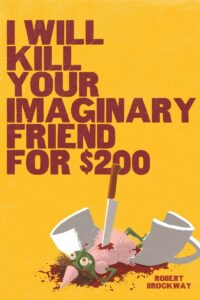
I’ve spent the last two decades trying to smuggle darkness into your brain under Spider-Man sheets. It’s the theme of my writing career: Give you something fun, strange, and frivolous, then rip the wrapper off to reveal the rot at the heart of it and run before you realize what I did. My new book isn’t like that! It’s called I Will Kill Your Imaginary Friend for $200, a lighthearted whimsical adventure about a man who can kill imaginary friends and the lonely little girl whose imaginary friend might be killing her. In no way did I slip in my feelings about the working class being devoured by corporate warfare, the constant grind of trying to make a living causing us to raise generation after generation of lonely, neglected neurodivergent children, and how those children are exploited by the sinister algorithms behind modern children’s media. No, in my book a depressed middle-aged man murders fairies and rhyming puppets and tries to fistfight a cursed children’s show. That’s all it is.
So let’s talk about that! Not the heavy stuff—stories about cursed children’s media. Let’s keep this one light. Surely none of these other creators will sneak in darker themes when you’re not paying attention. They seem trustworthy.
Books: Mister Magic
Kiersten White’s Mister Magic is about friends and former child stars reuniting as adults for a podcast about a strange, half-remembered children’s show they used to star in. As they recover their memories of the show and the tragic way it ended, they slowly realize the people behind the podcast, the town, and maybe the whole world have sinister motives for wanting them back together. And then there’s Mister Magic himself, a paternal figure with a mystical cape who presides over the show and its children as a nurturing force… so long as you follow the rules.
It’s got childhood trauma, adult drama, cult machinations, a simmering supernatural mystery—we even got a liminal house for the kids. The kids love liminal, I’m told. Kiersten White was raised Mormon and brought up on children’s media that doubled as church propaganda, until she finally broke free and escaped its influence. I don’t know why I brought that up, it probably doesn’t have anything to do with the book.
Film: Channel Zero – Candle Cove
Channel Zero is among the best horror anthology shows ever made. It seems impossible that it came out of the SyFy Channel, best known for movies about killer sharks and giant tornados and what happens when they fall in love. Channel Zero’s hook takes short, campfire-style creepypasta stories and adds character, depth, and theme across a full season. It sounds tough to pull that trick off once, but every season manages it. And the first one, Candle Cove, sets the bar high.
Candle Cove is about a child psychiatrist who helps kids because nobody was there to help him with his own fractured childhood. He returns home after a long absence to discover the imaginary show he watched with his brother wasn’t so imaginary, and it might be responsible for the recent rash of missing children. It’s bizarre, compelling, heartwrenching, and then bizarre again. Come to Candle Cove for the reconciliation of guilt for childhood sins, stay for the toothboy. I forgot to mention toothboy. There’s a toothboy.
Comics: Billy Bat
A prolific manga series unafraid to jump styles, shatter borders, and break rules, Billy Bat is about a Japanese-American comic book writer who discovers he might have accidentally stolen his iconic lead character, Billy Bat, from something he’d seen during his time in post-WWII Japan. Upon learning this, he does the unthinkable – something never before done in the history of comics: He tries to get permission from the original creator to use it.
Along the way he comes to find that the original creator didn’t invent Billy Bat either, that maybe nobody did. Maybe Billy Bat has always been here, throughout all of human history, a possibly malevolent force manipulating humanity across generations through seemingly harmless media. It’s not about Disney! It’s weird that you think it’s about Disney.
Video Games: Baldi’s Basics
Video games are fertile ground for the cursed children’s media trope. Five Nights at Freddy’s broke the seal, and now there are countless imitators, some better than others. Baldi’s Basics feels unique in a crowded space. Brightly lit, crudely rendered, it truly feels like a haunted piece of educational software for soft children of the ‘90s who spent their lunch breaks in the computer room instead of playing outside. The problems are easy, until they aren’t. Get them right, or Baldi gets mad.
If you’re of a certain age I ask you to look back fondly on your childhood: What is your favorite orb? Don’t overthink it, what orb jumps to mind? If it’s a kickball, I’m not talking to you. If it’s the pixelated spinning globe of Compton’s Interactive Encyclopedia, you are Baldi’s Basics intended audience. It captures the vibe of being alone in a brightly lit classroom, excited about your terrible educational games just because they’re games. But also feeling a little weird here, all alone in a space that’s usually full of other kids. Fully absorbed in what you’re doing on the screen, but keenly aware that means something might be coming up behind you. I don’t know why I’m overselling this, it’s like if Carmen Sandiego wanted to eat you.
***

Robert Brockway
Robert Brockway is a novelist, screenwriter, podcast host, and co-founder of the 1-900-HOTDOG comedy empire. He’s the author of the post-apocalyptic horror epic Carrier Wave, as well as the punk-rock horror series The Vicious Circuit from Tor Books. He hails from Portland, Oregon, where a witch once told him he was immortal. She hasn’t been proven wrong yet.