Did Charles Dickens's Bleak House Inspire Murder on the Orient Express?
Agatha Christie simply couldn't get enough of Dickens's nearly-one-thousand-page-tome. She even wrote a screenplay version.
This post contains spoilers for Murder on the Orient Express.
In 2013, the official estate of Agatha Christie posted a bit of trivia to its Facebook. “Did you know,” they asked their followers, “that the first Charles Dickens book Agatha Christie read was Nicholas Nickleby? But her firm favourite of all Charles Dickens’ works was Bleak House and she was later to adapt it herself for the screen, though it was never actually made.”
Yes, Agatha Christie was an enormous Bleak House fan. And she was determined to adapt it for film! According to scholar Mark Aldridge, who wrote about what Christie’s own desire to adapt her favorite novel indicates to us about her thoughts on adaptations of her own works by others: “In May 1962 Agatha Christie completed a rough draft of a screenplay that adapted Charles Dickens’ novel Bleak House. The intention was that the film would be produced by MGM, which at the time was adapting Christie’s own works for the screen.” He notes how unusual this was, since “Christie did not write for the screen at any other point in her career.”
Patricia D. Maida and Nicholas B. Spornick argue that her love of Dickens, and particularly Bleak House, not only inspired him to adapt his work to the screen, but also inspired her own writing. They note, “Aside from the positive attitude toward the police which Christie shared with Dickens, she also derived two important devices from him: use of the Least Likely Person ploy and the confrontation drama.”
But I think there is one more similarity… the collaboration of characters, wittingly or unwittingly, in some aspect of a crime.
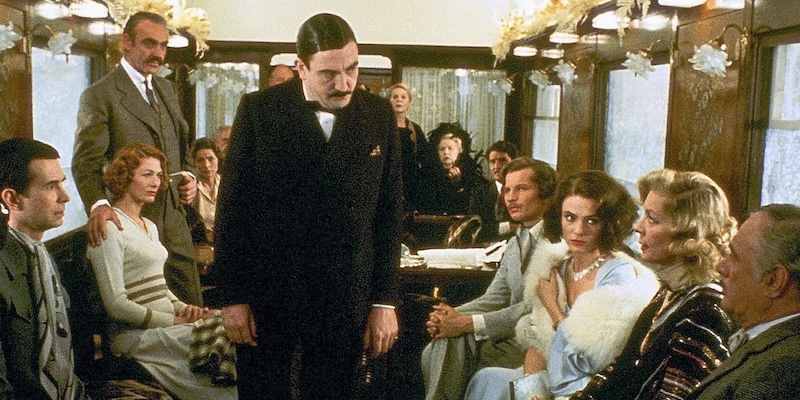
Sound familiar? I think that Bleak House influenced Christie in writing her 1934 classic, Murder on the Orient Express.
See, in Bleak House, nearly every character is a detective. Within the enormous mass of events that together make up the novel’s (multi-layered) plot, there are many strange matters and even a few mysteries… and many characters, varying in the degrees to which they are affiliated with the law, chose to conduct their own investigation in these peculiar events, accounts, and problems, which include ghost stories, rumors of illegitimacy, missing documents, general affairs of lies and deceit, impenetrable court cases, and incredibly suspicious deaths. The clerk Mr. Guppy, the lawyer Mr. Tulkinghorn, the physician Allan Woodcourt, are just some of the figures in the novel who take up the work of investigation… work which is eventually subsumed and continued by the police detective Inspector Bucket.
There is a community in Bleak House; characters have connections to others mentioned in entirely different places and contexts in the story. It seems often, that everyone knows everyone else.
We know Christie was thinking about Dickens in general as she wrote Murder on the Orient Express—Poirot takes up residence in a cabin reserved under the name Harris. He explains that the cabin will be available, that Harris will be a no-show. What’s his reasoning? “I read my Dickens,” he says, “M. Harris will not arrive.” Is this a deduction? No, it’s an allusion. Poirot is referring to the novel Martin Chuzzlewit, in which a character named Mrs. Harris (who is never seen) is thought not to exist at all. The name Harris, to Poirot’s mind, signals a lack of appearance, and so he takes the cabin as his own.
But the general structure, and ultimate reveal, that all the suspects in Murder on the Orient Express, have committed the murder together, seems to suggest an inverse in the narrative of Bleak House. What if, instead of everyone working to create a kind of collective of “the detective,” the characters worked in a collective to form “the murderer?”
This is just speculation on my part, but I do find it relevant. Both stories are exercises in how to juggle a murder plot alongside (or among) an enormous ensemble of characters?

Olivia Rutigliano
Olivia Rutigliano is an Editor at Lit Hub and CrimeReads. Her other work appears in Vanity Fair, Vulture, Lapham's Quarterly, AirMail, the Los Angeles Review of Books, Public Books, The Baffler, Bright Wall/Dark Room, Politics/Letters, The Toast, Truly Adventurous, and elsewhere. She has a PhD from the departments of English/comparative literature and theatre at Columbia University, where she was the Marion E. Ponsford fellow. She hosts the podcasst "Culture Schlock" at Lit Hub Radio. She is on instagram at @oldebean, twitter at @oldrutigliano, and bluesky at @oliviarutigliano.bsky.social.