Eight of the Best Meta Mysteries
Knowing, winking, playful mysteries to beguile and delight you!
I love when a mystery knows it’s a mystery. I mean, I love when any story knows it’s a story, but I especially love it when that story is a mystery. For me, the more meta, the more playful with genre and expectations and form, the better.
Personally, I’ve had one of the most insane and exhausting weeks of my life (we’re talking a cataclysmic apartment disaster, an evacuation from said apartment, and not one but two different sicknesses afflicting both parents and children!), and I recently thought to myself: if I could (somehow) take a break and have a few days to relax by doing whatever I absolutely want, I would want to read a meta mystery while floating in the pool at the Four Seasons on the island of Nevis. (This isn’t an ad…. unless the Four Seasons WANTS it to be! HMU!) (I’m kidding.) (I’m absolutely NOT kidding.)
What was I saying? Oh, right. Yes. Meta mysteries. Yes. They are so incredible joyful a genre that reading one is how I would want to relax. And although I’m not going to be able to whisk myself away to a West Indian paradise island anytime soon, I’m definitely able to pick up one of the following treasures and read it in, like, the park. Or someplace that’s not my apartment.
Anyway, enjoy!
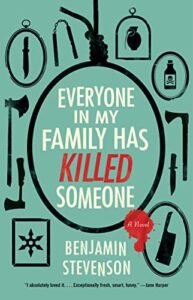
Benjamin Stevenson, Everyone In My Family Has Killed Someone
(William Morrow)
You know what you should read, this holiday season? My Family Has Killed Someone, Benjamin Stevenson’s smash-hit whimsical murder mystery about coming to terms with who you are (and who you are not). In the novel, our narrator-hero Ernie Cunningham (teacher, crime novel fan, and how-to author) finds himself embroiled in a complicated plot when a family reunion at a ski resort turns into a whodunnit. Could the mysterious events be the work of a serial killer called the Black Tongue? Perhaps. And all this, by the way, takes place three years after Ernie reported his own brother Michael to the police for murder after Michael requested help disposing of a dead body that turned out not to be dead. So, yes folks. I can’t wait for this one. –OR
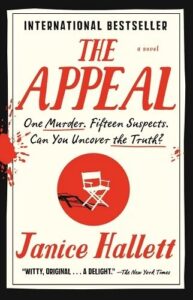
Janice Hallett, The Appeal
(Atria)
Okay, so this would be a great mystery novel whether or not it featured a community theater group, but the added drama makes The Appeal into a perfect follow-along caper. Told in emails, announcements, and other found texts, The Appeal has a charmingly meta set-up: two law students have been assigned all of these documents to analyze. If they misinterpret them, the wrong person may go to prison for a long time. And you, the reader, can interpret this fair play mystery right alongside them. –MO
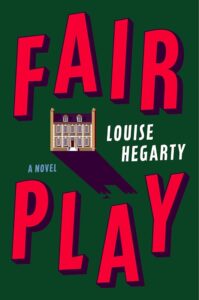
Louise Hegarty, Fair Play
(Harper)
In Hegarty’s ingenious and deeply felt mystery, a group of friends has gathered at an AirBnb to celebrate, but after a fractious evening, the birthday boy is found dead, casting a group of friends as the closed circle of suspects. The traditional mystery genre is paid its due as a detective arrives, along with a butler and a gardiner, appropriate enough since the friends were celebrating by playing a murder mystery game themselves. The result is a layered meta-fiction that plays out to a surprising and well-earned finish, one of the strongest mysteries start to finish to come around in years.–MO
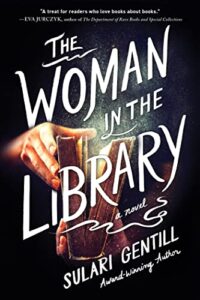
Sulari Gentill, The Woman in the Library
(Poisoned Pen Press)
Sulari Gentill, the author of the delightful Rowland Sinclair books, has penned a fascinating, very meta new mystery that walks the line between impressive literary experiment and gripping murder story. Winifred “Freddie” Kincaid, an Australian writer, is in Boston on a fellowship when, one day in the library, she hears a woman scream, and is inspired to write a story about it. Hannah Tigone is an Australian novelist writing the mystery about Freddie writing the mystery in the library. And Leo is Hannah’s biggest fan, writing countless emails to her that inadvertently influence the ways Hannah tells the story, until Leo’s own story is rejected and his presence in the writerly web grows far more dangerous. Yeah, you don’t want to miss this. –OR
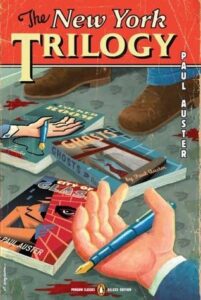
Paul Auster, The New York Trilogy
(Penguin Classics)
Paul Auster’s “City of Glass,” the first of the three playful mystery short stories that make up The New York Trilogy, is a masterclass of metafiction. It’s about a writer named Quinn who writes mysteries under the name William Wilson (that’s a Poe joke) about a detective named Max Work… who gets a phone call one night asking for Paul Auster, the detective. Right?????????–OR
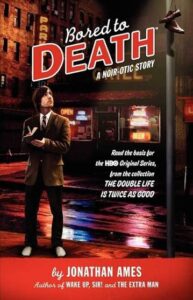
Jonathan Ames, “Bored to Death”
(Scribner)
In the short story that inspired his HBO series Bored to Death, Jonathan Ames writes about a frustrated writer named Jonathan Ames, who impulsively posts an ad for his own unlicensed private detective services on Craigslist, and winds up in a real-life (well, real-life?) noir. Wonderful.–OR
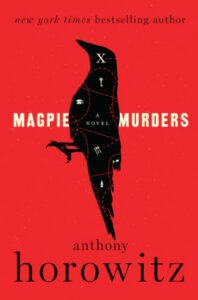
Anthony Horowitz, Magpie Murders
(Harper)
Magpie Murders a wonderful story-within-a-story. The story begins when a book editor named Susan Ryeland presents a strange event that changed her life: a mystery that came to her attention when she read the manuscript of a new mystery novel called Magpie Murders. That mystery manuscript is unfinished, though, which means Susan has to go and hunt for the answer herself. But that novel also contains the clues to a real-life mystery, and it is up to Susan (and her own readers) to dig them out and connect them to the real-life circumstance. Horowitz’s Magpie Murders is pure pleasure—a beguiling and refreshing experiment with the traditional murder mystery genre that follows the rules while also taking on an entirely new dimension.–OR
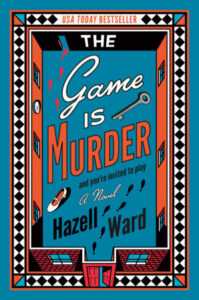
Hazell Ward, The Game is Murder
(Berkley)
Hazell Ward’s delightful, dizzying novel places the reader in the role of the Great Detective, to solve the murder at hand. It has countless twists, references to Golden Age and traditional detective fiction, authorial intrusions, and a million other tricks up its sleeves. Wonderful, wonderful, wonderful!–OR

Olivia Rutigliano
Olivia Rutigliano is an Editor at Lit Hub and CrimeReads. Her other work appears in Vanity Fair, Vulture, Lapham's Quarterly, AirMail, the Los Angeles Review of Books, Public Books, The Baffler, Bright Wall/Dark Room, Politics/Letters, The Toast, Truly Adventurous, and elsewhere. She has a PhD from the departments of English/comparative literature and theatre at Columbia University, where she was the Marion E. Ponsford fellow. She hosts the podcasst "Culture Schlock" at Lit Hub Radio. She is on instagram at @oldebean, twitter at @oldrutigliano, and bluesky at @oliviarutigliano.bsky.social.