

Ellis Blake's Top 5 Missing-Persons Novels
Reading great novels about the vanished and the taken.
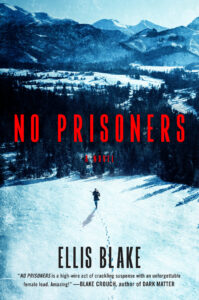
My latest novel NO PRISONERS is published on July 21st. It’s a thriller about a woman in New Mexico searching for her missing husband. The unanswered question is the basic engine of suspense, and so the idea of someone vanishing—or worse, being taken—has always captivated me as a reader: you’re faced not just with the Who Did It and the Why, but the more ominous, victim-centric concerns of What Happened and Will they be Found. Below are my top-five missing-persons novels that I’ve read in the past twenty years—thrillers and mysteries that in different ways were both a treat, and a lesson in how to write.
I discovered Lee Child’s Jack Reacher novels in January 2005, and by April I’d burned through the backlist. This foolish lack of rationing occasioned the awesome, temporal challenge familiar to all Reacher fans: the year-long wait until the next novel—in my case, THE HARD WAY, due for New Zealand publication in April 2006.
Child’s newsletter had teased his new book (“a kidnap thriller. Or is it?”) by excerpting the trim, intriguing opening paragraph: Reacher, waiting for an espresso, witnesses a man’s life change forever. (“Not that the barista was slow. Just that the move was slick.”) In the published text, “barista” became “waiter”, and I loved that such a blameless and appropriate noun had nonetheless been swapped for the sake of one syllable: pulling the reader in with as little friction as the physics of prose would allow.
Everything is smooth from there on. Reacher’s espresso wait had made him an accidental witness to a kidnapper collecting ransom money. The victims are the wife and young stepdaughter of a private military contractor, who has at his disposal half-a-dozen epically-remunerated ex-Special Forces guys. But they’re heavies not detectives, and they need ex-military cop Reacher for his investigative prowess. Ten books in, the seasoned Reacher fan is looking forward to the five- or six-on-one fight, meted out with a clinical and measured series of Oxford commas (maybe the knee, and then the scything elbow, and then the headbutt). But the physical conflict is superbly delayed, the plot developments upend the moral balance beautifully, and when Reacher’s shell casings go “arcing through the spill of bright light and jangling on the stones” they seem eminently justified. The Hard Way is a high point in both an excellent series, and the genre at large.
One of the great pleasures of reading thrillers is coming across a terrific character and then discovering there are eight (or ten, or a dozen) other books about the same guy. I experienced that first with Lee Child’s Reacher, and then with Robert Crais’ epic duo: Elvis Cole and Joe Pike. Crais’ latest—THE BIG EMPTY—is his best yet. Elvis Cole is hired to find the missing father of a social media influencer, and the storytelling is so brisk and nimble, the suspects quickly proliferate. Crais, Cole, and Pike have been in the trade for decades, but all three of them seem as unflagging and innovative as ever, the story gliding along with the muscle and polish of Joe Pike’s red Jeep. Half way through the book—with the missing father still missing, various characters no longer trustworthy, and Elvis Cole being tailed by both a criminal gang and a psychopath who talks to his car—I became conscious of the finite and diminishing number of pages in the book, and wondered how Crais was going to unify all his moving parts. But he does unify them, and with a savage, satisfying originality that makes The Big Empty an immaculate, resonant thriller.
I first discovered Adrian McKinty by way of his outstanding detective novels set during the 1980s in Northern Ireland (the fabulously titled POLICE AT THE STATION AND THEY DON’T LOOK FRIENDLY being a particular highlight). McKinty’s 2019 novel THE CHAIN is a bravura sidestep into contemporary US territory. The premise is darkly ingenious. Rachel Klein receives a phone call from a stranger, who says she has Rachel’s thirteen-year-old daughter captive. The only way to get her back is to pay a ransom, and then kidnap another child.
Thus is Rachel’s induction into the terrifying, self-sustaining crime enterprise known as The Chain. It’s a terrific, exhilarating read, cleverly leveraging a universal parental fear, and it carries thematic heft, too: most obviously in the pseudo-remedy facing victims of The Chain who must pay the suffering forward in order to alleviate their own. McKinty said that the story is “a thriller where economy of storytelling is everything” and that in each successive draft he “cut scenes, beats and ideas until a page turning core remained.” That core is a thing of thriller-writing beauty.
Tana French’s THE SEARCHER centers on Cal Hooper, formerly of the Chicago PD, now living in rural Ireland in the wake of a marriage separation. He’s an instantly likeable character, bruised but resilient, passing his time with the hard labor of renovating his cottage. But with twenty-five years’ experience as a police detective and a moral compass that does not wobble, he’s well placed to help local kid Trey find his missing brother.
The story has a masterly, unrushed confidence about it. French takes her time filling in Cal’s backstory, showing us the rural Irish landscape and its people: wary, streetwise Trey; Cal’s droll, eccentric neighbor Mart; the local pub and its patrons. But behind the atmosphere of geniality and cheer is a darker quality that French draws inexorably into focus as Cal works his witnesses and his clues. The Searcher is a deliberately slow, stunning burn from one of the very best crime and mystery writers in the world.
Richard Price’s FREEDOMLAND involves a horrifying setup: a woman, badly injured and in shock, arrives at an inner-city hospital emergency room. She claims to have been carjacked, and that unbeknownst to the carjacker, her four-year-old son was asleep in the backseat.
While nominally a crime story, Freedomland could equally be described as a five-hundred-page social novel, wherein the character of Lorenzo Council—a police detective tasked with finding the missing boy—offers a tour of late-twentieth-century urban struggle in America. The drugs, the poverty, the pervading suspicion of the law, and the characters who need protection more from themselves than from others. In the course of examining a crime, Price examines its consequences for both the immediate victims and the wider community: the police’s media-scrutinized hunt for the missing boy leads to civic unrest which pulls into focus issues of race, policing, class—and freedom. Price offers a lesson on how to do everything: smooth, wry prose; dialogue that’s so good it seems eavesdropped; and a story that both educates and entertains.
***

Ellis Blake
Ellis Blake is the pseudonym of Ben Sanders, award-winning author of American Blood and other books in the Marshall Grade series. He lives in New Zealand.