Erica Wright on Setting a Mystery in a Museum, Supernatural Crime, and Novel Research
The author of The Museum of Unusual Occurrence in conversation with Radha Vatsal
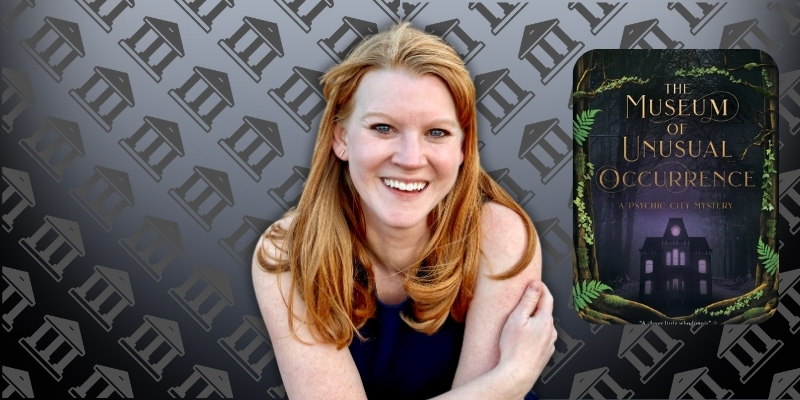
Erica Wright’s haunting new novel, The Museum of Unusual Occurrence, the first in the “Psychic City Mystery” series, is set in a museum of curiosities by the same name. The museum’s owner, Alcyone (Aly) Orlean, has her hands full taking care of all ten-thousand creaky square feet of her unconventional venture and looking after her sister, a high-school student. Then one day, the body of a young woman sprinkled with flower petals and with quarters on her eyes mysteriously appears in the “Rituals and Undead” exhibit.
“Now, encased in glass so that she could be seen but not touched, [the girl’s body] had turned into something else,” Aly says. “A fairy tale, a sculpture, a warning.” She realizes that if she wants to keep her sister safe, she’s going to have to find out who left that body in her museum, and why.
I first met Erica Wright at an event at Murder By the Book in Texas. We got to talking and I’ve followed her work ever since. A crime writer, poet, and author of nonfiction, her novels are atmospheric and suspenseful. The Museum of Unusual Occurrence is no exception. Beautifully crafted, it drew me in from the first page with its unique setting, off-beat, unapologetic narrator, and eerie mystery.
*
Radha Vatsal: So I have to start with inspiration. In the author’s note, you say you were inspired by the Mütter Museum in Philadelphia, PA. As I read the novel, I was also thinking of The Mütter [a medical history museum founded in the nineteenth century] and the Museum of Jurassic Technology in LA [a quirky cabinet-of-curiosities type museum].
What is it about places like the Mütter that fascinate you and make you want to set your mystery there?
Erica Wright: Did you know that you can see segments of Einstein’s brain at The Mütter? It’s a bit disturbing—especially since Einstein requested to be cremated—but also, I get it. People want to know what made this person so smart. It’s not completely removed from studying a Rembrandt painting and marveling at the depiction of light. I’m fascinated by how we express our curiosity and admiration for something through preservation.
And I’ll be honest with you, if you collect it, I want to see it. I’ve been to the National Bonsai Museum in DC, the Pirate and Treasure Museum in St. Augustine, and the Great American Alligator Museum in New Orleans just to name a few.
I was recently reading about the earliest known museum, created in 530 B.C.E. by a Babylonian Princess named Ennigaldi-Nanna or Ennigaldi for short. She excavated many of the artifacts herself, all from Mesopotamian culture, and you can still see the museum’s ruins in what’s now Iraq. Neat, right?
We can learn a lot about what matters to people by what they keep.
RV: In the novel you mention a couple of different “unusual occurrences” like the Aokigahara—”the Japanese forest alleged to make people take their own lives”—and the story of the Yuba County Five. Do you spend a lot of time researching mysterious cases like these? Are there others that have grabbed your attention and played a role in writing this book?
EW: The Museum of Unusual Occurrence is the first in a series, and I considered using one seemingly supernatural event as a sort of anchor for each book. I imagined each one as a display in my fictional museum of oddities. I decided to go in a different direction, but I don’t regret my research. In fact, I’m using some of the information I unearthed about near-death experiences in the draft I’m finishing now.
Near-death experiences occur when somebody loses brain activity, experiences cardiac arrest, or something similar and claims to glimpse the afterlife. It’s fascinating because of the number of reported cases—millions here in the United States alone—as well as their similarities across cultures. There’s an entire department at the University of Virginia dedicated to this and related phenomena: the Division of Perceptual Studies.
RV: Small towns—in this case Wyndale—play a large role in your books. (I’m thinking also of Famous in Cedarville.) What is it about small towns that make them so compelling as a setting for mysteries?
EW: I grew up in a small town of five hundred people in rural Tennessee. Famous in Cedarville is set in a fictionalized version of that place, and I wanted to convey a realistic sense of small-town living. In crime fiction, we often get extremes. There’s the gritty, hopeless rust bucket or the charming, sweet utopia where the air smells of freshly baked cookies. To be clear, I love books on both ends of that spectrum, but for some reason, I feel compelled to defend the middle ground.
Also, it’s hard to keep a secret when neighbors think they know everything about everybody. That makes for a fun challenge with a mystery novel.
RV: The main characters here have very unusual names: Alcyone and Merope. Can you tell us a bit more about that choice—and what it says about these two women?
EW: Their names are derived from two stars in the Pleiades constellation, also known as the Seven Sisters. The seven sisters all played a role in Greek mythology, perhaps Electra most famously. In my story, Alcyone and Merope are the only siblings, but their parents joked about having seven famous daughters. They live in a town full of eccentrics, so it made sense for them to have unusual names.
Only their mother uses the full names. Aly and Merry prefer their nicknames, which speaks to their more practical sensibilities. My initial vision for Aly was a no-nonsense curator who curates a museum of nonsense—though she’s determined to turn her museum into something more akin to a research institute. Merry is more attuned with her town’s beliefs and superstitions, but she’s still a teenager with dueling impulses to stand out and to fit in.
RV: The novel also features a host of oddball supporting characters. From Aly’s strong-willed but MIA mother, her actor ex-boyfriend, the unusually tall police detective, to the psychic who conducts seances. Which one did you most enjoy writing?
EW: Bud [the detective] appeared in my mind fully formed, this giant of a man with unruly red hair and a no-nonsense disposition. What’s funny is that after I’d drafted The Museum of Unusual Occurrence, I was having lunch with my family in a rural mom-and-pop restaurant near the Smoky Mountains. There at a table next to us was a man who looked exactly as I pictured Bud. It was as if the character had sprung to life. Hopefully I didn’t stare too much.
RV: You’re a poet and a crime novelist and you also write nonfiction. I’m curious as to how all these genres play off against each other in your work.
EW: When I studied poetry, the most challenging and rewarding course I took was on prosody, basically a study of meter and form. I don’t write formal poetry, but being forced to compose in iambic pentameter and terza rima, being forced to write sestinas and ballads, taught me an incredible amount about how language works. How sound works! I feel those lessons simmering in the background no matter what I’m writing.
I don’t intentionally write literary crime fiction, whatever that even means, but I do love a well-turned phrase. And a lot of my favorite crime writers—Tana French and Sara Gran come to mind—understand the impact of a single word. Your writing, too, has a wonderful cadence. And, of course, we share a love for research.
Research is probably the clearest link between my poetry, fiction, and essays. When I was writing my nonfiction book Snake, I got to interview the most interesting people. Herpetologists, wildlife educators, pet owners. I spoke with physicists down at Georgia Tech who were studying rattlesnakes to improve search-and-rescue robots. Fascinating stuff.
RV: Random question—I love the title—The Museum of Unusual Occurrence. Why “occurrence” in the singular and not plural
EW: This goes back to my original idea of having the museum focus on one unusual occurrence each season. Also, occurrences is harder to say!
RV: And two final questions: what are you reading right now, and what are you working on next?
EW: Well, the book I’ve been reading the most is An Anthology of Remarkable Bugs by Jess French because my five-year-old likes it. But I just reviewed the poetry collection Coming into an Inheritance by Jeff Hardin, and Tana French’s The Keeper is up next for me.
I’m currently finishing the second book in my Psychic City series and still fiddling with the title. Suggestions welcome.
***