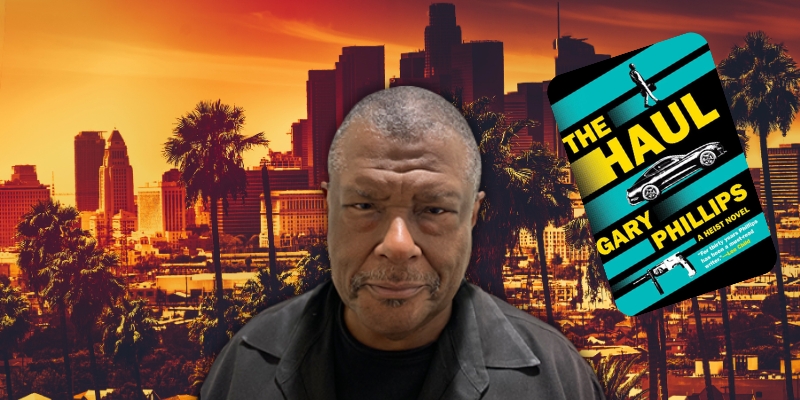
Gary Phillips on Writing a Contemporary Los Angeles Heist Novel
The author of The Haul in conversation with Alex Dueben
Gary Phillips has had a long career as a crime writer since he first emerged in the 1990s with the Ivan Monk novels, which have been reprinted in new editions in 2024, and are today acclaimed as some of the great crime novels of the era. Since then he’s gone on to write other series including Martha Chainey, the One-Shot Harry novels about a 1960s crime photographer, and his recent pulp novel Three Bullet Opera.
Phillips was a writer-producer on the TV series Snowfall, and is an award-winning editor behind anthologies like The Obama Inheritance, The Cocaine Chronicles, and South Central Noir. He’s a comic scribe whose books include Angeltown, Be-Bop Barbarians, Peepland, and the Martha Chainey graphic novel Cold Hard Cash, which comes out this month in a print edition.
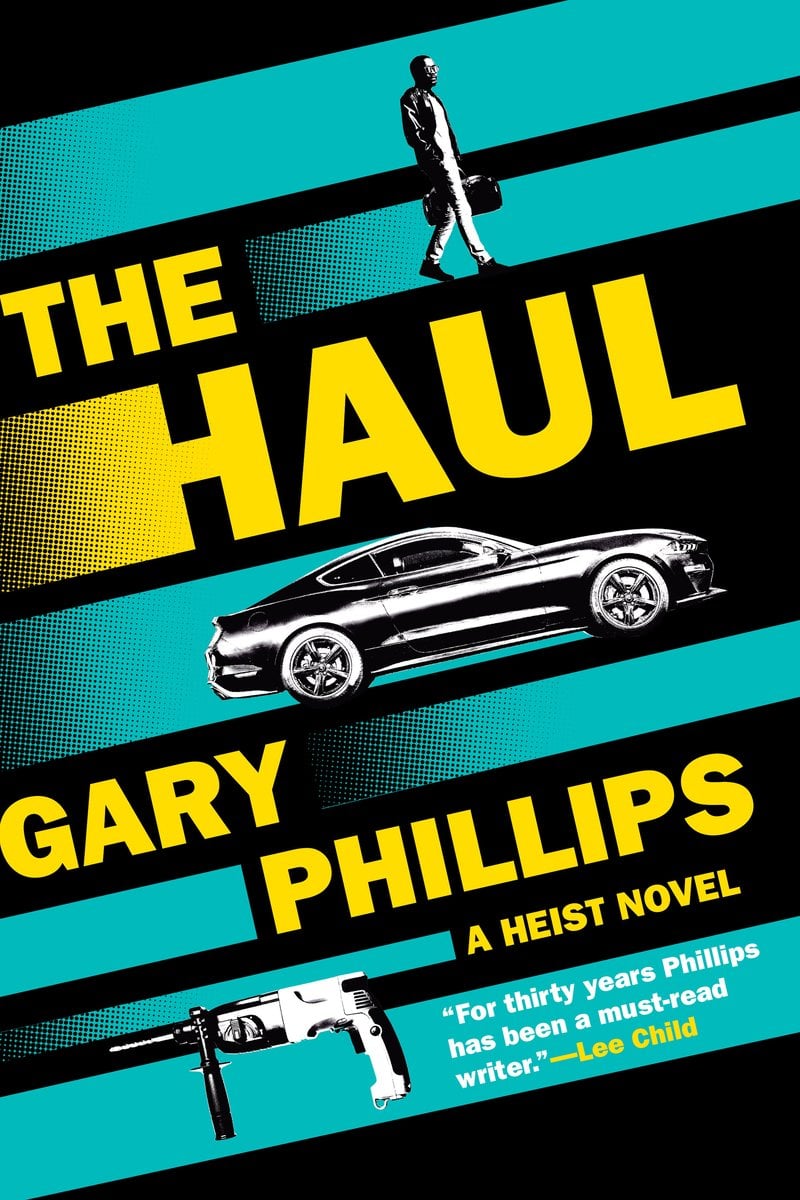
This month Soho Press releases his new novel The Haul. A heist novel set in present day Los Angeles, the book jumps in time, and manages to be a a great heist novel about trying to rob from a tech billionaire, and a character study and account of contemporary Los Angeles in a way that’s hard to pull together.
The book features the return of O’Conner, a character that appeared in The Warlord of Willow Ridge, and in the anthology Culprits, but this is a very different kind of novel than either of those books, and a very personal book, telling the story of how he became the man he is. Phillips has been producing some of his very best work in the past decade, and he was kind enough to talk about the many projects he’s working on, and what he needs to finish writing.
*
Alex Dueben: I really enjoyed The Haul, which is the third O’Conner book, sort of.
Gary Phillips: Yes, that’s right. The second novel, but then he also appeared in the linked anthology, Culprits, which which which became a miniseries, but but has almost except some basic skeletal structure. Other than that, it has nothing to do with what we wrote.
AD: I phrased that in a hesitant way, because it also is a book you can read without any knowledge of any of either of those and it makes perfect sense. I’m curious about just when the idea started, because it is a third book, but also unconnected and very different from both.
GP: Right. There’s a few small references to to the past. Where did these ideas come from? I guess I’ve been mulling around doing something different because I was already writing the One-Shot Harry books for Soho. I’ve got a third one of those in the can. I was curious to go back to O’Conner.
The heist novel, of course, is just a wonderful exercise in trying to figure out, can you can you make this heist novel different than other heist novels? Understanding that there are certain frameworks you can’t get away from. I mean, the heist has to go down and something has to go wrong, because otherwise if everything is fine, then we’d all go home, and then what was the point of the story you just told us? So what could be different?
I purposely didn’t want the tech character to be Musk because he’s such a cartoon in and of himself. Then I thought, there’s Balmer and he has this basketball team. That’s kind of interesting.
As I acknowledge in the book, the great Donald Westlake had been here a couple of times before with the Parker novels. I thought, I can acknowledge that, but I’m going to do a different setting. I’m going to do it modern day. Because it’s also about today’s world, where we’re full of crypto currencies and QR codes and such, where can we still find a whole bunch of cash? [laughs]
AD: One of the books you mentioned as a specific influence was Westlake’s The Seventh, and funny enough, I just saw the film version, The Split, for the first time a couple months ago.
GP: Is that right? It’s not too bad a version.
AD: It’s not too bad a version. Jim Brown did a good job. It’s an above average heist movie. Better than most.
GP: Better than most. Although, God help us, they didn’t know what to do with Diahann Carroll. That was an unfortunate waste. But you have this interesting cast, right? You got Gene Hackman, you got Ernest Borgnine, you got Jim Brown. It’s not bad. And it’s in LA, right. It takes place during a Rams game.
AD: The first O’Conner book, The Warlord of Willow Ridge, came out over a decade ago now.
GP: It’s true. 2012 maybe?
AD: It’s a novel that really came out of the Great Recession about this crumbling suburban development, where probably half the country could point to a neighborhood where the novel could have taken place. But what is it that made you want to return to the character, and really explore his background?
GP: I didn’t intend to. That wasn’t a notion. More it was about what we just talked about, how can I set up this robbery in a kind of interesting way? And make it today, so tech is involved, but still we would have to have cash involved. The more I talked about that and the more I thought about it, and I think also prodding from my editor at Soho, the wonderful Alexa Wejko, that I give a glimpse of him. Unlike Westlake where every once in a while he would drop some little tidbit about Parker’s past, but not a lot, right? What if I gave us a bit more of who O’Conner was and what is it that made the kid the man?
Once that settled with me, the idea being, what if the inciting incident of all this is really buried in the past. This one particularly harrowing night that as a young kid, I mean I fuss a little bit with his age, but he was a teenager, still a young kid coming up. Yet he’s had these experiences. He’s one of the witnesses to this event that sets in motion this all these years later. The point about we can never escape our past.
And, of course, you always want something to go south in the robbery, what could it be? Because O’Conner is a very thoughtful cat. Very much thinking four or five steps ahead because he has to. You have to think about all the possibilities. Of course, the one possibility that would blindside him is the thing that, of course, comes to bite him in the ass.
AD: That inciting incident and these glimpses of his childhood around it, really explains him in a way that the first book didn’t.
GP: In the first book he just arrives and he is who he is. Of course, again, playing with a little bit of time, slowing down his aging somewhat. Because even then he’s sort of thinking about, I should go straight. The challenge is always going to pull him back into the arena. I’m already contemplating what might be the next O’Conner novel.
AD: He’s a character who’s always going to want stability, but he can’t escape the challenge. He’s not alive without it.
GP: Exactly. And it defines him, right?
AD: It defines him. Like you said, every heist story is about something going wrong. Here it’s not about the heist at all. It’s something that comes completely out of left field and yet, it’s deeply connected to him and these characters.
GP: I thought it would give it a different kind of twist. It’s about greed, right? But it’s also about this thing from the past, this person from the past. Because of their relative ages, Teaflake doesn’t recognize O’Conner. O’Conner knows who Teaflake is. It’s ingrained in his memory. That one moment is forever forged in his brain. For Teaflake, he’s just some punk kid that he talked to one night and didn’t think about since then.
AD: This isn’t a deus ex machina. It’s tied in with everything, and I think some of that is not just how you crafted the backstory, but leaned into the setting and showing how these things echo through time.
GP: Good. Again, Alex, I can never praise my editor enough. I think I’m one of those writers that sometimes I get in the weeds on detail. Where even I can’t quite see it, but she can see it. But because I’ve gotten the weeds of detail, now I can hone in on that. I can pluck a few things from there and we can keep that in and salt that in.
I had to get all that detail because I had to know where the hell was I going with all this. Even though I plot out books before I write them, I’ve still got to know where I’m going. Once I know that, you can start taking some of that away or you can start salting that in at different places so that the thing you saw on page 30 has a meaning on page 112 or whatever.
AD: I feel like that’s one of those things that you’ve always done in your work. From the very beginning, you’ve been very conscious of time and place as key characters.
GP: I think so. I suppose it’s because of having more or less been in LA all my life and seeing the city change. Seeing the changes that have happened. I’ve told several people it’s somewhat daunting to write a new novel set in now, as opposed to the Harry novels which are set in the 60s, because the city has changed. I’m aware that I want to not write about a city that existed twenty years ago. Sometimes when I’m writing about an unfamiliar part of town, or a part of town that I know has changed demographically, I need to go there, check it out, hang around. You want to get a sense of how time has marched on.
I don’t want to be one of those old private eye writers who were writing about New York, but they were writing about a New York of their young years. And here they were, old men still writing as if that was the same city. It isn’t. Cities change. Cities are these living organisms that move and shift. You want to at least capture some of that in the, if you’re going to set a story in a modern day setting.
AD: As you said, some of that is research. But it’s different researching a historical book, even if it’s for a similar purpose.
GP: That’s right. You want those little things, like a self-driving car shows up in the book, because that’s what exists now. They’re ubiquitous. At least in my part of town, they’re all over the place. These little things in the landscape that we exist in now. The trappings of modern society.
AD: You mentioned you have another Harry novel finished. For fans of your comics and the Martha Chainey books, you did a comic, Cold Hard Cash.
GP: Yes. With Miss Martha. She’s another character that I have now revisited in the comic book form, but in prose form I need to go back to her as well. Basically it retcons Martha’s origin to a certain extent from the books, so the reader could jump right in, but she’s still Martha.
As always, the great thing about comics are the visuals. Working with a talented artist like I did with Adriana Melo, once Martha’s “look” was established and I provided a graph or two on who Martha is as backstory, Dri knew what to convey if the script indicated Martha is pissed, surprised, etc. That’s a shorthand you strive for in terms of a character’s mood and so on. You still want your dialogue to be sharp and specific to a given character, but what an added dimension the depictions bring.
She’s been requested to come to L.A. from her longtime friend, Rita Solomon, who was also a showgirl, but now runs this nonprofit. Somehow this grant money that they were given has disappeared. We follow Martha down somewhat of a tech rabbit hole, but again, we get back to the notion of cash and where is the cash?
AD: It always comes back to cash.
GP: It always comes back to cash. That’s right.
AD: Over the years, even when you’re writing a series, you’re jump between series and characters and approaches to how you work. Is this just how you think, this sort of restlessness?
GP: [laughs] That’s a good way to put it. Restlessness. I guess to a certain extent. I think it helps me as a writer to kind of get in these different heads and different spaces so that when I go back now to Harry, I feel rejuvenated. I’m hopefully not getting in a rut with Harry and then maybe switch back to O’Conner or switch back to Martha or eventually get that fifth and final probably Ivan Monk novel written.
I think it keeps me on my toes a little bit. You know, the writer as boxer, a la Norman Mailer, where you’ve been delivering the blows for a while, you’ve been taking the blows for a while. You don’t want to be all punch-drunk on the page. You still want to be as sharp and crisp as you can produce. You mix things up a little bit, move around a little bit. Some of those jabs are still the same, but some of that is different when you’ve got to inhabit these heads.
And now, Alex, in my golden years, thinking, wow, I’m in the heads of people who are not necessarily my gender, but also younger than me. O’Conner, he’s somewhere in his forties, and I can at least think back to my forties and give some sense of what that’s like. [laughs] But as you write somewhat younger characters, you got to really think, wait a minute now. What are they saying? What are they really thinking about? What is their outlook on life?
AD: As you were saying that, I thought about the Ivan Monk books, your first books, where you were very conscious about not writing the same book four times.
GP: Oh, good. I hope not. Like you said, that’s always the thing as a writer. There are certain grooves, certain ways that you write, that are comfortable, and it’s easy to slip into them. So the problem then becomes sometimes, didn’t I write that before? Didn’t I do that kind of thing before?
Some of that is going to always be there. That’s just the nature of who you are as a writer, I think. But then hopefully you try to be as fresh as you can, to either some new insight about the character or some other different thing that you haven’t explored before or maybe looked at at one point and now are coming back to it. I think the more you can try to push yourself as a writer, hopefully that also means that it’ll resonate with the reader.
AD: You mentioned before that you outline all the books. Do you think that helps in a certain way, just having that intentionality in the process early on?
GP: It helps me. I know people who are pantsers and they don’t. Invariably I often deviate from the outline or I go down a different tributary. For me, it’s a lovely safety net so that sometimes when I get lost and I can’t quite figure out, how do we get here, I can at least look at the outline and think, okay, I need to have this kind of happen or I need to at least think about that.
Sometimes you can’t force it, right? You can’t make certain things happen if you haven’t laid that out or if you’ve gone a different route. You’ve got to be willing to go with that different route.
It’s like jazz; you may have a piece in mind, a piece you’ve done a hundred times. I’m sure that when Miles Davis did “Concierto de Aranjuez” from Sketches of Spain, even he, I’m sure, would either get tired of it but also think, this is the five hundredth time I’m going to do it, but this time I’m going to do this. You’ve got to keep this rhythm going that you develop over a period of time, but you’ve also got to be able to say, how do I shift? How do I improvise? What’s different now?
AD: You mentioned a fifth and final Ivan Monk novel. Is this something you’ve been thinking about for a while?
GP: It has. I realized that unlike what Robert Parker did with Spenser, where Spenser and Hawk never seem to age, I think the Monk novel will have to be set in the 90s, because I specifically need the Dexter Grant character, who I’ve already said is a World War II vet. He’s up there in the 1990s—now, he’d be 100-some and I need him more mobile. I need Dexter in that novel, because primarily what’s going to happen is going to revolve around him. All that to say is that I think it makes sense to me that that fifth Monk novel would be closing out the 90s. Closing out that decade with Monk.
I’ve already done a little cross-pollination. Monk’s father shows up in the Harry novels, but Ivan is not mentioned at all. When I first started, Ivan and I were– it’s like Spillane and Mike Hammer, Ivan and I were roughly the same age. But now I’m an old man, so I get to have him an old man. I don’t mind having an old man character. In fact, I have an idea for a book with an old man and his grandson, modeled on my grandson. But for Ivan, I want him at a certain age, a certain age that he can still take a blow– and not go to the hospital for five weeks. [laughs]
I also wrote a novella. Is it a novella? I don’t know. It’s 50,000 words. It was for a small press here in LA called Writ Large Press, run by lovely people. Essentially it’s a pulp novel with a female character, Jackie Alvarez, an ex-sheriff, ex-CID. It’s very much pulp, and I’m not giving anything away by telling you this because it’s on the back cover of the book, but the infamous Dr. Mabuse shows up in LA in the modern day. It’s just a fun romp. It’s called Three-Bullet Opera.
AD: I made a joke earlier that we’ve talked before, but you might not remember me now because you’re moving up in the world. But you were a writer and producer on Snowfall for years. The Ivan Monk books were reprinted and the first Monk novel was part of the Alta Magazine California Book Club, as one of the essential books explaining and defining California. John Freeman hosted this really nice event.
From the outside, as a reader, it feels like you’re still doing your thing, but more people in the past decade are realizing and appreciating what you’ve been doing. I’m curious what that feels like for you.
GP: That’s a great question, man, because I know some guys who are still around who are not writing now, or not writing in the genre now, and others who are still carrying the torch. I suppose having a dad who was a mechanic and a mom who was a librarian, the whole work ethic, that this is your job and you should try to do your job as best you can. Hopefully along the way, learn this or that and bring it to the page. I think in that regard, I’ve had this peripatetic career, up and down and here and there.
Because of my love for crime fiction and being a fan of it, a reader of it as well as a practitioner of it. A practitioner of it on the page, I should say, in fiction, not real life. [laughs] That’s kept me going in the lean times. In the times when I couldn’t get arrested, but you just keep at it because it is the thing that sustains.
If I wasn’t doing this, what would I be doing? Well, I know what I’d be doing. I’d be watching a bunch of reruns of the original Hawaii-50, but I probably shouldn’t fill my days doing that. And because there’s still stories I want to tell. That’s what it is. I just get jazzed by whatever notion creeps into my head from something I’ve seen on TV or the news or whatever. Once that grabs you, you just got to run with it.
***

Alex Dueben
Alex Dueben has written for The Believer, Vulture, The Millions, The Los Angeles Review of Books, The Brooklyn Rail, and many other publications. He is the writer and editor of the artist monograph Hurricane Nancy, and his debut novel is forthcoming.