Before recording the strange history that follows, I felt I ought to take a look at the house where such a gruesome murder was committed. Accordingly, one afternoon in early spring, I set off, walking stick in hand, for a stroll around that infamous residence.
I was evacuated to this rural farming village in Okayama Prefecture in May of last year, at the height of the bombing raids. And since that day, everyone I’ve met has talked to me at least once of what some call “the Koto Murder Case” and others “the Honjin Murder Case” at the home of the Ichiyanagi family.
Generally, as soon as people hear that I’m a writer of detective stories, they feel compelled to tell me of any murder case with which they have the slightest personal connection. I suppose rumours of my profession had reached the ears of the villagers, so every single one managed to bring up the topic of the Honjin Murder Case at some point. For the people of this village there could hardly be a more memorable case, and yet most of them were not aware of the full horror of this crime. Usually when people tell me these kinds of tales, they never turn out to be as interesting to me as they are to the teller, much less potential material for a book. But this case was different. From the moment I heard the first whispers about the case, I was fascinated. Then, when I finally got to hear the account from the lips of F—, the man most directly connected to the case, I was at once seized with a great excitement. This was no ordinary murder. The perpetrator had scrupulously planned the whole ghastly deed. What’s more, it was worthy of the label “Locked Room Murder Mystery”.
This was no ordinary murder. The perpetrator had scrupulously planned the whole ghastly deed.
The locked room murder mystery—a genre that any self-respecting detective novelist will attempt at some point in his or her career. The murder takes place in a room with no apparent way for the killer to enter or exit. Constructing a solution is an appealing challenge to the author. As my esteemed friend Eizo Inoue wrote, all of the works of the great John Dickson Carr are some variation on the locked room murder theme. As a writer of detective novels myself, I intended one day to try my hand at one of these, and now I’ve been unexpectedly blessed—one has fallen right into my lap. I know it’s shocking but I feel I owe a debt of gratitude to the killer for devising such a fiendish method to stab this man and woman.
When I first heard the story, I immediately racked my brain to think of any similar cases among all the novels I’ve read. The first that came to mind were Gaston Leroux’s The Mystery of the Yellow Room and Maurice Leblanc’s The Teeth of the Tiger; then there’s The Canary Murder Case and The Kennel Murder Case, both by S.S. Van Dine; and finally, Dickson Carr’s The Plague Court Murders. I even considered that variation on the locked room murder theme of Roger Scarlett’s Murder Among the Angells. But this real-life case wasn’t quite like any of the above-mentioned. Maybe, just maybe, the killer had read a selection of stories like these, dissected all of the different devices used, then picked out the elements that he needed, constructing his own device… At least that’s one theory.
Out of all of those books, it’s The Mystery of the Yellow Room that bears the closest resemblance, at least as regards setting and atmosphere; less so, the facts of the case. In that story, the crime scene was a room with yellow wallpaper; in the Honjin Murder Case, the columns and beams, ceiling and rain shutters were all painted in red ochre. Red ochre wasn’t an unusual hue for houses in this region—in fact, the house I was living in had also been painted that colour. The difference was that my house was extremely old, and the red lustre had faded to a dark brownish sheen. On the other hand, the room where the murder took place had just been repainted, and must have been gleaming with its fresh coat of red. The tatami mat flooring and the fusuma sliding doors that divided the two main rooms were brand new too, and there was a byobu folding screen decorated with gold leaf. The only unpleasant sight must have been the couple lying there, soaked in the crimson of their own blood.
To me, the most captivating element of this case was the way in which the traditional Japanese string instrument known as the koto was connected from beginning to end. At all the critical moments, its eerie music could be heard. I, who have never quite escaped the influences of romanticism, still find that incredibly alluring. A locked room murder, a red-ochre-painted room and the sound of the koto… all of these elements are so perfect—too perfect—like drugs that work a little too well. If I don’t hurry to get it all down in writing, I fear their effects may start to wear off.
Now I seem to have got a little bit ahead of myself… From my house to the grounds of the Ichiyanagi residence takes roughly fifteen minutes on foot. It’s in the small hamlet of Yamanoya, just outside the larger village of O—.
A hill lies to the north of Yamanoya, made up of three gentle ridges, reminding me somehow of the legs of a starfish. At the very tip of one of those legs sits the grand residence of the Ichiyanagi family.
A small stream runs along the west side of the starfish hill, and on the east there is a narrow road coming from the village of H—. Shortly after the stream and the road round the foot of the hill, the two meet. The Ichiyanagi home occupies the roughly triangular acre and a half of land in between. In other words, the property is enclosed by the hill to the north, the stream to the west and the H— village road to the east. The main entrance faces the road on the east side.
I began by walking by that side with its grand black gate embellished with studs. An imposing wall stretched to both left and right, running for a total of about 350 feet. When I looked in through the gate, I saw that there was another inner fence, indicating that the property was as impressive as rumour had suggested. However, I couldn’t see beyond this inner fence.
I tried walking around the south end of the premises to the west side, and then followed the stream in a northerly direction. At the very northern corner of the outer wall, I came across a broken-down waterwheel and a simple wooden bridge. I crossed the bridge and clambered up the steep side of the hill, ducking down to push my way through the thick bamboo that grew there. From up here on the hillside that formed the northern boundary of the Ichiyanagi property, I had almost a perfect bird’s-eye view over the grounds.
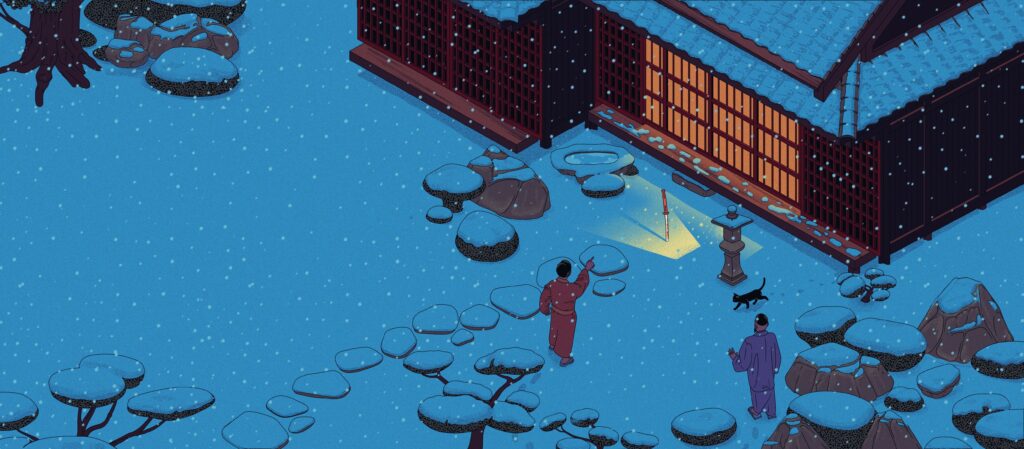
The closest roof to me was that of the annexe house, the scene of that terrible murder. From what I’d heard in the village, this building had originally been constructed for the retired head of the Ichiyanagi family, and was much smaller than the main house, comprising only two rooms: one eight and the other six tatami mats in size. Yet typical of this type of structure, although the building itself was small, the garden was extensive, stretching both to the south and the west sides, and crammed with trees, bushes and ornamental rocks.
I’ll write about this annexe house in more detail later. Looking beyond the annexe, further to the south, I could see the main building—the magnificent single-storey Ichiyanagi home, which faced in an easterly direction. And beyond that, the quarters occupied by the branch family. Next to this were the storehouse and several other small buildings dotted about, seemingly at random.
The main house and the annexe had been divided by a high fence and were connected by a means of a simple garden gate made of twigs and branches. Right now, the fence and gate were damaged almost beyond recognition, but at the time of the murder they were still in good shape, solid enough to slow down the people who came running at the sound of the screams.
This completed my survey of the Ichiyanagi residence, and I took a little while to scramble my way out of the bamboo thicket. Next, I headed back to O— local government office, right at the far south end of the village. There were few houses around that area, and further south again, nothing but rice fields until the next small town, K—. Running through those rice fields was a fairly major two-lane road. If you walked for about forty minutes total, you would come to N— train station. In other words, if you were travelling by train, there was no other way to enter O— village than by this road. You were forced to pass in front of the government building on your way in.
Right across the street from it was a tavern with an earthen floor and a simple window in the front. It was a place where wagon drivers and other tradesmen would stop by for a quick drink and something to eat. But more significantly, the character who would go on to play a central role in what I’m calling the Honjin Murder Case made his first appearance at this very tavern. This was the first sighting of the three-fingered man… The incident took place around sunset on 23rd November 1937, or the twelfth year of the reign of the Showa Emperor.
In other words, two days before the murder.
The okamisan, proprietress of this tavern, was sitting on one of the wooden stools out front, gossiping with a couple of her regulars—a wagon driver and an official from the government office—as the figure of a man came hobbling down the road from the direction of K— town. When he reached the tavern, the man came to an abrupt halt.
“Could you tell me the way to the Ichiyanagi residence?” The okamisan, the village official and the wagon driver stopped talking to look the man over. This wasn’t the kind of person one would expect to visit the Ichiyanagi family. He wore a crumpled felt hat pulled low over his eyes and a large mask covered his nose and mouth. Matted hair poked out from under his hat, and there was stubble covering his face from cheek to jowl. All in all, he was a shady-looking character. He wasn’t wearing a coat; the collar of his jacket was turned up against the cold, but that jacket and his trousers were smeared with grime and dust and worn away to a shine at the elbows and knees. His shoes were caked in grey dust and both soles were hanging off. Everything about the man looked rundown. It was hard to tell, but he was perhaps around thirty years old.
“The Ichiyanagi residence? It’s that way. But what business do you have with the Ichiyanagi family?”
The village official glared at the man, who blinked repeatedly while mumbling something unintelligible behind his mask.
Just at that moment, on the same road from the very same direction that the man had come, a rickshaw appeared. The okamisan glanced at it, and turned back to the visitor.
“Hey, you! Look. Here’s the very man you want to see, the master of the Ichiyanagi house.”
The passenger in the rickshaw was a man of forty or so with a dark complexion and a severe expression on his face. He wore dark Western-style clothing, and sat stiffly upright in his seat. He never once glanced to the side, or took in his surroundings, but kept his eyes fixed on the road ahead. With his sharp cheekbones and prominent nose, there was something austere and unapproachable about him.
This was Kenzo, the current master of the house of Ichiyanagi. The rickshaw passed by in front of the group of onlookers and quickly disappeared around a bend in the road. The wagon driver waited until it was completely out of sight before turning to the okamisan.
“Rumour has it the master of the house has found himself a bride. Is that right?”
“Looks like it. The wedding’s the day after tomorrow.”
“Eh? Already? Now that’s what I call quick.”
“Well, if he wastes any more time, then someone might come up with new objections to the marriage. Now that it’s been decided he’s in a rush to get it done. He’s quite a force of nature, that one, when he puts his mind to something.”
“Well, I s’pose that’ll be how he got to be such a big-shot scholar,” said the village official. “Mind you, he did well to get the consent of the old matriarch.”
“Well, of course she doesn’t approve. But I heard she had to give in eventually. The more she opposed it, the more stubborn the young master became.”
“How old is he now? About forty?” asked the wagon driver. “Forty on the nose,” replied the official. “And this is his first marriage.”
“A middle-aged man in love. More passionate than a youngster, that’s for sure.”
“And the bride’s only twenty-five or -six too,” said the okamisan. “Rin-san’s daughter, I heard. Landed herself a big fish. Now that’s what I call marrying up!”
The official turned back to the okamisan. “Is she a stunner, then, the bride?”
“They say she’s not all that good-looking. But she’s a teacher at some girls’ school, so she’s clever and capable—I guess that makes her a good match for the master.” The okamisan sighed. “Looks like all the young girls’ll need an education from now on…”
“Okamisan, don’t tell me you’re planning to go to school to land yourself a rich husband?”
“Oh, you can bet I am.”
The three of them burst out laughing. It was at that moment the strange visitor opened his mouth again.
“Okamisan,” he said hesitantly, “could I possibly have a drink of water? My throat is so dry…”
Startled, the three friends turned. Truth be told, they’d completely forgotten that he was there. The okamisan scowled at him for a few moments, but eventually filled a glass with water and handed it to him. The man thanked her, and shifted his mask so as to be able to drink. The three villagers exchanged a look.
[I]t was as if a large pebble had been dropped into a still pond. The ripples spread wider and further, building into waves of anger.
There was a long gash on the man’s right cheek that appeared to have been stitched up after an injury. It was a deep scar that ran from the right corner of his lip up his cheek, as if the side of his face had been slashed open. The reason the man was wearing a mask wasn’t to protect him from dust or disease; it was to hide that scar. And there was one more gruesome detail that caught their eye. As he reached for the glass, they saw that he only had three fingers on his right hand. The ring finger and little finger were both cut in half; only the thumb and first two fingers were whole.
The three-fingered man finished his water, thanked the okamisan and hobbled off in the same direction the rickshaw had gone. The three locals were left staring after him.
“What the hell?…”
“What does he want with the Ichiyanagis?”
“Ugh, he gave me the creeps! Did you see that mouth? I’m never using that glass again!”
The okamisan placed the used glass on the very far end of the shelf, a decision which would prove to be helpful in the following days.
Incidentally, if you are the kind of reader who enjoys reading between the lines of a story, and recall the particulars of the crime, you may already be able to guess what I am about to write next. Namely, that you only need three fingers to play the koto. Its strings are traditionally plucked by the thumb, index and middle fingers.
According to the village elders, the wealthy Ichiyanagi family wasn’t originally from O— village at all, but from the neighbouring town of K—. This automatically made them unpopular among the narrow-minded villagers.
K— used to lie along the old Chugokukaido, a section of the main route linking east and west Japan. In the Edo Period it was a rest station for travellers, and the Ichiyanagi home was a honjin, or an inn where Edo Period nobility would stay. However, when the shogun was overthrown, and the imperial system was reinstated in the late 1860s, the family head realized that he was about to lose the honjin. He had the foresight to act before the old feudal system collapsed completely and moved his family to their current location. He was able to take advantage of the turmoil of the time and acquire farmland dirt cheap, instantly becoming a rich landowner. That was why the local folk liked to call the Ichiyanagi family a bunch of upstart kappa, mythical water goblins. This word was a local term of abuse for people who moved from K— town to O— village.
Anyway, at the time of the gruesome murder, the occupants of the Ichiyanagi family compound were as follows:
First and foremost, there was the widow of the previous head of the family, and mistress of the house, Itoko. She was at the time fifty-seven years old. She always wore her hair in a meticulously coiled chignon, and never once let her mask of dignity drop. Itoko was immensely proud of being a descendant of a honjin family. When the villagers spoke of the “old matriarch”, this was to whom they referred.
The dowager Itoko had five children, but only three of them were living with her at the time. The oldest of these was her son Kenzo, a graduate of philosophy at a certain private university in Kyoto. He’d taught for a few years at his alma mater after graduation, but had fallen prey to a respiratory disorder and returned home, shutting himself away from the world. Nevertheless, he was a great scholar and being confined to the house didn’t prevent him from dedicating himself to his studies. He wrote books, from time to time contributed articles to journals, and had become a well-known academic. Apparently it wasn’t his poor health that had prevented him from marrying—he was just too busy with his studies to think about such matters.
After Kenzo came Itoko’s elder daughter, Taeko. She had married a businessman and was living in Shanghai at the time, so had no direct connection to the events of that night. Itoko’s second son, Ryuji, was thirty-five and a doctor, employed by a major hospital in Osaka. He had not been at the family home that night either. He rushed home right after hearing of the tragedy, and so had some involvement in the immediate aftermath.
For many years after giving birth to Ryuji, Itoko and her husband hadn’t had any more children. Everyone thought there wouldn’t be further additions to the family, but after a gap of almost ten years, she had another son, and then a full eight years after that, a daughter. The boy was called Saburo, and the girl Suzuko. At the time of the murder, Saburo was twenty-five, and Suzuko seventeen.
Saburo was definitely the black sheep of the family. He’d been expelled from middle school, and sent instead to a private vocational school in Kobe. He was expelled from that school too, and at the time of the murder had no occupation of any kind. He used to hang around the house all day. The consensus was that he was intelligent enough, but never applied himself to any kind of work. There was also a certain slyness to his nature. Down in the village he was pretty much universally despised.
As for the youngest child, Suzuko, well… I can’t help feeling sorry for her. Perhaps it was because her parents were already quite old when they had her that she was rather delicate, like a flower that had to bloom in the shade. In addition to her poor physical health, she was a bit slow. She wasn’t exactly mentally disabled—in some ways she was very gifted; in fact, when it came to playing the koto, one would go so far as to call her a musical genius. From time to time, she would show flashes of incredible insight, but in most everyday matters she behaved like a child of seven or eight.
These were the members of the main Ichiyanagi family, but there was another branch of the family living on the same property. The head of this branch family was Ryosuke, a cousin of Kenzo and his siblings. He was thirty-eight years old at the time, and he lived there with his wife, Akiko, and three young children. Obviously, these children had nothing to do with the murder case, and so I’ll leave them off this list.
Ryosuke was completely different in temperament from his cousin Kenzo and the others. He’d only finished primary school, but being good at mathematics and a worldly type, he was the perfect person to manage the Ichiyanagi family’s affairs. As far as Itoko was concerned, more than her eccentric oldest son, the absent second son and the untrustworthy third son, Ryosuke proved to be the closest to a confidant that she had in her life. As for his wife, Akiko, there was nothing particularly distinctive about her; she was just an ordinary woman, obedient to her husband.
And so these were the six inhabitants of the Ichiyanagi residence: Itoko the family matriarch, Kenzo, Saburo, Suzuko, Ryosuke and Akiko. Together they lived a conservative, traditional lifestyle, peaceful until the moment that Kenzo announced his engagement. Then it was as if a large pebble had been dropped into a still pond. The ripples spread wider and further, building into waves of anger. The woman Kenzo wanted to marry was Katsuko Kubo, a teacher at a girls’ school in Okayama City. The Ichiyanagi family was united in their opposition to this marriage, not because they had any kind of problem with Katsuko personally, but because they objected to her lineage.
Gentle reader, the word “lineage”, which has all but fallen out of usage in the city, is even today alive and well in rural villages like this one. You might even say it rules every aspect of people’s lives. We are now in a period of upheaval following the Second World War, and farmers and peasants are increasingly no longer obliged to kowtow to the upper classes, or to show the same level of respect for those with high social standing, fortune or property. Those values have come crashing down in the wake of Japan’s defeat.
However, what is still intact is lineage. The reverence, respect and pride associated with being born into a family with distinguished ancestry are still alive and well in rural communities. And lineage has nothing whatsoever to do with genetics or eugenics. For example, if the family of an established community leader, such as someone who’d been a village headman in the days of the shogunate, started producing male children who suffered from physical disabilities or epilepsy or lunacy, each would still be permitted to serve as headman when his time came because his family line was good. This is still true now, and even more so in 1937, when this story takes place. As far as the Ichiyanagi family was concerned, there was nothing in the world more important than being the descendants of the owners of a honjin. It was everything to them.
Katsuko Kubo’s father had once been a tenant farmer in O— village. But he’d been rather more ambitious than the average peasant. He had left the village, along with his younger brother, and set sail for America. There the brothers had found work on fruit farms until they had saved enough money to return to Japan and establish their own orchard about twenty-five miles from their home village. Both brothers married, but the elder died shortly after his wife had given birth to their daughter, Katsuko. Upon the death of her husband, the young widow had returned to her home village, leaving Katsuko to be raised by her uncle. She turned out to be a very studious child, and her uncle spared no expense in paying her school tuition. After graduating from a teacher-training school in Tokyo, she took a job in a girls’ school in Okayama City, not too far from her home.
The fruit farm established by Katsuko’s father and uncle was hugely successful. Katsuko’s uncle was scrupulously honest when it came to putting his niece’s share aside for her, so that she worked as a schoolteacher not because it was necessary to make a living, but because it was what she wanted to do. She was a woman in possession of both her own fortune and a career.
Despite this, in the eyes of the Ichiyanagi family, it didn’t matter how educated she was, how wise or intelligent, or how large a fortune she possessed—the daughter of a tenant farmer would always be just that: the daughter of a tenant farmer. She had no family name, no pedigree, and they thought of her as no more than the child of Rinkichi Kubo, poor peasant farmer.
As far as the Ichiyanagi family was concerned, there was nothing in the world more important than being the descendants of the owners of a honjin.
Kenzo had met Katsuko when he’d been invited to speak at a students’ group in Kurashiki City. Katsuko was a member of the group. After this initial meeting, Katsuko used to visit Kenzo to ask him for help with the foreign-language books she liked to read. This relationship continued for about a year, until suddenly one day Kenzo proposed marriage.
I’ve already mentioned how the Ichiyanagi family opposed this marriage, led by Itoko and Kenzo’s cousin Ryosuke. Out of Kenzo’s own siblings, it was his sister Taeko who felt the most strongly about the engagement; she even wrote a vehement letter to her older brother on the subject. On the other hand, the middle brother, Ryuji, supported Kenzo and privately sent a letter to Itoko saying that she should let her eldest son do as he liked. However, he never said a word about this directly to his older brother.
And what was Kenzo’s reaction to all this criticism? His approach was to stay completely silent. He made no move whatsoever to respond to any of it. And of course, water eventually wins over fire. One by one, the opponents ran out of heat, their voices faded, their steps faltered and finally, with a wry smile and a shoulder shrug, they were forced to admit defeat.
The wedding ceremony was held on 25th November 1937. And that very night, the heinous crime was committed. However, before I can get to the gory details of the murder, I must mention a few apparently trivial incidents that seem to have been some kind of prelude to what finally transpired.
These all took place on the day before the wedding; in other words, on 24th November in the afternoon. The scene was the Ichiyanagi family sitting room, where Itoko and Kenzo were taking tea, and having what was clearly an uncomfortable conversation. The youngest, Suzuko, was sitting nearby, happily playing with a doll. This was typical of Suzuko—wherever she went she was absorbed in her own world and never got in anyone’s way.
“But that has been the tradition in this house for generations.”
Itoko had already lost to her son over his choice of mar-riage partner, and was apparently still unable to hide her displeasure.
“But, Mother, we didn’t do that when Ryuji got married.” Kenzo didn’t even deign to glance at the sweet manju bun offered to him by his mother. Instead, with a sour face, he continued to smoke his cigarette.
“That’s because he’s the second son. You and Ryuji aren’t the same at all. You are the heir of this family, and Katsuko-san will be the wife of the heir.”
“But I don’t think Katsuko can even play the koto. She can probably play the piano.”
That was the topic of their quarrel. For several generations, the bride of the heir to the family title had been expected to play certain pieces on a koto at the official wedding ceremony.
“So you see, Mother, there’s no point in bringing this up now,” Kenzo went on. “If you’d told me about this earlier, I could have prepared Katsuko.”
“My intention isn’t to put any kind of damper on the wedding ceremony. I don’t want you to think that I’m trying to embarrass Katsuko in any way. However, family tradition is what it is…”
Just as the tension in the room was beginning to mount, Suzuko came to the rescue.
“Mama, can’t I play the koto?”
Itoko was taken by surprise, but Kenzo gave a wry smile. “That’s a lovely idea. Thank you, Suzuko. Mother, surely no one could object to Suzuko’s playing?”
Itoko seemed about to concede, but right at that moment her nephew, Ryosuke, appeared in the sitting room and addressed his young cousin.
“Suzu-chan! This is where you’ve been hiding. I’ve been looking for you everywhere. See, I’ve finished making that box for you!”
He was holding a beautifully fashioned wooden box of the size that usually held mikan—mandarin oranges. Itoko frowned:
“Ryo-san, what’s that?”
“It’s Tama’s coffin. Suzu-chan was upset when someone said she should bury him in a mikan box. She said, ‘Poor Tama being stuck in an old box like that.’ She refused to use it, so I managed to make this one instead.”
“Yes, poor Tama!” Suzuko echoed. “Thank you, Ryosuke.”
Tama was the name of Suzuko’s pet kitten, but for the past few days it had suffered from vomiting and diarrhoea, and had finally died that morning.
The wedding ceremony was held on 25th November 1937. And that very night, the heinous crime was committed.
Itoko grimaced slightly at the sight of this wooden coffin. “Ryo-san,” she said quickly, as if to change the subject, “what do you think of Suzuko being the one to play the koto?” “Sounds all right to me, Aunt Itoko,” said Ryosuke lightly, helping himself to a manju bun. Kenzo kept his back turned to his cousin and continued to puff on his cigarette.
At which point Saburo came in.
“Hey, Suzu-chan, that’s a pretty box you’ve got there! Who made that for you?”
“You’re mean, Sabu-chan. You lied to me—you promised to make one for me, but you didn’t. Anyway, Cousin Ryosuke made this for me so I don’t need yours any more.”
“Really, Suzu-chan. I can’t believe you still don’t trust me!”
“Saburo, did you get a haircut?” said Itoko, glancing at her son’s head.
“Yes, just now. By the way, Mother, I just heard something very strange at the barber’s.”
Itoko didn’t respond, so Saburo turned instead to his elder brother.
“Kenzo, yesterday evening you went by the O— government office in a rickshaw, right? Did you happen to notice a weird-looking character hanging around outside the tavern?”
Kenzo looked puzzled.
“What do you mean by a weird character, Sabu-chan?” Ryosuke asked, his mouth stuffed full of manju.
“Well, it’s really creepy. They say he had a huge scar from his mouth up his cheek like this. And then he had only three fingers on his right hand, just his thumb and the next two fingers… Anyway, it seems this man was asking the okamisan about our house. Hey, Suzuko, you didn’t notice any strange men hanging around yesterday evening, did you?”
Suzuko looked up at Saburo and began to mumble, Thumb, index finger, middle finger. As she did so, she moved each of the corresponding fingers on her right hand as if playing the koto. Itoko and Saburo watched her in silence. Ryosuke was busy peeling the paper off another manju. Kenzo kept on smoking his cigarette.
As I said before, a honjin was a kind of inn in feudal Japan where daimyo lords and other important officials would stay on their way to or from paying attendance on the Shogun in the capital, Edo—the old name for Tokyo. Ordinary members of the public were not permitted to stay at a honjin. A family who owned such a high-class lodging house were also members of the elite, and so it followed that this was a place where the rules of high society were closely adhered to. There were differences between a honjin in this region and one on the Tokaido route, closer to Edo. First of all, there were fewer daimyo travelling on the Chugokukaido, and accordingly there were variations in the scale of operations, but a honjin was still a honjin.
In keeping with the honour associated with being descendants of a honjin family, the wedding celebrations of the current head of the Ichiyanagi clan were expected to be a flamboyant affair. The following report was made to me by F— who was kind enough to offer me an insight into the usual customs of the region:
“These kinds of events are way more grandiose in the countryside than they are in the city. And with a family as important as the Ichiyanagis, and the groom being the heir to the family line, he would be dressed in a kamishimo, the formal dress of the samurai; the bride would wear a white kimono with an uchikake robe over it. Normally there would be between fifty and a hundred guests.”
But this particular wedding turned out to be an extremely private gathering. On the bridegroom’s side, besides the immediate family members, there was only a great-uncle from K— town in attendance. Kenzo’s own brother, Ryuji, didn’t even come back from Osaka. The only person to attend from the bride’s side was her uncle, Ginzo Kubo.
Consequently, the ceremony itself was a rather forlorn affair, but there was no question of skimping on the celebrations for the many tenant farmers and farmhands who lived and worked on the Ichiyanagi land. It was tradition in these parts for the newlyweds to drink all night with the locals.
And so, on the day of the wedding ceremony, 25th November, the kitchen at the Ichiyanagi residence was bustling, with extra hands drafted in to help alongside the usual servants. Around 6.30 p.m., when preparations were at their busiest, a man suddenly appeared at the kitchen door.
“Excuse me, is the master home? Would somebody mind passing this to him?”
Old Nao turned from lighting the fire under a pot to see a man wearing a crumpled felt hat pulled down low over his eyes…
Old Nao turned from lighting the fire under a pot to see a man wearing a crumpled felt hat pulled down low over his eyes, the collar of his worn old jacket turned up against the cold and an oversized mask hiding most of his face. A very suspicious-looking character, she thought.
“You want to see the master of the house?”
“Um… yes. I need to give this to him.”
In his left hand, the man was holding a scrap of paper, folded over several times. Later, when interviewed by the police, Nao would describe his appearance this way:
“It was weird. He had all his fingers curled around it. He was clutching the paper between the knuckles of his forefinger and middle finger. Like a leper would… Yes, that’s right, he kept his right hand in his pocket. I thought there was something off about him, so I tried to get a good look at his face, but he quickly turned his head away. Then he shoved the paper at me and ran away, right out the kitchen door.”
There were lots of other people in the kitchen at the time, but nobody could have dreamed how significant the man’s visit would turn out to be, and so nobody paid him any attention.
After the man ran off, the servant stood there for a while with the paper in her hand, not quite sure what to do until Ryosuke’s wife, Akiko, hurried into the kitchen.
“Does anyone know where my husband’s got to?”
“I think he just went out.”
“Hmm. I wonder what’s so urgent when we’re this busy? Never mind. If you see him, please tell him he needs to get changed as soon as possible.”
Nao called to Akiko to wait and handed her the piece of paper, explaining what had just happened. On closer inspec-tion it looked like a page torn from a pocket diary.
“For Kenzo-san? I see…”
Akiko frowned slightly, but didn’t slow her pace. Tucking the paper into the obi sash of her kimono, she left the kitchen and peered into the sitting room. Itoko was in there in conversation with her maid, Kiyo, who was helping her with her formal kimono. Suzuko, already wearing her own kimono, sat by her mother’s side, plucking at a beautiful gold-lacquered koto.
“Auntie, where’s Kenzo-san?”
“I don’t know. He’s probably in his study. Just a moment, Akiko-san, would you help Kiyo tie my obi?”
Right as Akiko and the maid had finished tying Itoko’s obi sash, Saburo came ambling in wearing a heavy winter kimono. “Saburo, why are you still in those clothes?… Where have
you been?”
“I was in the study.”
“Reading another of those detective books, I’ll bet,” Suzuko said, as she tuned the koto. Saburo was obsessed with mystery novels.
“What’s wrong with reading novels? How about you, Suzuko? Have you held a funeral for that cat yet?”
Suzuko ignored him and kept playing.
“If you haven’t then you’d better hurry up. If you leave a dead cat lying around, it’s going to turn into a howling ghost.”
Suzuko looked upset.
“You can be as mean as you like, Sabu-chan, but I already did Tama-chan’s funeral this morning.”
“Stop it, Saburo! That’s completely inappropriate,” Itoko admonished him. “Be careful what you say. By the way, was your brother in the study?”
“No. Isn’t he in the annexe?”
“Akiko-san, if you find Kenzo could you tell him to start getting ready as soon as possible? The bride will be arriving any time now.”
Akiko left the sitting room and just as she started to slip on her geta garden sandals to head over to the annexe house, her husband, Ryosuke, came strolling casually out of the branch family house, still in his everyday clothes.
“What are you thinking? You need to start getting dressed or you won’t be ready in time!”
“Don’t be ridiculous. The bride won’t be here until eight. There’s no hurry. And anyway, where are you off to?”
“To the annexe to look for Kenzo-san…”
Kenzo was standing on the wooden engawa veranda of the annexe house, staring up at the sky.
“Aki-san,” he said, as he saw her heading his way, “it looks as if the weather’s going to change. What? This is for me?… Ah, thanks.”
Kenzo took the note from Akiko and moved inside to read it under the electric light. Akiko followed and began to adjust the flower arrangement in the tokonoma alcove.
“Aki-san, tell me who brought you this note!”
Noticing something out of the ordinary in Kenzo’s tone of voice, Akiko stopped and turned to look at him. Kenzo was standing over her with a look of animal fury on his face. “I… er… Nao-san was the one who gave it to me. She said it was delivered by a kind of vagrant. Is there some problem or…”
Kenzo continued to glare at Akiko as she spoke, but then he seemed to remember himself and turned away. His eye fell on the note again. He grabbed it, ripped it into shreds, then looked around for some place to dispose of the pieces. Finding nowhere appropriate, he stuffed them into the sleeve of his kimono.
“Kenzo-san, your mother asked me to tell you to prepare for the ceremony.”
“Yes, right. Aki-san, would you mind closing the shutters?” And with that, Kenzo left the annexe house.
The previous all happened around seven in the evening. About an hour later the bride arrived, accompanied by the official matchmakers, and the wedding ceremony began.
As I previously mentioned, there were very few wedding guests. On the groom’s side the dowager Itoko; brother and sister Saburo and Suzuko; the branch family husband and wife, Ryosuke and Akiko; and one more, a seventy-year-old great-uncle from K— town by the name of Ihei. The sole guest on the bride’s side was her uncle, Ginzo Kubo. The official matchmaker was the mayor of the village, but this was a mere formality; he was just there for show.
After the pledges were made and sake cups exchanged, the beautiful black- and gold-embellished koto was brought out, and Suzuko performed as had been arranged. Suzuko may have been backward for her age in most regards, but when it came to the koto she was incredibly accomplished. The player and the instrument together filled that room with their beauty.
However, a koto performance during a wedding ceremony was very unusual, and the piece that Suzuko played was one that Katsuko had never heard before, so the bride was rather confused. Itoko explained it to her:
“Many years ago, the wife of the head of the Ichiyanagi family was a very talented koto player. It so happened that a noblewoman—the daughter of a daimyo—was passing through on her way west for a wedding ceremony and stopped at the honjin. The expert koto player performed a song that she had written herself called ‘The Lovebirds’. The daimyo’s daughter admired the song so much that the next day she sent the family a koto, which they nicknamed ‘The Lovebird’. Ever since, the Ichiyanagi family has required the bride of the heir to play the koto at her wedding ceremony. The piece that Suzuko just played was ‘The Lovebirds’ and the instrument that she used was that very same Lovebird koto.”
Hearing this, Katsuko’s eyes grew wide.
“So I should have been playing the koto just now?” “That’s right. But as I had no idea whether you were aware
of our tradition or not, I hesitated to ask, and requested Suzuko to play in your place.”
Katsuko refrained from responding. Instead Ginzo Kubo answered for his niece.
“If Katsuko had been asked beforehand, she would gladly have played for you.”
“Really? Big sister, do you play the koto too?” asked Suzuko. “Miss, this young lady is going to become a good com-panion to you,” said Ginzo, addressing Suzuko. “And perhaps she’ll be more than just your big sister. She could be your
koto teacher too.”
Itoko and Ryosuke exchanged glances. Seeing this, Kenzo spoke up.
“So then this koto belongs to Katsuko now.”
Itoko didn’t respond right away, and there was an awkward silence in the room. It was the worldly-wise mayor who came to the rescue:
“If the bride is talented at the koto, she really ought to have been invited to play today.” He turned to Itoko. “There’s still the final part of the ceremony to take place in the annexe building. What do you think, madam, about a second performance?”
“That’s true,” said Itoko. “Would you play for us, Katsuko-san? As we’ve already had Suzuko perform ‘The Lovebirds’, please choose any piece. Something joyful that you like to play… It is after all this family’s tradition for the bride to play the koto on her wedding night.”
And that was how it came about that Katsuko played the koto later that evening.
The wedding ceremony ended around 9.30 p.m. and that was when the drinking and merrymaking began for guests in the house and kitchen alike.
Before they finally get to retire on their wedding night, all newlyweds have to go through something of an ordeal, but in the countryside it’s especially tough. Kenzo and Katsuko were obliged to bring sake to their guests long into the dead of night.
As they served the locals in the kitchen, they were treated to lewd songs. Back in the house of course they weren’t subjected to anything so bad, but Great-Uncle Ihei got blind drunk and starting ranting incoherently.
This character was the younger brother of Kenzo and Ryosuke’s grandfather, but he had set up his own branch of the family when he was young, and they referred to him as the sub-branch uncle. Like most elderly men he was known for being quarrelsome and fond of his drink. On top of that he had all kinds of objections to and complaints about the wedding, and the more he drank the worse he got, spewing out his disgust directly to the bride and groom. Finally they entreated him to stay over, as he was in no state to make it home safely, but he refused to listen. Eventually, after midnight, he announced he was leaving.
“Saburo, you’d better see him home.”
Kenzo, who’d done a good job of ignoring Ihei’s abusive language, was kind enough to be worried about the drunken old man getting home in the dark.
“And as it’s so late you might as well stay over at Uncle’s place too.”
It wasn’t until they opened the door for Ihei to leave that they all realized it was snowing, and rather heavily too. It was rare for snow to fall at all in those parts, and to see it really piling up, it was natural that everyone was surprised. When they recalled events later, they would realize the crucial role that this snow had played in the terrible crime that was about to be committed.
Finally the newlyweds were able to retire to the annexe, and it was about one in the morning when they performed the last of the ritual exchanges of sake cups. In the words of Ryosuke’s wife, Akiko, this is what happened:
“I carried the koto to the annexe with the help of the maid, Kiyo. They performed the sake ceremony, but the only family members present were Aunt Itoko, my husband and myself. Sabu-chan had gone to take Uncle Ihei home and Suzu-chan had already gone to bed. After the ceremony, Katsuko played ‘Chidori’ for us. When she’d finished, we leaned the koto vertically up against the tokonoma alcove. I placed the box of picks in the far corner of the alcove, but I don’t really remember clearly whether the katana was on the shelf at that time.”
It was almost two in the morning by the time the ceremonies were finished. The family left the newlyweds alone in the annexe and went back to the main house. At that time, it was still snowing heavily.
Then, some two hours later, a blood-curdling scream rang out, followed by the eerie strains of a koto being plucked with wild abandon.
__________________________________