
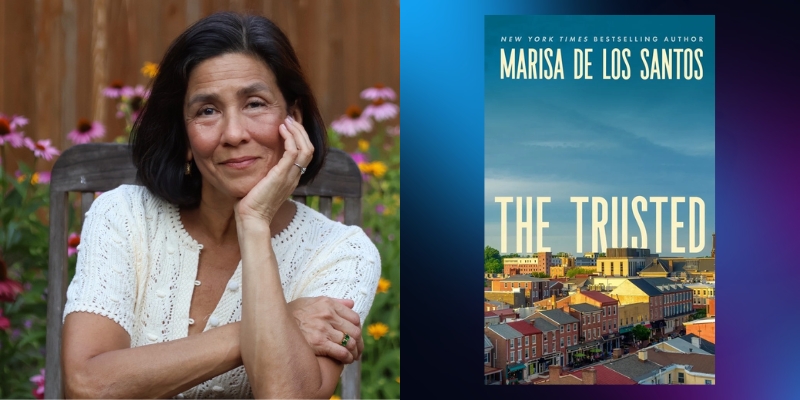
Marisa de los Santos on John Green, detectives, and switching genres as a writer
The author of The Trusted becomes a crime author "slowly and then all at once"
John Green wrote this: “I fell asleep the way you fall in love, slowly and then all at once.”
I treasure this quotation because it applies to so many changes and revelations, and it happens to be a really good description of how I fell into writing crime fiction. After a career built mostly on upmarket fiction or women’s fiction or book club fiction or whatever term is meant to describe books mostly about relationships, mostly by women, I’ve switched genres. Forever? Not sure. For now? Absolutely. Does it feel momentous? Kind of, yes. How did it happen? Slowly and then all at once.
I’ve wanted to write detective fiction for a very long time. Years. As a reader, I devour it. For well over a decade, when someone asked me to list my favorite living writers, Tana French was one of the first names out of my mouth. She still is. In my mind, she’s the gold standard, but there are many other crime writers on the list, writers of the kind of book you read and immediately say, “God, I wish I’d written that.”
Why? When I think about this question, I run into that thing where you try to explain why you love something that feels so natural and second nature to love that you’re at a loss. It must be due in part to the way I’m fascinated by puzzles: word, jigsaw, logic, riddles, any knotty problem that doesn’t have to do with numbers.
I’m drawn to intricately put-together things that also seem seamless. Poetry is like that, which is maybe why I started out as a poet. There’s a mystery at the heart of every good poem, a thing to unlock, language that flings open a window to a fresh view of what it is to be a person in the world. The tangled and cryptic made beautifully or tragically or terrifyingly clear.
So there’s that.
Also, I love crime fiction for the way it can mop its characters into the darkest corners and then force them to find their way out. Characters in detective fiction confront humanity at its most broken, and sometimes that humanity is their own.
I’m especially fascinated by the perspective of the detectives, people whose life’s work is predicated on people hurting other people, whether it’s out of fear, jealousy, personal gain, desperation, or what can only be called evil. Imagine making a pact with the world to stare down what most of us try to avoid, evil and destruction, and to try to hold to account the people who have the audacity to hurt, to murder their fellow human beings.
Detectives pick a side in a way that most of us never have to and they do their best to keep their feet firmly planted on the ground of right and just, even when that ground shakes under them.
So why didn’t I write a crime novel ages ago? There are two reasons.
Firstly, I’ve never had a lot of choice about what I write. I’ve never been a writer with loads of book ideas or one that says, with deliberation, “I want to write X next.” There’s usually a single idea that comes out of the kind of nowhere that’s really everywhere: newspapers, encounters on the street, an overheard conversation, a weirdly blue sky or the way the light hits someone’s face. So many tiny glimmers and slivers that eventually coalesce into an idea.
I write what I’m given to write. I hate how woo-woo that sounds, but oh well. That’s the way it is.
And secondly, I didn’t have a character. Nearly everything I’ve ever written begins with a character, one that lives and develops inside my head, sometimes for years. For me, the story emerges from the characters, not the other way around. And for a long time, I didn’t have a detective character, even though I really, really wanted one.
But to get to the “slowly” part from the John Green quotation, when I look at my books that weren’t mysteries, I see that they were. There’s a mystery at the center of each of them and, in some of them, there’s a character who is actively seeking to solve that mystery.
A boy looking for his biological father. A young woman trying to discover the history of the house she’s inherited. A woman seeking out, however reluctantly, the person who set a fire that threw her world into heartbreak. Two sisters trying to uncover lost years of their mother’s life before it’s too late.
Detectives who aren’t detectives. Mysteries that aren’t murders. Clues to follow. Red herrings. Scraps and shards and dark corners and someone taking the measure of human cruelty or courage or grief or love and picking a side.
Which brings us to the “all at once” part: Lina Cordova. My detective. Well, one of two. Aaron Cash would show up a little later (God, I love that guy). But Lina came first. She arrived suddenly and then lived inside my head until she became a full-fledged person to me. Where did she come from? Beats me. Why then and not before? No idea. But I was super happy to see her.
Lina is half-Filipina, half-white, like me. She has a Filipino doctor father, like me. She is fiercely in love with her people, her dogs, her home. So am I. But she’s not me. She’s way taller, for one thing. And worlds braver. I learned her like you learn a language, slowly then all at once. Before I could write her story, I had to become Lina-fluent. So that’s what I did. It was awesome.
Who is Lina Cordova?
She had the same best friend, Helly, from childhood, through elementary, middle, high school, through college and Lina’s law school years, and into adulthood. Then, someone murdered Helly and that person was never held to account and Lina’s heart and her whole being cracked.
For a long time, she lost herself. So, as so many of us do, she took her shattered self and her family home, to the small city of Sheppley, Pennsylvania, where she found herself again, and she became a cop. One whose ace in the hole is her dead best friend, the voice inside her head that pushes her, sometimes relentlessly, toward the truth. Lina talks to Helly and Helly talks back and of course it’s not really Helly, but, for Lina, it is.
Lina is a mother. She has a teenage daughter and a son on the autism spectrum. She has an ex-husband named Joe, who is still her safe harbor in every storm. She has a dead mother she adores and a father with whom she and her kids live and who is grumpy and bossy and as solid as a lighthouse on a rock. She is drawn to pretty clothes and excellent coffee. She comes home each day to an old stone house, warm yellow light, kids doing homework, two Yorkies, the smell of her dad’s cooking, and peace.
I like an edgy, brooding, jaded, teetering-on-the edge-of-some-personal-chasm-or-other detective as much as the next person, but that’s not Lina. (It’s not Aaron, either, despite his past, the sort people are lucky to get out of alive).
Lina has her frailties: at one point, she calls herself a “soft-boiled detective” and she’s right. No emotional armor, no cynicism. She can’t help but think of even the worst criminals as not monsters but human, a fact that can make her job extremely hard and that also functions as her superpower. She’s the kind of person who watches a pregnant fox cross a road in front of her and feels so protective of it she could weep. She’s funny and piercingly smart. She is haunted, hunted like a fox by hounds, by the cases she left unsolved.
All at once, I had Lina. And then, I had Aaron. And then, from these two people, all at once, I had The Trusted. Because in that way the world of crime fiction is like the world of any other fiction, at least for me, a place where the story emerges from the characters, spins itself into being out of who they are: their personal histories, all their little quirks and preferences and weirdness, their friendships, all their passions, the books they read, the food they eat, everything that scares or sustains them.
Thanks for showing up, Lina. You, too, Aaron. Thank you to all my earlier books and the characters who allowed them to happen. It turns out, at long last, slowly then all at once, I got to be a crime writer after all.
***

Marisa de los Santos
Marisa de los Santos is the New York Times bestselling author of Love Walked In, Belong to Me, The Trusted, and Falling Together. She has also published a poetry collection called From the Bones Out.