

How Harry Kurnitz Conquered Hollywood, Broadway, and the Biblio-Mystery
The life and times of a pioneering writer.
The multi-talented Harry Kurnitz (1908-1968), who wrote several mysteries under the pen name Marco Page, packed a lot of life experience into his sixty years—newspaperman, novelist, Hollywood screenwriter, Broadway playwright, art collector, raconteur, cosmopolite. While doing research for this introduction, I was reminded of what the legendary polymath Isaac Asimov once told me when I asked about his own prodigious output in a wide variety of literary projects. “Nothing is wasted,” he replied simply, and tapped his prominent forehead. For Kurnitz, a graduate of the University of Pennsylvania who honed his reportorial skills as a book and music critic for the Philadelphia Record in the 1930s, everything was in play and grist for his creative mill.
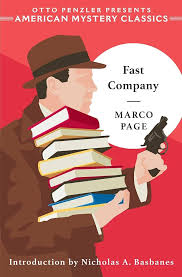
Writing as Marco Page, Kurnitz set his first novel, Fast Company, among New York’s rare book community during the Great Depression, a hardscrabble world filled with characters forced to improvise “when the bottom fell out of the market,” as my tattered eleventh Pocket Book printing from November 1945 describes the situation beneath a banner panel that teases “Rare Books and Raw Murder Mix.”
Published originally in hardcover in 1938 by Dodd, Mead, the novel was a pioneering work that prefigured an international tradition of biblio-mysteries by such stalwarts that include John Dunning (Booked to Die, 1992), A.S. Byatt (Possession: A Romance, 1990), Arturo Pérez-Reverte (The Club Dumas, 1993), Bradford Morrow (The Forgers, 2014), and the Italian semiotician Umberto Eco, whose tour-de-force of medieval biblio-chicanery, The Name of the Rose, has sold more than 50 million copies worldwide since its release in 1980.
When Kurnitz began writing Fast Company in 1937, eight years had elapsed since the electrifying sale of the library of the famed Broadway composer Jerome Kern, an auction of 1,486 high spots of English and American literature that grossed more than $1.7 million at Anderson Galleries in New York in January 1929, with a per-lot average of $1,165 that remained an auction record for more than fifty years. It was a sensational sale by every metric and proved prescient on Kern’s part eight months later when the stock market collapsed and the value of rare books came tumbling down with it.
Just how dramatically values had tanked would be made tauntingly clear at the very time Kurnitz was writing Fast Company, with the sale of two prize acquisitions from the Kern collection to Lord Victor Rothschild in England. Financier Owen D. Young had paid $29,000 each for a six-volume first edition of Henry Fielding’s Tom Jones and an autograph manuscript of Alexander Pope’s Essay on Man—$58,000 total for two of the sale’s crown jewels. In 1937, Young, acting through the agency of the prominent Manhattan dealer Gabriel Wells, who had acquired the items on his behalf at the sale, sold both to Rothschild for a combined £3,500 (roughly $17,500), a calamitous loss of more than 70 percent.
As an ironic postscript, Rothschild would sue Wells and Young several years later, alleging that the Tom Jones contained skillfully inserted facsimile leaves and a restored binding—it was not, he asserted, the “rare uncut condition” and “sound original binding” the Kern catalogue had described, and therefore not worth the paltry sum he had already paid.
This was precisely the kind of sophisticated manipulation Kurnitz had depicted in Fast Company, and one of several possible reasons the principal victim of the plot, a much-despised high-end bookseller with shaky ethics named Abe Selig, is found bludgeoned to death in his office, the deed carried out with a marble bust of Dante from a nearby shelf.
Though the Kern sale is never explicitly mentioned in Fast Company, Kurnitz describes several “very large auctions in which most dealers, hoisted by their own enthusiasm, seriously overextended themselves, and in which a few million dollars’ worth of literary gems were unloaded at peak prices.”
When the market for “all boom-time luxuries” declined, he continues, the demand for first editions, presentation copies, manuscripts, letters and association copies “dwindled until it finally was invisible to the naked eye.” Dealers with the means to ride out the storm sat on their choicest inventory. “To keep the wolves from their inactive doors.” Others—most notably Joel Glass, who is at the center of the novel—“resorted to a variety of sidelines, including stamps, prints and etchings, with one dealer going so far south of the book business as to eke out a living as a notary public and process server.”
In the instance of Glass, a productive moonlighting gig comes in the form of amateur sleuthing in search of missing objects of value, the incentive for that having come “by pure chance” when he recovered a portfolio of Rembrandt etchings that had “vanished from a Newark Art Gallery,” earning for himself a $2,000 finder’s fee from a “grateful insurance company.” By combining an exacting eye for detail with a deep knowledge of precisely what he’s looking for, Glass is able to pay the rent for his fancy East Side office and maintain visibility in the antiquarian trade while navigating the realities of a severely stressed market.
Glass is ably assisted in this enterprise by his striking wife Garda, gorgeous, bright, and every bit his match in detection and repartee. The chemistry between them crackles beneath the constraints of 1930s publishing—a tacit, smoldering energy that infuses the novel alongside the banter, the whiskey, and clouds of cigarette smoke.
Garda is much more than a witty sidekick; she keeps Joel from overextending himself and maintains an even keel. Together, they form a partnership that is truly symbiotic. “You’re wonderful,” he tells her after an especially self-assured exchange of words in their apartment. “Come on, before you read my mind and then we’ll never get to dinner.”
Glass and Garda move in a world populated by “girls,” as they were known back then—attractive, often alluring women like the captivating Julia Thorne, Abe Selig’s secretary, whose presence generates enough ambiguous tension to keep readers wondering exactly where her interests and passions might lead.
When we first meet the odious Selig, it is in a verbal confrontation with Joel Glass and it is clear from the outset what people think of him and his underhanded tactics. “This afternoon I made up my mind that I would drive you out of New York and I’m going to do it,” Glass tells him. “You started out as a smut peddler in this business, Abe, and you should have stuck to it because you’ve got the soul of a smut-peddler. You’re a fat, rich louse.” When Glass learns later that night from a police detective that Selig has been murdered, he muses aloud that the unknown perpetrator should be awarded a Nobel Peace Prize.
Kurnitz is careful to stress in the novel that the “overwhelming majority” of booksellers “will buy nothing of real value unless satisfied as to the antecedence and character of the person offering it, but as in finance, medicine and every other profession, there is a scurvy, knavish fringe of the rare book trade, a little group of sharpers to whom a stolen book represents a real bargain to be bought cheap. With artful alteration such a volume may be passed out to an unsuspecting collector at a price which while it is less than par, nevertheless enables thief and dealer to profit handsomely.”
That, in a nutshell, sums up the clandestine activity of Abe Selig, and the type of dangerous and unscrupulous people he has surrounded himself with. As a consequence, there is no shortage of suspects.
Among those with motive is Ned Morgan, a former employee of Selig recently released from a two-year prison term for allegedly stealing a trove of valuable books—potentially worth several hundred thousand dollars—from his boss’s inventory. He admits going to Selig’s office that night intent on vengeance but insists he found him already dead. Glass is convinced that the most valuable books were never stolen at all, since they were never recovered, and that Morgan, despite his intentions, is innocent of the murder.
With the prospect of a substantial recovery fee from the insurance company and a chance to clear Morgan’s name, Glass launches his own investigation. What he doesn’t anticipate is how perilous that quest will prove to be.
Encouraged by the runaway success of a series of films based on Dashiell Hammett’s 1934 novel The Thin Man that featured an urbane husband-wife team of amateur detectives, Metro-Goldwyn-Mayer moved quickly to acquire Fast Company. Shortly after the novel’s publication in February 1938, the studio brought Kurnitz to Hollywood to draft the screenplay, launching what MGM hoped would become a companion franchise.
Though the studio tinkered with different lead actors across three films released in quick succession— Fast Company in July 1938, followed by Fast and Loose and Fast and Furious, both in 1939—the series featuring Joel and Garda never achieved the cultural staying power of William Powell and Myrna Loy as Nick and Nora Charles in the Thin Man treatments. The irony is that Kurnitz had so thoroughly mastered the witty married-detectives dynamic that MGM eventually assigned him to write two actual Thin Man films, Shadow of the Thin Man (1941) and The Thin Man Goes Home (1945).
For Kurnitz, Hollywood remained his base of operations for the next fifteen years, during which he wrote more than forty screenplays. His credits ranged from Adventures of Don Juan for Errol Flynn to The Inspector General for Danny Kaye, demonstrating the versatility that had served him well as a Philadelphia journalist. He earned an Academy Award nomination for Best Screenplay for What Next, Corporal Hargrove? (1945). Among his most prestigious later assignments was co-writing the screenplay for Billy Wilder’s Witness for the Prosecution (1957), based on Agatha Christie’s courtroom thriller.
Wilder was known for his method of tinkering incessantly with scripts during production, but on Kurnitz’s insistence, they finished the screenplay before shooting began. According to a colleague, “Billy almost went nuts” having to cope with the break in his favored routine, but the film went on to earn six Academy Award nominations, including Best Picture and Best Director.
Kurnitz also collaborated with William Faulkner on Land of the Pharaohs (1955)—though, as was often the case with the Nobel Prize-winning novelist’s forays into screenwriting, Kurnitz’s professional expertise proved essential to making Faulkner’s literary vision filmable.
During these years, fortified now with the means to do so, Kurnitz became a serious art collector, acquiring works by Picasso, Matisse, Rouault, and Derain, a hobby that would serve him well when he returned east to write for the stage.
“I’m a gambler,” he would tell an interviewer as the opening of one of plays approached. “There isn’t a bigger gamble in the world than the theater. There’s no such thing anymore as an in-between play. It’s either a smash hit or a crashing failure.”
His first play, Reclining Figure, had premiered at the Lyceum Theatre in 1954. It was a comedy that explored the same world of dealers, collectors, and chicanery that had animated Fast Company, only now set in the art world rather than rare books—and the anxiety surrounding that opening was just as intense.
Kurnitz told Gilbert Millstein of the New York Times that he was terrified on opening night for that play, so anxious about the response from a live audience and a corps of critics that he took a date to dinner at 21 instead of attending the premier. “Had one drink, ate one scallop and smoked one pack of cigarettes. It was like waiting for them to come in, shave your head and slit your pants. I mean, the electric chair.”
Deemed a success, the play ran for 116 performances and launched his Broadway career, which would include the hit comedy Once More, With Feeling (1958) and the musical The Girl Who Came to Supper (1963), written in collaboration with Noël Coward, earning for Kurnitz a Tony nomination for Best Author (Musical).
When the Opening Night vigil for that first play was finally over, Kurnitz told Millstein that he celebrated by drinking “everything in sight,” and “wound up playing gypsy violin solos in the Little Club at four o’clock in the morning.”
Celebrated as a stream-of-consciousness conversationalist, he elaborated on his choice of music for that stressful evening: “Sober, I think gypsy violin is the vilest manifestation of the creative instinct. Drunk, I beat my way toward it like a salmon going upstream to die. I play Hungarian, Rumanian and Russian gypsy music. Gypsy fiddle is best played drunk because then it doesn’t matter whether you play in time, in tune or whatnot. In Hollywood, your wife doesn’t even know your picture’s opening. Out there, you go to a preview in a big car with a mob. If the picture’s good, everybody knows you. If it’s a stinker, you come back alone and the chauffeur tries to slam the door on your hand.”
Harry Kurnitz certainly had a facility with words and a lively way of expressing them. Divorced in the 1940s, he never remarried and had no children. Constantly on the move, he led a nomadic existence, staying in luxury suites everywhere he went. A three-pack-a-day smoker and in declining health, he was reported to have been working on a detective story for Random House at the time of his death in 1968 after suffering a heart attack in his room at the Beverly Wilshire Hotel.
In a memorial tribute published in the The Observer, the English theater critic Kenneth Tynan wrote that “Kurnitz bought good paintings and listened to good concerts wherever his planes touched down. He was a civilized man with a plentitude of wit and charity. ‘What did Harry think?’ we used to ask, always knowing that there was only one Harry whose opinion counted in the higher reaches of show business. There won’t come such another.”
*

Nicholas A. Basbanes
Nicholas A. Basbanes is the author of nine works of cultural history, with a particular emphasis on various aspects of books, book history, and book culture. In addition to his books, Basbanes has written for numerous newspapers, magazines, and journals, including The New York Times, Los Angeles Times, and Washington Post, and lectures widely on a variety of cultural subjects. Among his most well-known titles are A Gentle Madness: Bibliophiles, Bibliomanes, and the Eternal Passion for Books and On Paper: The Everything of Its Two Thousand Year History.