How the Directors of 'Chronovisor' Created a Modern Borgesian Mystery for the Big Screen
Kevin Walker and Jack Auen, in conversation with Radha Vatsal.
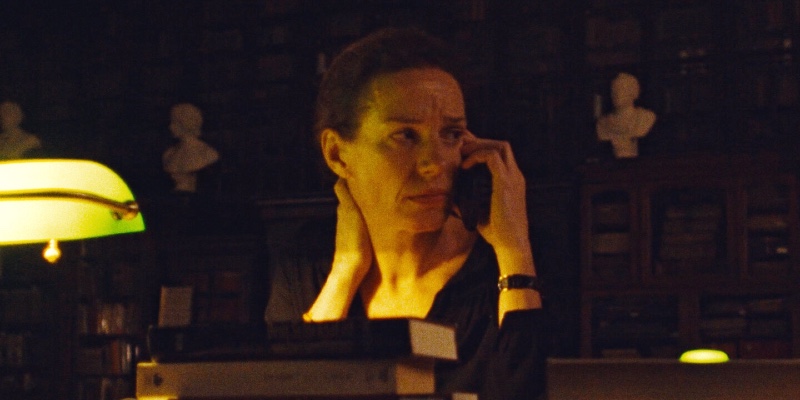
Chronovisor, Kevin Walker and Jack Auen’s debut feature, is an immersive, intellectual mystery in the style of Jorge Luis Borges and Umberto Eco. Taking place mostly in libraries and showcasing the esoteric knowledge they guard, it follows academic Béatrice Courte (played by real-life professor Anne-Laure Sellier) as she delves into research on the “Chronovisor”—a mysterious device invented by the Benedictine monk Father Pellegrino Ernetti that senses and records events from the past.
Drawing on actual primary sources and focused on the written word, the film pulls you into its shadowy world of analog sources where turning pages in the pursuit of knowledge feels as action packed as a thriller.
Chronovisor is both formally inventive and enjoyable to watch. It played at New Directors/New Films 2026 and was written, directed and edited by Walker and Auen. This interview was conducted over email.
Radha Vatsal: One of the first things that struck me is the music by the 19th-century composer Gustav Holst, whose work inspired contemporary film composers like John Williams (Star Wars) and Hans Zimmer (Gladiator). Chronovisor isn’t an action film but the soundtrack made me feel like I’m watching one. Can you talk about how/why you decided to score it entirely with Holst?
Kevin Walker and Jack Auen: From the outset we knew that we were looking for the kind of orchestral score that doesn’t really exist in contemporary American cinema anymore. Something grand and sweeping, more common in the 1990’s and 2000’s, and in films that typically have a much more epic scale than Chronovisor. We wanted the music to convey a sense both of grandeur and hermeticism. The film is quite intimate in some respects, and mostly devoid of dialogue, so the music was essential for effectively communicating certain interior experiences we wanted to capture. It was during Kevin’s searching through orchestral suites in the public domain that he discovered [Holst’s] “The Planets”. From the first moment we listened to Saturn and Venus we knew that our criteria had been met.
RV: The film makes very effective use of the written word. In fact, a large part is text on the screen. That could have been passive but in this case makes me feel like I’m going down the rabbit hole with Béatrice. Was the choice to use so much text and real documents as well as archival clips something you made at the outset? And how did you decide on the way you would visually present text on the screen?
KW & JA: We’re grateful that the experience of reading so much text felt engaging to you! We’re aware that that might not be the case for everyone, or even for most viewers, which is totally understandable. When Kevin first stumbled across the conspiracy theory around the Chronovisor and shared it with me, the idea of making a fictional narrative film was not immediate. At first, we were much like Béatrice and devoured all the available archival materials we could find, merely as fascinated observers. It wasn’t until a few weeks later, and upon reflection about the rabbit hole that we had just gone down ourselves, that we thought there might be potential for a narrative treatment of that process. But once that decision had been made, the prominence of text came very quickly afterwards.
The manner in which that text appears on screen was discovered both by necessity and as a byproduct of certain thematic ambitions. The superimposed translations were a result of a dissatisfaction with our attempt to use traditional subtitles for the research scenes.
As for the moments where individual words are isolated on the page, that came from an undergraduate psychology course Jack took, where the professor demonstrated that exact effect as a speed-reading technique.
RV: Speaking of Béatrice, you cast a real academic (Anne-Laure Sellier) in the role because, as you’ve said, you needed someone who could speak several languages and sound plausible delivering complicated monologues with technical vocabulary. Of all the professors in the world, how did you pick her? Had you seen her act? What was it like to direct a non-professional?
KW & JA: We had never seen Anne-Laure act and never made her read for the part. We initially sent a number of rather insane-sounding emails to various professors that Jack had access to from my NYU email (he was a graduate student at Stern and Tisch at the time). We had seen a TED talk online that Anne-Laure had given and were immediately struck by her face, her accent, her manner of speaking, and her general disposition. We ended taking a huge leap of faith on her, and we’re infinitely grateful for her dedication to the role and just blown away by the performance she delivered!
RV: How did you become interested in the Chronovisor as a device and decide to make a film about it? Or did you start with the idea of wanting to tell a Borgesian type of tale and then find the Chronovisor made a perfect vehicle for that?
KW & JA: Kevin first encountered the conspiracy about the device in “Angels, Archons, and Aliens: An Assessment of the Theological and Psychological Implications of Ufology” by Ambrose Andreano. After we had consumed as much of the available information about the conspiracy as we could find (which took several months) its fitness for cinematic interpretation was immediately apparent. Kevin also cut together a short version of what is now the film’s ending, as a standalone project. While we were really interested in the result, it didn’t fully scratch the itch. From that point, sculpting a feature narrative around the device was, though difficult, a very organic process.
RV: After Christopher Nolan’s Odyssey filmgoers seem more aware of different film formats. Can you talk a bit about the difference between various formats and why you shot the film in 16mm?
KW & JA: Given the volume of analog material shown on screen and the need to ground Ernetti’s potentially incredible claims in possible reality, one of our first aesthetic decisions was to shoot on 16mm film. No format, in our view, better captures the richness of analog textures, nor reproduces them with such tangible fidelity. This sense of reality was crucial for Chronovisor, both to give Béatrice’s claustrophobic story the physicality it required to feel vivid and urgent, and to present Ernetti’s legacy as a subject of legitimate intrigue grounded in a reality more fact than fiction. 16mm was the only financially feasible alternative outside of 8mm film and video, which were lower resolution than was required for typographical fidelity.
RV: You’ve said that Jorge Luis Borges and Umberto Eco were your inspirations for the story. Do you have any filmic inspirations for the look and feel you were going for?
KW & JA: Classical Period by Ted Fendt was an inspiration for its naturalistic approach to lighting, 16mm cinematography, and use of scholarly characters in an academic setting. The Hogwarts library in Harry Potters 1 and 2 was the platonic library in our mind for location scouting and set design. David Gatten’s The Great Art of Knowing was an essential case study for the potential of text-driven cinema. But really it was Leo Zhang, our cinematographer, who brought an expert eye and a mastery of the analog to the production that accomplished textural and aesthetic feats far beyond what we could have conceived and executed ourselves.

Radha Vatsal
Radha Vatsal is the Film/TV Columnist for CrimeReads. She is the author of No. 10 Doyers Street and the Kitty Weeks mysteries, and her essays have appeared in the The New York Times, The Atlantic, the Los Angeles Review of Books, and elsewhere. She holds a Ph.D. in Film History from Duke University. You can find her on Instagram or email: rvatsal@lithub.com