

How the Rise of Mystery Podcasts Created the True Crime Memoir Boom
James Renner explores the phenomenon of true crime authors writing themselves into their stories
A couple years before Amy Bradley vanished on a family cruise in 1998, she dated a woman named Kat. They fell in love at Longwood University in central Virginia, at time when it was still dangerous to be open and gay, especially in the south. They would often drive down to the Outer Banks and stay at a rented house where they could live as their true selves for a time without being fearful of what their family or friends might think if they caught them holding hands.
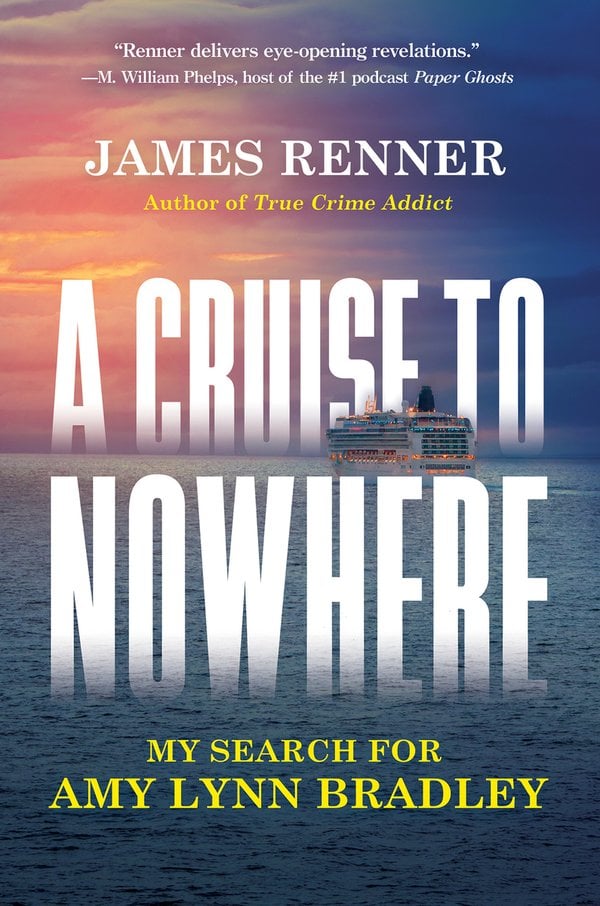
Kat knew Amy better than just about anyone back then. And so, when I finished my latest true crime book, A Cruise to Nowhere: My Search for Amy Lynn Bradley, I sent her an early version of the manuscript to review.
“Is this book about you or Amy?” she wrote back.
This is a common critique of my true crime books. I’ve written five now, and each of them is a blend of memoir and traditional reporting. The chapters alternate between new information I’ve uncovered about unsolved mysteries like the disappearance of Maura Murry and stories about my life. I don’t only lay out the facts of the case. I try to bring you, the reader, along for an adventure, hunting for clues alongside me. I want you to see how my work on these cases impacts my home life. I want to share my mistakes with you.
More importantly, I want you to know my biases going in. In my Mass Communications seminar at Kent State, the professor told us that a good journalist should remain unbiased. I didn’t know much at twenty-one, but I knew that was performative bullshit. Every true crime writer has an angle. Every true crime writer is an unreliable narrator at best. I think, by sharing my shortcomings, you can better see the biases I bring with me.
I’m not the only true crime author who mixes memoir with investigation. In fact, it’s a growing trend that may say something about our changing tastes and the way we consume true crime these days. It also reflects the first big shift in true crime narrative since the publication of Truman Capote’s In Cold Blood in 1965.
Before Capote’s “true crime novel” about the murder of the Clutter family by two psychopath drifters, crime stories followed the principals of newspaper journalism—cold, detached reporting of simple facts. Capote, a novelist and playwright, wished to write a book about a crime that contained all the literary flair of a great American novel. He set the scene, he treated the criminals with sympathy to get at their true character, he included dialogue and thematic arcs.
The newness of In Cold Blood was so admired, it helped to usher in a new way of writing known as New Journalism, a way of reporting that borrowed the structure and atmosphere of good fiction, while still being factual. This allowed for counterculture reporters, referred to as gonzo journalists, to become characters in their own books.
New Journalism wasn’t limited to true crime. My favorite writer, Tom Wolfe, came out with The Electric Kool-Aide Acid Test, in 1968, which told the story of Ken Kesey and his merry band of psychedelic hippies as they traveled the country in a school bus. And while he wasn’t present for the journey, Wolfe was so meticulous in his interviews of Kesey’s Merry Pranksters that the reader felt they were there.
In 1971, we got Fear and Loathing in Las Vegas by the king of gonzo journalism, Hunter S. Thompson. This book bends the line between fact and fiction to a breaking point, as Thompson recounts a real trip he took to Las Vegas to cover a news story but adds fictionalized events and dialogue.
Ten years later, journalist Gay Talese came out with Thy Neighbor’s Wife, in which he explored the changing social norms of sexuality in America. But he didn’t just interview people, he participated. He wrote candidly about his stay at a swinger’s resort and his own infidelity, there.
The first books to blend memoir with true crime came from direct sources, first. Probably the most popular of the bunch was the queen of true crime Ann Rule’s 1980 book, The Stranger Beside Me, in which she tells the story of working at a suicide crisis hotline with the serial killer, Ted Bundy. My personal favorite is My Dark Places by James Ellroy, which tells the story of his obsession over his mother’s murder.
There’s also the sub-genre of true crime memoir in which the surviving victim writes of their own experiences. Books like A Stolen Life by Jaycee Dugard or Hope: A Memoir of Survival in Cleveland by Amanda Berry and Gina DeJesus.
Then a shift happened. Not in books at first, but in the new storytelling medium of podcasting. In 2014, we got Serial. This was not the story of Hae Min Lee’s murder. This was the story of Sarah Koenig’s reporting of Hae Min Lee’s murder. Outside the NPR regulars, we didn’t know who Sarah Keonig was. We just knew that some journalist was going on crazy adventures and falling in love with the lead suspect. And it was fascinating.
Serial was definitely on my mind when I wrote True Crime Addict in 2016. Like Keonig, I brought the reader along for the journey. The title has many meanings. At the time, I was not only addicting to true crime, but also alcohol and oxycontin and I wanted to include all that as well. It remains my most popular book.
Perhaps the most successful true crime memoir so far is I’ll be Gone in the Dark by Michelle McNamara, which came out in 2018. But every year sees more. In 2019, we got Billy Jensen’s Chase Darkness with Me. And Jake Anderson’s wonderful, moody mystery, The Vanishing at Smokestack Hollow, in 2024. The best of the bunch might be An Unexplained Death, by Mikita Brottman, which looks at the strange story of Rey Rivera’s death at the Belvedere hotel.
Why is this blend of storytelling genres becoming so popular now?
I think podcasts are to blame again.
Serial didn’t just introduce the true crime memoir- by journalist; it also inspired so many other creators to produce their own true crime podcasts. These podcasts created a new subculture of fans who were hungry for more true crime that included personal anecdotes.
When I look at my sales, it’s pretty obvious. Prior to Serial, roughly eighty percent of consumers purchased by story as a physical book. About twenty percent was audio. Now it’s nearly reversed, with something like seventy-five percent of reviews coming out of Audible downloads for one of my newer true crime books. They are treating my books like long-form podcasts.
This is a new wave of true crime writing, fed not by traditional readers but by podcast fanatics looking for a fix.
And I’m happy to deal.
***

James Renner
James Renner is an investigative journalist, podcaster, and critically acclaimed author of both nonfiction and fiction books, including True Crime Addict and The Man from Primrose Lane. Previously the host of Lake Erie's Coldest Cases on ID Discovery, he currently hosts the podcasts "The Philosophy of Crime" and "True Crime This Week." He is the Founder and Director of The Porchlight Project, a nonprofit that provides genetic genealogy for cold cases in Ohio. He lives in Akron with his wife and children and can be found online at Jamesrenner.com.