It's time to talk about Psych
Olivia Rutigliano on the all-time buddy crime comedy
It’s high time for this website to publish an article about Psych.
But first, I have to explain why it’s taken so long.
In 2019, I learned that I had been chosen for a fellowship at CrimeReads. It was to be a six-month internship with the (relatively new) publication that would last from July to January of the next year. I remember the moment I got the acceptance email—I was walking through Central Park with a friend, eating an ice cream cone from the Emack & Bolio’s on 79th street. That’s not important, really, except to establish that in the moment I got the news, I was already in a good mood. I was already having a good day. Then I got the email. Seven years later, I still remember the surge of joy.
On my first day at CrimeReads, I met my counterpart at our sister website, Literary Hub. We introduced ourselves. Her name was Eleni and I liked her right away—she was warm and friendly. This was back when we went into a physical office (both sites have been fully remote since the pandemic), and it’s funny to recall this detail, after I’ve been so used to working from home for so long. It was a small office in the West Village of Manhattan, one room, with white IKEA desks and a brightly decorated bulletin board covering one wall. The staff was packed in. I’m not even sure how they found extra desks for Eleni and myself, but they did.
Then, Eleni and I were showed our tasks, tried them out. Molly Odintz trained me. And the first week went well. On the first Friday, the day when most of the staff worked remotely, Eleni and I bumped into each other in the kitchen. She offered to share her protein waffle, and somehow that led to us chatting. I told her I was working on an article about the 50th anniversary of Scooby Doo. She said that was one of her favorite shows, and had wanted to write something for CrimeReads about it too—about how it introduced the Gothic to kids. I said she should do it, and we could publish them together, on the same day. And just like that, we were inseparable.
In Psych, crime-solving is not a way for our two protagonists to get to know one another. It’s an excuse for them to hang out.
A week after that, I officially met Katie. She was one of the other young people in the office, the assistant editor at Book Marks, our other sister site. She had a small dog named Ollie who came to work with her and slept in a cushy bed next to her desk. One day, when the two of us were alone in the room at the end of the day (the last ones to leave), she told me a funny anecdote about her life. “I’m just going to tell you because I know we’re going to be friends,” she said.
I don’t know the exact moment Katie and Eleni became friends too, but it happened quickly. Often, the three of us would have lunches together in the kitchen. Soon, we would make other friends—our senior editor Corinne, and Emily, and Kait, and others from the Grove Atlantic offices next door. But in those early days, Eleni and Katie were my first friends at work, and they made it especially wonderful. I remember us ordering in soup from Panera and, on a particularly ambitious day, Beyond Meat burgers from the nearby Bareburger. We’d talk about books and movies and TV. And at some point within this first month, I told them that I had been planning on writing an essay about one of my favorite crime shows: Psych. And that’s the moment I found out that it was one of their favorite shows too.
We decided that we needed to write an essay on Psych together, that we would each produce a reading of the TV series and place them together in a single post, as co-authors. We needed to do research, so we gathered at my apartment on a few weekend days and ordered pizza and watched our favorite episodes.
For months, at lunches and after work, we’d discuss our tripartite essay. Sometimes we went to The Gray Dog in Chelsea where, at the time, all the entrees came with your choice of “fries or a cute salad.” We’d whittle our observations down to thesis statements, then ask the others if they thought we were on track. I don’t remember what we each wanted to discuss, because, for some reason, we never wrote our ideas down.
But work responsibilities and life events kept us from officially ever putting this together. Eventually, we realized that this trio of theses might never actually ever exist. We were all getting busier and busier, and the task proved more and more elusive.
Now, seven years later, I’m married and have a baby. I’ve experienced that wondrous thing, of friends coming to celebrate these milestones with me, of commemorating and toasting with and taking care of me. I’ve been thinking a lot, lately, about what my own friends mean to me.
And so the time has come, I think, to write about Psych, and to do so in the context in which we first decided to write about it: as a text of paramount importance for its sense of friendship.
Psych is the story of two friends. and how they become private detectives. Most crime stories, I suggest, use their central mysteries for some sort of metaphor about the unknowability of human relationships; in many texts, two detectives partner up and learn to have a relationship, slowly working out the riddles of human connection (can we ever really know someone else? can we ever really know ourselves?), while they solve puzzles about the depths and darknesses of human nature.
That’s not Psych. In Psych, crime-solving is not a way for our two protagonists to get to know one another. It’s an excuse for them to hang out.
*
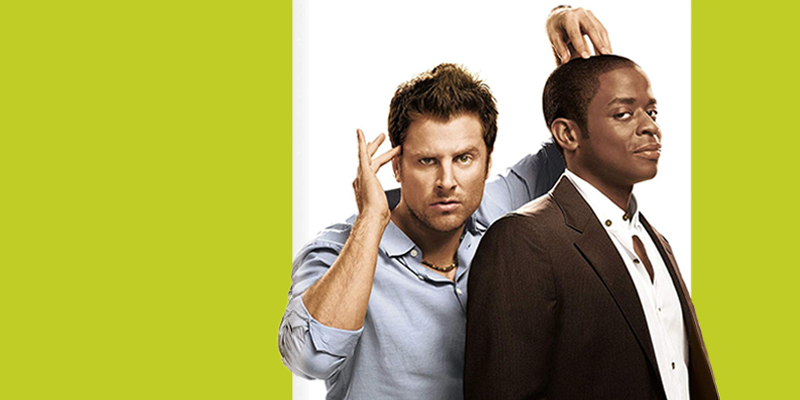
The conceit of Psych is simple and brilliant. James Roday Rodriguez (known simply during the show’s run as “James Roday”) stars in it as Shawn Spencer, a disorganized, immature, and plain silly man-child gifted with an extraordinary eidetic memory. He’s had years of practice honing his observational and analytical skills, thanks to training from his tough father Henry (Corbin Bernsen), a retired detective. So, he’s basically a crime-solving machine. The only problem is… he’s not responsible enough to know exactly how to handle his gift. Thus, one day, Shawn is brought to his local police department for questioning about why he’s been calling in tips to the cops, giving them the answers in murder cases. Is he an accomplice? No. Does he have inside knowledge? No. Rather than tell the truth (which is boring, and involves addressing his father’s impact on his life), he decides to pretend he’s psychic. That’s how come he’s always right.
You know who doesn’t support this plan? Shawn’s lifelong best friend Burton “Gus” Guster (Dulé Hill). He’s responsible, book-smart, uptight, and constantly irritated by Shawn, and he thinks lying to the cops about being psychic is a really bad idea. Of course Gus is right; Gus is always right. But Shawn loves this new fabrication, and doubles down—opening up a private detective agency to bring in clients who will engage their psychic crime-solving services. Gus goes along with it (very irritably), even though he has a full-time job as a pharmaceutical sales rep. Why? Because, ultimately, he loves paling around with Shawn.
The best part of the show, though, is the dynamic between Shawn and Gus.
Henry, Shawn’s dad, is intrigued—not by Shawn’s lie, but by the challenge he has set before himself. Besides, Shawn needs a job. So Henry corroborates Shawn’s “gift” to the cops and… shazam! A new detective duo has hit the streets of Santa Barbara (which, you might be surprised to hear, is apparently a hotbed of crime). They constantly run afoul of the cops, especially the smug, prickly, gun-happy detective Carlton “Lassie” Lassiter (Timothy Omundson), the department’s tough interim chief Karen Vick (Kirsten Nelson), and the department’s newest recruit, the perky detective Juliet O’Hara (Maggie Lawson). But it’s all in good fun. Or at least it is after they catch the murderer, or bank robber, or art thief, or whoever else is at large.
The best part of the show, though, is the dynamic between Shawn and Gus. Theirs is an Odd Couple relationship. Shawn is vain, lackadaisical, and a little bit cocky. He’s allergic to hard work and plays fast and loose when solving crimes—keeping up his facade of clairvoyance through flamboyant performance, sneakiness and subterfuge, and often, dumb luck.
By contrast, Gus is nerdy, levelheaded, dependable, financially stable, professional… everything Shawn is not. Well, almost. They rub off on each other, too. These characters bicker, they feud, they tease, they prank, they finish each other’s sentences, and they love one another like brothers. Roday Rodriguez and Hill have sparkling chemistry; you’d think they were lifelong friends themselves. Much of the dialogue feels spontaneous and ad-libbed. The constant sense is that scene partners are often trying hard not to break out in laughter and ruin another take. The whole thing is pure joy.
*
Psych ran on the USA network for eight seasons, from 2006 to 2014. One hundred and twenty-one episodes. There have since been four TV movies, starring the original cast (one musical, and three regular movies). Today, I don’t know a person who doesn’t love Psych, but when I initially saw it, I knew only one.
I’ve been thinking a lot, lately, about what my own friends mean to me.
The first person to introduce me to the series was my younger sister. She got into the show after I left for college. One summer, when I was back, she showed me what I had been missing. Before CrimeReads and Lit Hub, before I ever published any essay of any kind, Psych belonged to my sister and me. It was our show. At this point, the series was still airing—we had five seasons at our disposal. We watched every episode. We watched them in order. We watched them out of order. We watched them over and over again.
By the time my sister went to college, we knew every joke on every available episode. When it came time to decorate her dorm, I bought her a giant poster (with Shawn and Gus aiming water-guns) from the USA network online store. We’d send each other text messages back and forth with the silly names that Shawn calls Gus when introducing them to clients or suspects, names it seems Roday Rodriguez had made up on the spot. “I’m Shawn Spencer, psychic detective, and this is my partner ‘Trapezius Milkington.'” Or, “Methuselah Honeysuckle,” or “Lemongrass Gogulope,” or “Squirts MacIntosh,” 0r “Chocolate Einstein,” or “MC ClapYoHandz,” or “Clementine Woolysocks,” or “Pinky Guscatero,” or “Santonio Holmes,” or “Jazz Hands.” You get the idea. “Shutterfly Simmons.” I’ll stop. The point is, the inside jokes between Shawn and Gus became our inside jokes, too.
The way it works when you’re an older sibling is that you wind up influencing what the younger ones consume—even if you don’t deliberately foist upon them the things that you’re consuming. They’re observing you, learning from you, and in many cases, looking up to you. I can’t tell you how many things my sister grew up loving things simply because I loved them too. It was my greatest delight to share them with her.
But Psych is the first time in our relationship that she got to introduce me to a text that would become foundational in my life. It’s extra important to both of us for this reason. I had always adored and admired my younger sister, and I was so excited to partake in something with her that had been her enjoyment first. I’m glad she watched it on her own. I’m glad she showed it to me.
*
Psych was developed by the screenwriter Steve Franks in the early 2000s, during what Franks calls the “the early days of the depressing murder mutilated body procedural.” He told Maggie Lawson and Timothy Omundson on their Psych podcsat, The Psychologists are In, “this will be the antidote” to that… it would resemble “the shows I loved when I was growing up.” He cited Moonlighting, with its quippy, zinger-slinging script and its goofy, magnetic sillyness of Bruce Willis’s David Addison.
The show was developed as the story of a fake psychic detective. But it didn’t find its core zaniness until Franks met James Roday Rodriguez (referred to in this section as “Roday,” as it was his sole surname at the time). In the same podcast episode, Omundson talks about auditioning with Roday, who was improvising. Omundson’s character, Lassiter, is Shawn’s main antagonist at the Santa Barbara police department, and frequently becomes annoyed with Shawn’s hyperactive antics. “James really gave me an incredible gift in that in that audition,” Omundson said. “Because I… just wanted to kill him.”
Roday said, of one of his auditions, “I went in there so loose and and so like footloose and fancy free. I remember I did some silly… improv that lasted 40 seconds before I even started the first line because I was just… swinging it.”
He nailed it, the charismatic, bouncing-off-the-walls verve they were looking for. He was the first choice. Well, sort of… the studio offered the part to Matthew Perry first. Steve Franks was convinced Perry would pass. He wanted Perry to pass. Roday reflected, “So there was like a 72 hour period wherein Steve was just, you know, checking in with me every day saying ‘he’s not going to do it. He’s not going to do it. He’s not going to.’ And I was like, ‘OK, I appreciate this. I love you for it. But I have to tell you, you should kind of want Matthew Perry to do your show.’”
But Perry passed and Roday got the part. Then it was time to cast Gus. Roday said,
“It was it was all set up for him to come in and win the day. Charlie from from West Wing. Emmy nominated Dulé Hill. Not what Steve had written for the role of Gus, but an exciting option that nobody had really considered or thought of. And again, to Steve’s credit, the second that it was pitched and became a possibility, he just jumped right on it. I think in his mind, he had always been thinking like Ferris Bueller and Cameron. It’s Ferris and Cameron. And then here comes Dulé, not Cameron, in any way, shape or form. But he saw the possibilities. He saw something beyond what he had created. And instead of like holding on to this thing, like this baby and saying, no, no, no, he immediately was like, ‘yes, absolutely.’”
Dulé Hill said, of auditioning with Roday, “I come from the world of Aaron Sorkin, where you say the words that are on the page. But when you were working with James Roday on Psych, that is not the case. That is actually the opposite. And this cat was all over the place. I’m like, what in the world is happening right now? But I kind of just stayed in it. And next thing I know, I was working with all of you all.”
But Hill had reservations about the character, who was written not as Shawn’s straight man, but as his even goofier best friend. “I didn’t want him to be the bumbling fool, the bumbling sidekick, you know what I mean? Always messing up, always doing something stupid or whatever.”
But then he had an idea. He told Omundson and Lawson, “I said, ‘this character would be fun to play if he thought he was the coolest man on earth. He clearly is not, but if he thought that everything he did was like, ‘I’m Billy Dee Williams, I’m Denzel Washington, I’m so smooth.’
But everything he did was the opposite of that.’ That could be fun to play.”
They built the dynamic from there, built the show around the dynamic. It wasn’t long before it became clear that the point of the show was the actors, not the mystery plots. “Our iconic episodes,” Hill explains, “are the ones where we go nuts.”
*
“What do you love about Psych?” I asked my sister, while thinking about the frame of this article. “Send me a quote.”
“Psych is pure ridiculousness, wrapped in a murder mystery,” she wrote back. “Low on gore but chock-full of creativity, it makes for an easy and rewarding watch every time—from Gus’ constantly changing silly pseudonyms to Shawn’s slapstick, fake-psychic divining. Psych is reminiscent of an old-school low-stakes murder mystery like Murder She Wrote or Columbo, it doesn’t force too much plot at the expense of fun. Psych is 100% fun”
I asked Eleni the same question.
She said: “I love the zany humor of Psych, the chemistry of the cast, and its ability to adapt tropes of the mystery and thriller genres (e.g, Hitchcock, Twin Peaks, Clue) to its own unique sense of humor and aesthetic. Even after the initial thrill of watching it for the first time has passed, in rewatching it, I especially delight in the quick-witted dialogue and myriad artistic and pop culture references. I always discover something new in it—whether it’s a joke or a movie I haven’t seen. To me, this deep appreciation for language and other artworks add rich dimension to the show, making it feel as if its internal universe is always expanding.”
And Katie.
Katie said: “Psych is a show about noticing! It’s about what you can do when you pay attention—whether that’s solving a murder or continuing a funny bit with your friends. It’s such a love letter to friendship. And there’s so much play in it, too. The leads have so much chemistry, and you can tell they’re having fun, and the whole show is this brilliant homage to genre and how we can play within that.”
That’s the thing about Psych. The whole thing is a playground. The hallmarks of the mystery genre are the jungle gym and the slide and the monkey bars: tools to have fun with, to play upon, as means to spend time with friends.
To answer my own question, I love Psych because it’s playtime. And playtime is even better with friends.

Olivia Rutigliano
Olivia Rutigliano is an Editor at Lit Hub and CrimeReads. Her other work appears in Vanity Fair, Vulture, Lapham's Quarterly, AirMail, the Los Angeles Review of Books, Public Books, The Baffler, Bright Wall/Dark Room, Politics/Letters, The Toast, Truly Adventurous, and elsewhere. She has a PhD from the departments of English/comparative literature and theatre at Columbia University, where she was the Marion E. Ponsford fellow. She hosts the podcasst "Culture Schlock" at Lit Hub Radio. She is on instagram at @oldebean, twitter at @oldrutigliano, and bluesky at @oliviarutigliano.bsky.social.