
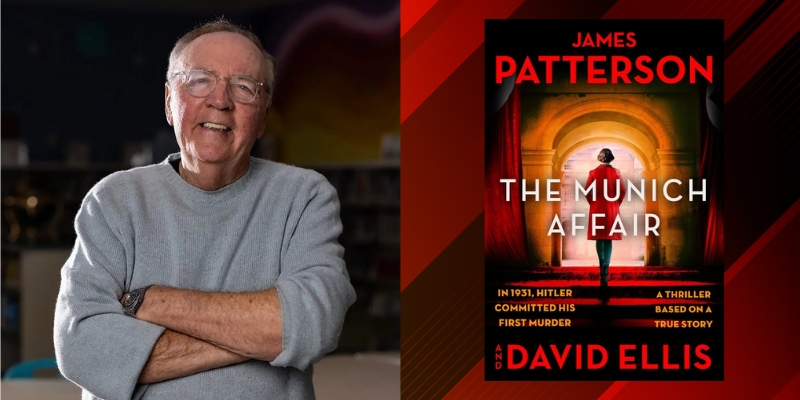
James Patterson on dictators, historical fiction, and writing a world war II thriller
John B. Valeri profiles the author of The Munich Affair
James Patterson may be one of the world’s most prolific and bestselling authors but there is no secret to his success. It comes down to curiosity and the asking of a simple question that has sustained writers since the beginning of time: What if?
For example: What if, before his rise to absolute power, Adolf Hitler killed his half-niece/mistress Geli Raubal in retaliation for her defiance? And what if he next used his influence over the police and press to have her death declared a suicide? And what if he then waged a campaign of terror against those individuals and institutions who wouldn’t fall in line with that story?
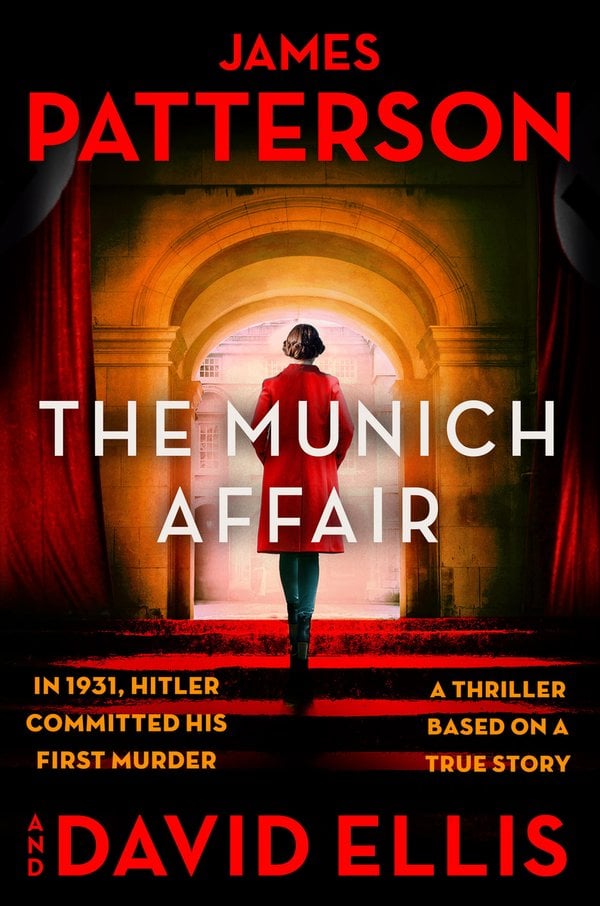
Such speculation served as the impetus for The Munich Affair (Little, Brown and Company; September 21, 2026), a historical thriller based on a true story co-written with frequent collaborator (and “a really wonderful guy”) David Ellis.
“I loved the whole idea. It’s been controversial for a long time,” Patterson says. “I like…taking a real story and then fictionalizing it….We don’t know for sure whether Hitler actually did kill [Geli Raubal].”
The debate is not a new one. Though largely swept under the rug in 1931, a few intrepid reporters—including German activist and journalist Fritz Gerlich—refused to kowtow to political pressure, risking grievous personal and professional reprisals in their search for truth.
“A lot of newspapers chased the story,” Patterson says. “One of them, Fritz Gerlich, wouldn’t give it up…and the reality is that Hitler put Gerlich into Dachau.”
In The Munich Affair, Gerlich—later shot dead at Dachau, the first and longest running Nazi concentration camp in 1934—teams up with (fictional) Detective Thomas Bauer and resistance figure Erich von der Haas in a series of covert operations designed to bring down Hitler’s regime.
Given today’s cultural climate, it’s a markedly timely and topical story for an author who prefers to keep his prose free of politics.
“I don’t talk much about politics,” Patterson says. “But we certainly have a world now, and probably for some time, where we have…dictatorial leaders in several countries.”
And while the authors’ intent wasn’t necessarily to inspire readers to make comparisons between current world leaders and Hitler, perhaps that outcome was inevitable.
“When you read it, you will,” Patterson says. “And I didn’t try to do this, per se…but you do feel some of the things and you go, Hmmm, it sounds like some of the things that are going on now.”
Patterson likens the atmosphere during Hitler’s rise to power and authoritarian rule—in which he was able to declare himself Führer (merging the roles of chancellor and president into one) by manipulating the democratic system and suspending civil liberties—to modern-day aggression, whether North Korea’s totalitarian dictatorship or national operations such as ICE, whose extreme tactics undermine a legitimate issue.
“So, I think [the book] is kind of timely,” he says. “We can think about it and wonder, if to some extent, people blame the Germans for not rising up somehow and overcoming the Nazis…and somehow allowing, or turning a blind eye to, what happened in Germany….”
Which begs the question of whether future generations might reflect on current days with similar retrospect.
“Maybe at some point people will look at this country and ask, ‘Why didn’t we stand up a little bit more and deal with some of the things that are going on now?'” the author says.
Regardless, Patterson maintains that his primary responsibility is to entertain; any education or enlightenment that results is a plus, not the priority.
“You lay out a story, you lay out some information, and you let [the readers] figure it out,” he says. “I’m not a fan of editorializing. I try not to do too much of that.”
Though a departure, the book’s historical context is not unprecedented in Patterson’s wide-ranging oeuvre (which has sold an estimated four hundred and twenty-five million copies worldwide).
It’s something he first experimented with in 2003’s The Jester (co-written with Andrew Gross), in which an innkeeper-turned-pilgrim becomes disillusioned during Europe’s First Crusade and deserts the cause only to devastating consequences.
Like The Jester, The Munich Affair opens with a modern-day prologue, though the book extends this framework to include a secondary storyline in which a contemporary scholar—Eleanor Robbins, a history professor at the University of Chicago—is drawn into the mysteries of the past and travels to Germany to secure evidence of Hitler’s final moments with Raubal.
“In terms of storytelling, it makes it interesting to have her in there, dealing with Neo-Nazis right now,” Patterson says. “You get a feel for a ‘real’ person in the present day…trying to come up with the truth and being in a little bit of danger.”
While her character infuses the narrative with urgency and resonance, Robbins (like Bauer) also underscores the fact that the book is fiction, albeit grounded in the realities of the historical record.
The author recognizes this blurring of the lines for what it is, in contrast to works “masquerading as nonfiction”—such as the hundreds of books written about Shakespeare despite the fact that very little of his life and literary career can be stated with absolute certainty.
For a more comparable example of his intent, Patterson points to Norman Mailer’s anti-Vietnam novel, The Armies of the Night (provocatively subtitled History as a Novel, the Novel as History), which is considered a seminal work in creative nonfiction—a hybrid genre that combines the substance of fact with the style of fiction.
“He would create a lot of scenes and they would be, in his opinion, accurate. But they were still scenes,” Patterson says. “Some people would say, ‘Well, that’s not fair. You can’t do that in non-fiction.’ But he felt you could.”
It’s a similar approach Patterson takes with his own fact-based works, whether fictionalized like The Munich Affair or non-fiction books about tragic figures such as the Kennedys, Marilyn Monroe, and John Lennon or his collaboration with Vicky Ward on a more contemporary crime story, The Idaho Four (and their forthcoming book on Luigi Mangione, American Rage).
“Okay, here’s a scene and obviously I can’t know all the dialogue, but I have a sense of what went on,” he says of his intent to capture the essence of truth. “I think it’s okay as long as you tell people what you’re doing and then they can make their own judgments about it.”
Of course, there are times when creative liberties prevail—particularly when considering the demands of a thriller; such is the case with The Munich Affair’s combustible conclusion.
“We took a lot of license with the ending, but I thought it was…poetic, philosophical. It was an interesting way to pull it all together,” Patterson says. “I think you feel the fiction taking over a bit, but that’s okay, because we’ve had a big dose of [history]….Ultimately, we’re going to get to the bunker.”
Hitler retreated to Berlin’s underground Führerbunker in January 1945, as Allied and Soviet forces began to overtake Nazi strongholds and infiltrate Germany, signaling an imminent end to war.
It’s here that Hitler and his new wife, Eva Braun, died by suicide on April 30. Both ingested cyanide, and Hitler also shot himself in the head with a pistol. Their bodies, once discovered, were then taken to the garden of the Reich Chancellery, where they were set ablaze with petrol for cremation.
Despite official confirmation of this scenario, speculation as to how they died—or even if they died—has persisted to this day. It’s the stuff that conspiracy theories and historical thrillers are made of.
“I don’t think a lot of people are going to guess the ending on this sucker,” James Patterson vows. “They think they know, but they don’t know.”
It’s a promise backed up by decades of writing and hundreds of books, all of which are meant to keep readers turning the pages while asking what next?
And: What if?
***

John B. Valeri
John B. Valeri is a book reviewer, author, and host of the web series “Central Booking.” He has contributed to The Big Thrill, CrimeReads, Crimespree Magazine, Criminal Element, Mystery Scene Magazine, The New York Journal of Books, The Strand Magazine, and Suspense Magazine. Visit him online and watch past episodes of “Central Booking” at JohnBValeri.com.