

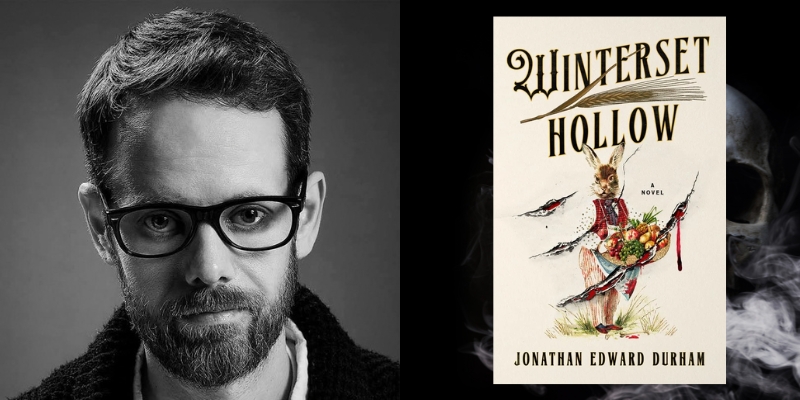
Jonathan Edward Durham on Infusing Yourself Into Your Villains
The author of Winterset Hollow offers a session of villainy therapy
So, you’re a writer? First of all, c’mere. Hugs. Being a writer is hard for so many reasons, but chief among them is that it’s hard to invent truth.
It’s hard to make something up that feels real, especially when it isn’t, which is really the only reason you’d be doing that in the first place. But as long as it seems real, you can make it as unreal as you want. But if it feels unreal, then it doesn’t really matter how real it is at all, even if it’s actually real. See? Pretty straightforward.
We, as readers and writers, generally have a pretty easy time connecting with our heroes, because they’re super cool and dreamy. And because of that, it’s second nature to make sure we know them deeply enough for them to feel real. And structurally speaking, there’s usually plenty of time to make that happen, because we often see the story through their eyes. After all, their journey is the one we typically follow. If only there were some catchy phrase for that.
But the inverse of all of that can hold true for villains for the very same reasons, because they’re usually annoying and mean, though sometimes they can be pretty dreamy too. Villains are often hard to connect with for both readers and writers, because, well, we usually have very little in common with them. You know, what with all the murdering and evildoing and fancy mustaches and all that.
And on top of that, we typically spend far less time following their journey, so they often end up feeling distant. And if you look at anything from far enough away, it almost always just looks, well, flat.
That’s a word I hear thrown around a lot when it comes to villains. Flat. Two-dimensional. And that can be a real problem, because let’s face it, villains are often the entire reason for our stories in the first place. They’re the things that create our heroes. The sparks that incite our incidents, if you will.
And while their journey isn’t usually the one we choose to follow, they almost always draw the map for it in one way or another, so it’s just as important that they feel real too. Even when they’re not. Which they aren’t. To be clear. When it comes to our bad guys and gals, we need to dig deep, even if we don’t like what we find.
So, here’s a little villain therapy or you. Would you like some water? You’re welcome to lie down on the couch if you like. We’re going to work through some things together, and at the end of it all, you can even pick sticker from the sticker box. Sound good? Honestly, I’m just proud of you for being here, because that’s a big step. And for the record, I think you’re being very brave today. So, let’s begin….
So how do you, as a writer, connect with a character who’s going to do horrible things to the world you’ve created? Yes, you’ve brought them into this world, and you can take them out again, but nobody likes a helicopter parent. So how do you make sure you stay invested in them deeply enough for them to develop in a meaningful way? Well, like any good writer, I’m about to make this allll about myself. And you should too.
Make yourself the villain. I mean, look, you’re a writer, so you probably already hate yourself anyway. Lean into it. Write what you know. Okay, that’s not really what I mean, but it’s not exactly far off either. You don’t want to literally make yourself the villain of your story, because they’d probably just spend their time playing around on their phone instead of buckling down and doing villain things. Sorry if that hit a little too close to home, even I feel attacked by that.
You don’t want your villain to be you, but if you give them a little piece of who you are, that can go a long way towards making sure you always feel connected enough to write them well, because you’ll have something in common with them from page one. Do you struggle with insecurity? Certainly not you, dear writer. Did you dislike your parents? Have you ever dealt with substance abuse? Are you a liar? Are you selfish? Overly ambitious? Do you get angry? Are you a coward?
We tend to want to put bits of ourselves into our heroes, because again, they’re super cool and dreamy, and obviously you are too. But your villains need you just like your heroes do. They need pieces of you. Even just a kidney or something. Because when they feel real to you, they’ll feel real to your readers too, even when they do horrible things you would (probably) never do. And maybe even a few horrible things you (probably) would. You do you. We’re not here today to judge.
I wrote a book called Winterset Hollow. And in that book, there are four principal antagonists, which is…a lot to deal with. And I needed a way to make sure they all felt real and different enough from one another that each of them was necessary. So when I started developing their characters, I gave each of them a piece of me. Namely, an aspect of my own mental health I’ve struggled with. Depression, anger, imposter syndrome, and anxiety.
And those things became the seeds for what they eventually grew into. And because of that, I cared about them, and it was important to me to write them well. And do you know what? My readers ended up caring about them too. Some of them even have those villains tattooed on their bodies, which is something we’ll have to save for another session. Maybe next week. But right now, I want to circle back to something you said earlier….
Your villain feels flat. Yes, you did say that, it’s right here in my notes. And this villain is a person, correct? Hmm, okay. Let me ask you something, if I may. Have you tried not thinking about them as a person? Now, I know what you’re about to say. “That sounds like terrible advice.”
And if you don’t read any further, you’d be very right. But hear me out. If I asked you to think about your story as a village, you’d probably put your characters in that village as, well, the villagers. Because they’re people and that makes sense. But have you tried not doing that?
When we think about people, especially people in a narrative, we tend to think about what they look like, what they say, how they act, where they’re going, or what they want. And that’s because those things are important. And if I asked you to tell me about one of your villagers, your answer would probably be some combination of those things. Which is good, because again, those things are important. But if I asked you to tell me about a house in that village instead, what would you say?
I’m guessing your answer might be different. And it should be, because we think about things like houses very differently than we think about people. We think about when they were built. We think about who built them and why they were built. We think about the people who’ve lived there and whether or not they took good care of it. We think about what they’re made out of.
Is it sturdy or falling apart? Are there issues with the foundation? We think about history and time and experience, and what those things have done to that house, rather than what the house wants or how it acts. Because it’s a house. And that’s important, because houses don’t build themselves, and neither do villains.
Well, I hope we’ve learned something here today. And if not, we’ll just go ahead and blame it all on your mother, because that’s our time, and your insurance only covers one (1) session. So be kind to yourself, and be kind to your villains too. Or don’t, it’s whatever. But one thing’s for sure, they’re about to be everybody’s problem, including yours, so it’s important you know how to deal with them. Now, would you like a sticker?
***


Jonathan Edward Durham
Jonathan Edward Durham was born in Eastern Pennsylvania where he read voraciously through his youth and beyond. He studied literature at William and Mary while pursuing a degree in neuroscience, and now writes to bridge the wonder of his favorite childhood books with the pop sensibilities of the classic thrillers he grew up with. He still lives in the Lehigh Valley with his husband and a house full of animals. He is the author of Winterset Hollow.