The Backlist: Reading Kem Nunn's Seminal 'Surf Noir' with Jordan Harper
Jordan Harper and Polly Stewart discuss 'Tapping the Source'
Every reader of this genre knows that there’s no noir like California noir. Southern California is the exemplary place where beauty and death sit side by side, and it’s produced a seemingly endless number of writers who make magic out of the grime and despair of life on the edge of the known world. Among contemporary southern California writers, there’s no one I admire more than Jordan Harper, partly because of the outsider perspective that allows him to take a critical eye to the practices and culture of the place he calls home. His latest novel, A Violent Masterpiece, came out out April 28th.
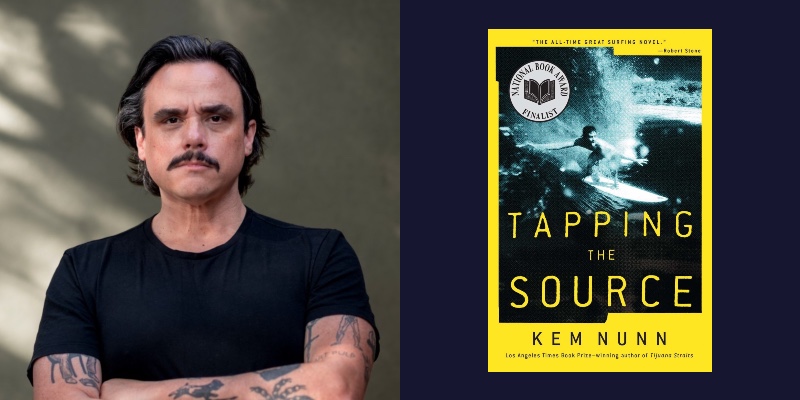
Now I have Jordan to thank for introducing me to another great work of California noir, Kem Nunn’s Tapping the Source. Published in 1982, the novel follows Ike Turner, a lonely boy from the high desert who arrives in Huntington Beach determined to track down his lost sister. Along the way, he falls in with a magnetic crew of bikers and surfers who seem less interested in helping him solve the mystery of his sister’s disappearance than in drawing him down into their own dark world. It’s one of the best books I’ve read all year.
Why did you choose Tapping the Source by Kem Nunn?
To me, it’s one of two or three truly great noir works that either readers have forgotten about or are on the verge of being lost. Winter’s Bone is another one that I’m afraid is going to sink into obscurity, along with the works of David Peace. All of them are gorgeous pieces of literature and great noir stories all at the same time. What really appeals to me as a reader is when a novel meets the aesthetic rule of Porque no los dos—a great page-turner that has something to say and is also written really well. I don’t like it when anyone tries to build a fence around either of those elements—whether it’s people who by “literature” means novels where nothing happens, or people who will excuse bad writing and bad characterization in the service of a plot. I’m always looking for books that combine a great plot with excellent writing. Tapping the Source is a great example of that, and it’s been a pretty big influence on my work specifically.
This novel is sometimes categorized as “surf noir,” which I have to confess I didn’t know was a thing before I read this book. Assuming you’re familiar with the genre, can you talk a little bit about what it is and what other writers are associated with it?
As far as I know, it kind of starts with this novel. I know we’re going to talk about Point Break later, and I’m sure I could think of other examples, but this is kind of the surf noir novel. Part of what makes it compelling for me is that it’s just very clear that Nunn surfs. You can tell by the authority of the writing that he lived this life and found a way to incorporate the seediness of Huntington Beach in that era. He created this vibe that people instantly understand—a little side project of the broader genre of California noir. In the novel, they never really define the phrase “tapping the source,” but you understand innately that surfing creates this grounding element, connecting you to the beauty of the world among all the grit and grime that surrounds the characters.
I thought the sentence-level writing in this book was just extraordinary, and it sounds like for you too, you’re reading for the prose as much as for the plot.
Absolutely. I think it’s one of the best-written noir novels, and it’s amazing to think that this was Nunn’s first book. He’s working in this register that’s really beautiful, and when it’s not beautiful, it’s terse in just the right way, not clunky or convoluted. He’s really good at telling you exactly what you need to know, and sometimes what you need is a two-paragraph description of how the ocean looks in the morning. It’s very poetic in a way that I sometimes wish wasn’t so rare in noir.
We talked about surf noir as a genre, but the novel is also partly set in the California desert outside King City. I think Nunn is doing a lot with the contrast between the California that people think they know from movies and TV and the real California, and I see that in your work as well. What is it that the rest of the country doesn’t understand about the West Coast, and how does that difference show up in this novel?
The moments in the high desert are pretty brief, but you’re right that they’re really evocative, and they remind us that there’s more to California than the little band of greenery around the ocean. California is also the Inland Empire, the high desert, the mountains, the marshlands and the redwoods. In other parts of the country, if you wanted your character to go from a poor rural area to a place where they can get into more trouble, it’s likely they’d be crossing state lines, but with California, you don’t need to do that. You can drive three hours and the cultures are like night and day. That’s one of the small miracles of this place.
Ike Tucker, the protagonist, is described as weak and insignificant at the beginning of the novel, but by the time we get to the end, he’s clearly someone that the people around him need to take seriously. What did you think of him as a point of view character?
I pulled a lot from Ike when I wrote The Last King of California. That book was indebted to Tapping the Source in a lot of ways, and particularly in terms of the idea of someone coming to a place that they don’t feel equipped to handle and finding out who they are. Ike, like a lot of weak people, fantasizes about what it would be like to be strong, but then when he sees what strength and power actually does to people, he realizes that it’s not always a good thing. The idea of a coming-of-age story as a story of disillusionment is something a really respond to, and you’ll find that in a lot of my books.
Ike has a hard time over the course of the novel, but I had the idea that he was going to be all right at the end—like maybe he was going to move to Maui and surf. Did you feel like things were going to turn out okay for him?
I agree, but I think that the fact that he comes out mostly unscathed also points to the idea that it’s not really Ike’s story. This is one of those novels, like The Secret History or The Great Gatsby, where the person at the center of the story isn’t really the important one. There’s much more of a dynamic story happening to other people, and Ike is sort of a device to keep the incredibly dark lives of the other characters at a remove from the reader. There’s another version of this novel where Preston is the main character, and that’s a very dark novel. This is already a dark novel, but that’s a much darker version.
The secondary characters in this novel may be the best thing about it: Preston, the haunted Vietnam vet turned biker; Hound, the ex-surfer whose endless philosophizing makes less and less sense as the novel goes on; and Milo Trax, the sinister son of a movie mogul, who owns the lush Santa Barbara ranch where the last act of the novel takes place. How does Nunn make them so compelling?
I think it works so well because he’s willing to let them be really complicated. He’s willing to dig in and let them do unforgiveable things, but then also turn around and say or do things that are kind or interesting or profound, or at least quasi-profound. I don’t think we’re supposed to think that everything that Hound says is really wise, but I believe that I would lean in at those moments. I think Nunn lived among these people, and you can feel that.
As you said, Preston is a Vietnam vet, and as we move farther in time from Vietnam, it feels like we’re losing the sense of what a scar that was on not only the national psyche, but on the individual psyches of so many people. It plays way in the background of this story, but we pick up on the fact that a lot of what’s going on with Preston is that he had to go over there and do these unspeakable things and then come back and reintegrate, and he can’t do it. You could miss it on a first read, but if you ask yourself, “Why is Preston like this?,” Vietnam has to be a big part of the answer. I’m not sure that younger people understand how awful that war was and how awful it was for the people who came back. The book is about the uncovering of terrible crimes, and one of those crimes is what the war did to Preston.
Ike is entranced by surf culture when he first arrives in Huntington Beach, but he soon sees the dark side, and it’s increasingly clear that the community’s loss of innocence happened long before he arrived. It’s as if he’s late for a party he didn’t even know was happening. Do you think there’s a theme here – something about the winding down of empire in late-twentieth-century America – or am I reading too much into it?
I don’t know if Nunn was conscious of that or not, but that’s absolutely what the book is about. When the book begins, Ike is already more corrupted than would be normal in a loss of innocence story, and then things get even darker from there. At one point in the novel, he tumbles down into absolute immorality, and we get a glimpse of what the end of this way of living is. My new novel, A Violent Masterpiece, has a similar theme. The end of this fantasy of absolute power is the inability to see other people as people. It’s a cautionary tale, and we see Ike go astray and then get back on something like the right track. I do agree with you that when this story is over, he’s not going to keep using people. He’s going to go surf and find the good version of that lifestyle.
You mentioned The Great Gatsby earlier, and I keep thinking about that last passage about a sailor seeing America for the first time, “face to face for the last time in history with something commensurate to his capacity for wonder.” Does this novel suggest that that was never a thing—that there never was any perfect version of Huntington Beach, or surfing culture, or America for that matter?
In American Tabloid, James Ellroy says that we lost our innocence on the boat ride over. I’ve never been sure if Ellroy meant the boat ride from Europe or from Africa, but in either case, the loss of innocence applies. America is a noir place. There’s a reason why we’re the epicenter of this kind of fiction, and particularly Los Angeles and southern California. We can’t look back at a fall from grace, because this country and this place never had grace to begin with.
I’m not sure how to talk about the ending while avoiding spoilers, but it’s safe to say that it’s the darkest and most menacing part of a fairly dark book. Did you think it fit with the rest of the novel?
I’ll be honest, I don’t think he nailed the ending. It’s too much, too quickly, and it feels outside of his comfort zone. At that point, we’re with the rich people on the ranch in Santa Barbara, and it feels like the author was reaching for something he didn’t quite grasp. It’s the gritty details that make you believe in the reality of a scene, and I don’t see that in the ending. I don’t think that invalidates the brilliance of the novel as a whole, though.
I’ve seen different reports online about whether this novel was the source for the novel Point Break. Do you have an opinion?
I certainly don’t think it’s inspired by it in any kind of actionable way. Sometimes you hear people talk about it as if a crime was committed, and I don’t think that’s the case. Even if the people behind the movie did read the book, and my suspicion is that they did, I don’t think it added up to any more than the scenario: someone infiltrates the surf world in order to solve a crime. There aren’t fifty novels with that plot; there’s one, so you can see the connection. But we all take ideas and themes and settings from other works, and nobody cares when it’s from a big work that was very successful. If someone says to me, “You write about the same world as James Ellroy, except in the modern day,” I’d be an idiot to deny that. I don’t plagiarize, but my work is heavily influenced by him. I think because this is surf noir’s preeminent novel, that connection gets more attention than it really needs to.
Part of it is probably that a lot of people wonder why there’s never been a Tapping the Source movie, and they seem to think that the producers of Point Break stole that opportunity. I don’t think that’s true. I think the reason there’s never been a Tapping the Source movie goes back to the similarity to novels like Gatsby and The Secret History. With Gatsby, you have to kind of mutilate the book to make it work as a movie, because Gatsby’s not the main character—he’s next door to the main character—and one of the reasons they’ve never been able to get The Secret History off the ground is because the narrator, Richard, is so passive. He’s there as a device to keep you at one remove from the story, and that doesn’t work in film.
Is there anything else about Tapping the Source that you come back to in your own work?
This was a really foundational novel for me. It reads like a novel written by someone who didn’t know the rules yet, in the best possible ways. I don’t think that he knew that he was transgressing these lines of literary and genre. I think he was just writing what he wanted to write, and I think that’s probably why it’s as strong as it is. If you can get the stuff that matters to you on paper before someone tells you that you can’t do it that way, you can get really good work done. I don’t think he knew that you weren’t supposed to write beautiful, lyrical descriptions of surfing in a crime novel, and that’s one reason it works.
-Author photo, Brian Hennigan.

Polly Stewart
Polly Stewart is the author of The Good Ones. She grew up in the Blue Ridge Mountains of Virginia, where she still lives. Her short fiction has appeared in Best American Mystery Stories, and her nonfiction has appeared in the New York Times, Good Housekeeping, and other publications. She writes the monthly Backlist column for CrimeReads.