Joseph Moldover on What Being a Psychologist Taught Him About Writing Crime
Mulling the value of being proven wrong in writing and life
It’s humbling to be proven wrong, especially by a six-year-old.
Let’s say you’re a clinical psychologist. You spent the better part of a decade chasing down credentials. Graduate school, internship, fellowship. Comprehensive exams and dissertation; state licensure and board certification. You’re supposed to be an expert.
And then, after all those years, you made it. Your diplomas are framed and on the wall. There’s a sign out front with your name on it and people say “what’s up, doc?” when they see you around town and sometimes they even treat you to a cup of coffee.
Families come to you with all sorts of problems. Issues with their kid’s behavior, with learning, with communication. They want to know what the diagnosis is. They want to know what the treatment should be. They want to know where their child should go to school, and what sort of help they need, and what the future might or might not look like.
It’s your job to come up with answers. It’s your job to come up with a theory: about why a problem is happening and what will make it better. It’s what you’re being paid to do.
So, are you going to let a six-year-old kid, someone who just recently cleared kindergarten, who has absolutely zero regard for your credentials, who has a somewhat checkered history with nasal hygiene, are you going to let that person prove you wrong?
What I’ve learned, in over twenty years of practice, is that if you want to have any hope of getting to the right answer then you’d better.
In “A Scandal in Bohemia” Holmes tells Watson: “It is a capital mistake to theorize before one has data. Insensibly one begins to twist facts to suit theories, instead of theories to suit facts.” Published in 1891, Holmes was speaking as a psychologist ahead of his time.
In the early 1970s eight people with no mental health problems checked themselves into a series of psychiatric hospitals. These “pseudopatients” were Professor David Rosenhan and seven assistants who were interested in when the professionals treating them would figure out there was nothing wrong.
The answer, published in the journal Science in 1973 under the title “On Being Sane in Insane Places,” was never. Nothing Rosenhan and his colleagues did could prove their sanity. The clinicians treating them had a theory—that they suffered from serious mental illness—and every subsequent fact was twisted to suit it. To take one famous example, pseudopatients who openly took notes for the eventual scientific paper were written up for demonstrating pathological writing behavior.
In between the question and the answer, we tend to get lost in all the milling facts. It’s true in clinical psychology and it’s true in a crime novel. Sometimes the facts are right in front of us: it was an undisguised fact that Rosenhan and his colleagues were taking copious notes. Sometimes the facts are hard to come by.
For a psychologist, they may be the product of sophisticated emotional tests. In crime novels they result from lab work, interrogation, or (literal) digging. Yet whether they’re hidden or out in the open, the facts are the easy part. Knowing how to glue them together is what’s hard.
The temptation—for Watson, for the clinicians treating David Rosenhan, and for you, the psychologist, sitting in your office with your diplomas on the wall and your name on the door—is to rush into a theory because theories feel certain. Because they’re comforting. Because they’re very, very cozy.
But here’s a secret: they’re also boring. Being wrong is exciting. Life is boring when you’re always right.
So, you have to practice three simple words: “Prove me wrong.” You have to be open to it. More than that, you have to embrace it. You have to learn to enjoy the stomach twisting ride of your theory disintegrating beneath your feet.
Maybe you theorize that the kid sitting in your office is acting up in class because they have ADHD. The classic signs are there; the parents and teachers are checking off all the boxes and the pediatrician is ready to write a prescription. Then a new fact appears: the child can barely read, and testing suggests they’re severely dyslexic. You need to change your mind about the diagnosis, about the behavior, about what is going to help. It sounds simple, it sounds obvious, and I can’t tell you how often it doesn’t happen because, like Rosenhan’s doctors, we’re all stuck in our theories.
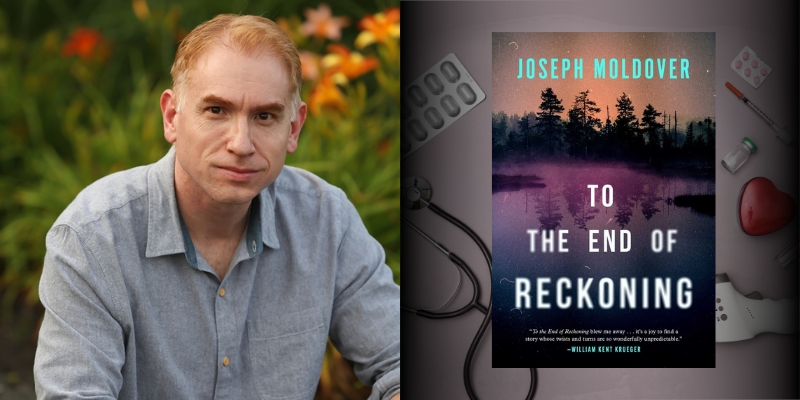
There’s no question that learning to be proven wrong made me a better psychologist. It also made me a better writer. In my forthcoming novel, To the End of Reckoning, twenty-three-year-old Lukas Moore and his father, Dr. Richard Moore, take on the role of amateur detectives. Richard has suffered a traumatic brain injury and wrestles with precisely the sort of mental flexibility necessary to change one’s mind.
Together, the father and son team sift through facts around the mysterious disappearance of their neighbor, Jason Grant. Everyone else has settled on a theory—that Jason died by suicide a year ago—but there are details that don’t fit. Richard has lost the mental flexibility of his pre-injury brain, but he has held onto the lesson of his long career as a psychiatrist: that premature theories blind us to inconvenient facts. He is willing and eager, in all his arrogance and perseveration, to be proven wrong.
Let yourself be proven wrong, too. Invite it from the people in your life, including six-year-olds. Celebrate it when the theories that seem certain get turned on their heads. It’s not comforting, it’s not cozy, but it’s also not boring and there’s a solid chance that what comes next will be closer to the truth than what came before.
***


Joseph Moldover
Joseph Moldover, a clinical neuropsychologist, is the author of the young adult novels Every Moment After and Just Until, as well as the adult novel To the End of Reckoning. His short fiction has appeared in McSweeney’s Internet Tendency, Pangyrus, Stonecoast Review, MonkeyBicycle, One Teen Story, Typehouse, The MacGuffin, and elsewhere. From 2020–2023 he co-hosted the online program and podcast Authors Love Bookstores for A Mighty Blaze. He lives in Massachusetts with his wife and their four children.