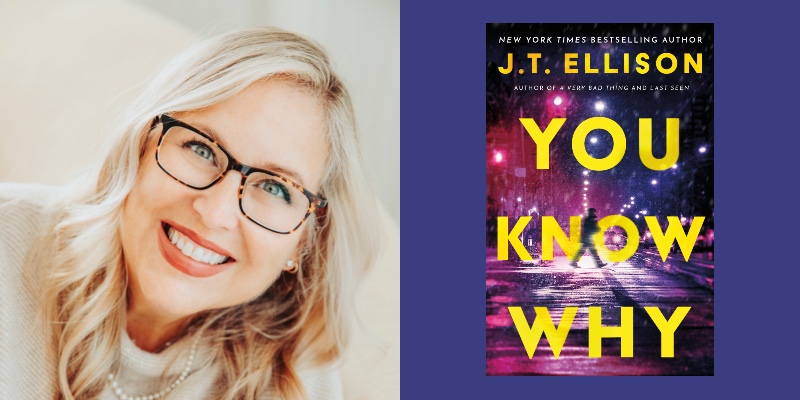
J.T. Ellison on Deception, Duality and Domestic Suspense
A wide-ranging conversation with the bestselling author.
Everyone in this book is hiding something.
While J.T. Ellison speaks this truth in reference to her new standalone novel, You Know Why (Thomas & Mercer; August 25, 2026) specifically, it could also be taken as a general summation of her bestselling body of work. Having written more than 35 novels—including domestic noir, police procedurals (Taylor Jackson), medical/forensic thrillers (Samantha Owens), and a six-book series with Catherine Coulter—that have been published in over 30 countries, she has used secrets (and secret keepers) as a catalyst for suspense, tantalizing readers and reviewers alike with every turning of the page.
This is certainly true of Ellison’s newest, which opens ten years in the past, on a picturesque winter’s night in Georgia. With snow is falling steadily and blanketing the ground outside her cottage home, young mother-to-be Chloe is surrounded by the sight of a Norway spruce glistening with lights, the smell of a pie baking in the oven, and the sound of carols playing through her phone. But she is no longer alive to witness this once charming scene. Rather, Chloe has been stabbed to death with the very pair of scissors she was using to wrap Christmas presents, her husband hovering over her bloodied and lifeless body while her sister screams from the doorway. And … cut.
A decade later: Brooklyn and Trey Locke, accompanied by their two children, are off to Italy for the holidays, their Nashville departure unexpectedly re-routed through Atlanta. Before they can disembark the plane, Trey is approached by a woman who calls him “Andrew.” Uncharacteristically shaken by the encounter, he later disappears from the airport, abandoning his family to the well-meaning overtures of Eden. With little choice but to trust this seemingly benevolent stranger, Brooklyn soon learns that Eden recognized her husband as the man who murdered her sister before fleeing town and changing his name. Unmoored by this revelation, Brooklyn nevertheless has a few secrets of her own …
Now, J.T. Ellison gets candid about the people and prevarications that populate her crime fiction …
John B. Valeri: The book is set against the backdrop of the holidays, with an opening scene in which the seasonal charms are shown in sharp contrast to the horror that has just occurred. Why does this time of year work particularly well for suspense stories – and in what ways does the heightening of everything, from emotions to senses, play into this?
J.T. Ellison: The holidays are supposed to be an idyllic, innocent moment: Decorations that transform homes into miniature North Poles; children excitedly opening packages from Santa; family and friends gathering to celebrate and feast; and fresh starts coming in a few days at the New Year. It signals more than a close to the year; it is the culmination of weeks and months of preparation. I always loved Christmas growing up. Now, it’s fraught. Exhausting. Performative. What better time to stage the murder of an innocent, against this perceived backdrop of peace and joy. The juxtaposition of the Vince Guaraldi Trio playing A Charlie Brown Christmas at a violent murder scene was hard to pass up.
JBV: Brooklyn and Trey both have histories they are trying to escape, neither of which is known fully to the other. In what ways does this enhance their initial attraction to one another? Conversely, how does it then come to threaten the sense of stability they have created in making a home and family?
JTE: Brooklyn and Trey meet in a small town in Mexico, which immediately creates the intimacy found in international travel. Expats find each other like magnets, don’t they? So a certain sense of adventure appeals to them both, and the idea of a travel romance is wildly romantic to us all. Neither expects to fall in love; they’re both a little damaged and looking for a good time with a like-minded creature. And when they do fall in love, quickly, and keep traveling together, they don’t go too deep into their respective pasts. Also typical of a new relationship, I think. They learn what they need to earn each other’s love, respect, and trust, but go no further. If you’re hiding something, it’s good to pair up with someone who has the same issues, right?
They stay like this for many years until Trey’s past comes back to haunt him, and Brooklyn realizes he is not the person she thought he was, at all. Or is he? As their lives implode, she must grapple with understanding the secrets Trey has been keeping, the rather elemental things he has kept from her. The fun of it, though, is that Brooklyn, too, was escaping her past when they met, and has secrets of her own. I think they recognized that darkness in one another, even if they never spoke of it until they were forced to. Once their pasts are dragged to the fore, they have to decide whether to continue loving and trusting one another. A hard, hard decision.
JBV: To that point: the book alternates between past and present events. How much of the characters’ backgrounds did you know at the outset versus what developed organically throughout the writing? What was your process like to keep these intricacies straight and then unravel them in ways that would both surprise and sustain readers?
JTE: Trey’s past was clearer in my mind than Brooklyn’s, because of that prologue. Chloe’s death was heart-wrenching; I knew everyone involved was scarred. I knew Brooklyn had secrets (because I wrote that in the synopsis—Brooklyn, too, has secrets) but I didn’t know what they were. That’s the fun of creation for me, the back and forth of getting to know my characters and their motivations, then layering these insights into the story. I added Brooklyn’s past later in the writing, almost halfway through. It was very fun to braid her past into the narrative.
The dance of time, weaving past and present, is always a challenge. Where to put the chapters so the story doesn’t drag or stop entirely? I play with that a lot in all my books, but for this one, with so many inciting incidents happening ten years before the current storyline, I did it with delicate, surgical insertions. That’s the advantage of a multi-POV story. You can move through time so much easier.
JBV: Brooklyn suffers a TBI during an attempt on her life. In what ways does this cause her to question the validity of her own memories and mental state and allow her to use her injury to distance herself from the authorities? What was your research like to capture the nuances of such a condition and present it realistically while also using it to serve your own authorly needs?
JTE: Wow, the TBI. That whole section and subplot was so difficult. In an earlier iteration, she was actually in a coma for three weeks. I did a lot of research and spoke at length to a trauma surgeon and ultimately decided that for her to recover quickly enough to reengage with the story in the timeframe I needed, that coma just wouldn’t work. So I backed it down to the severe TBI, and she’s out of commission for three days, with all kinds of aftereffects that were more realistic to manage than coma recovery.
Either option would cause all sorts of mind unreliability. I love it when the narrator becomes unreliable to herself and the authorities. It creates all kinds of narrative options. And Brooklyn’s particular situation makes room for the rest of the characters to move in, literally and figuratively, to “help” get her back on her feet. Chaos ensues, naturally.
JBV: Eden sees in Brooklyn and her children the very things she was deprived of (and seemingly at the hands of Trey/Andrew, no less). What exactly are these things – and how does the complexity of her feelings play into her motivation(s) in “helping” Brooklyn and her family in the wake of their misfortune(s)?
JTE: Eden is her own fascinating creature. This story is a dual narrative—Brooklyn’s husband disappears from the Atlanta airport, and Eden sees her sister’s murderer on a plane. The twin stories propel us through, and Eden’s side is rather heartbreaking. Chloe’s death marked her, and those kinds of scars never heal. So when she sees Andrew (Trey’s name in his past life) on the plane with his new family, she sees the life that’s been stolen from her and her sister. The children, especially. She feels an immediate attachment. These should be her sister’s children. Her own blood. It’s an unhealthy bond, for sure. Her sole goal is to help, to make things easier for the kids, and in so doing, she loses herself.JBV: The story includes two sets of sisters – Brooklyn & Margot and Eden & Chloe. Tell us about the unique dynamics of sisterhood and why this relationship makes for such compelling storytelling. In what ways are these pairs outwardly different but fundamentally similar – and how does Brooklyn’s and Eden’s knowledge of this influence their view of one another?
JTE: I don’t have a sister, and I’ve always wanted one. All my best friends do have sisters, though––lots of them. I go full anthropologist when they are around or speak of them. The dynamic is fascinating to me. Though I don’t see it in my friends, I imagine that no matter how close sisters might be, there’s still an element of competition. Mom and Dad love me more, that kind of thing. I also saw something so interesting early on when I was developing this story. A family, with three young daughters, playing by the lake where we like to walk. The girls were playing a little too hard, and the mother snapped at the eldest, “Be the example.” My jaw dropped. That pressure, being the eldest, being held to a different standard, must be enormous. That moment shaped my development of Eden and Chloe, without a doubt. Brooklyn and Margot are identical twins who are incredibly different. I feel like Margot takes on the role of the eldest daughter—the good girl—versus Brooklyn’s wild child persona.
It was a lot of fun to play with these relationships—the good parts, and the bad.
JBV: Det. Theresa Lee (my favorite!) serves as a bridge of sorts between past and present and the injustices still need to be reconciled. What is the import of her presence and perspective throughout the story? And how can she be viewed as a stand-in for the reader, whose own assumptions may cloud their judgment and objectivity?
JTE: Theresa steals this book, doesn’t she? First, her name came from a charity auction: The wonderful crime fiction fan Theresa Lee won the auction to have her name in my book. (I have heard she likes her portrayal.) I was able to use her as my jumping-off point, so Theresa was alive the second she hit the page. The Gussins, too, won second place in the same charity auction, and Margot was another auction name.
I loved turning the dissatisfied detective trope on its ear with Theresa. She’s a small-town cop who has this terrible open murder case. She knows who the killer is and wasn’t able to prove it. It’s the case that got away. She’s approaching retirement and has given up on ever getting this solve. She’s facing all sorts of decisions about what to do for her second act when she is dragged right back into this case. That’s where everything shifts for her. She is the beating heart of this story, and yes, she is the observational POV that allows the reader to know more about what’s happened than either of the main characters. She is also the book’s ticking clock, because soon after we meet her, the case blows wide open and nothing is what anyone involved could have imagined.
JBV: One of the great (many) debates in fiction is the need for characters to be “likeable” vs. relatable or sympathetic. Nearly all of your central characters straddle that line. In what ways do you endeavor to separate the “good” from the “bad” without diminishing the complexities of human nature?
JTE: That’s a great question. I don’t worry so much about characters being likable or relatable. I want them to be understandable, and ultimately, forgivable. I want the reader questioning themselves throughout—feeling close enough to the character to wonder what they would do in the same position. That’s the crux of good crime fiction, I think––the sense of there but for the grace of God, go I. The whole argument about female characters needing to be “likeable,” I think, is bosh. Likeable translates into boring. I want complex, complicated women who are inevitably surprising. I love when you root against someone only to realize you love them in the end. And I love having characters you root for turn on you like a rabid dog. We’ve all been in this position in real life—people surprise you. They disappoint you. They turn out to be shockingly good in a crisis, or bail when things get the tiniest bit rough, or show up when you least expect them. We are complex creatures, and that has to translate to the page or all the female leads become sweet, innocent Disney princesses. And that’s not the kind of book I’m writing. I want a heavy dose of Maleficent in my Cinderellas.
I think Eden and Brooklyn exemplify these diversities perfectly. One is sweet to start and turns sour, and one is sour and turns sweet. Of course, I can’t tell you who is who without ruining it all, but suffice it to say, everyone in this book is hiding something.

John B. Valeri
John B. Valeri is a book reviewer, author, and host of the web series “Central Booking.” He has contributed to The Big Thrill, CrimeReads, Crimespree Magazine, Criminal Element, Mystery Scene Magazine, The New York Journal of Books, The Strand Magazine, and Suspense Magazine. Visit him online and watch past episodes of “Central Booking” at JohnBValeri.com.