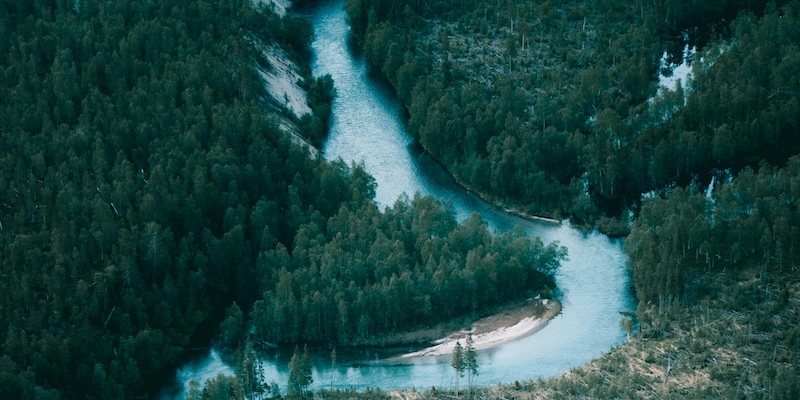
Kerri Hakoda on the Symbolic Power of Rivers in Mystery
How bodies of water shape narratives in crime fiction by Agatha Christie, Ariel Lawhon, and others
The image of the river has always been a study in contrasts—sometimes a raging torrent, sometimes a symbol of peace. At times it’s depicted as a watery grave; at others, a mother’s womb. The Greeks describe the Rivers of the Underworld as peril-riddled barriers between the living and the dead. In Christian belief, being dipped in a river is a sacred ritual, the gateway to eternal salvation.
Rivers have especially vital roles to play in crime fiction, with its often black-and-white conventions of good vs evil, sleuth vs villain. Less clearcut are the distinctions between revenge and justice, vindication and redemption, but the river flows on in its strangely permanent/impermanent, life-giving/taking, saving/damning dual roles. These roles could be in the form of actual characters that influence the plot or the stage upon which the characters are cast—or sometimes both.
In its most rudimentary form, the river serves to confine the story within its shores, and no more so than in the cozy mystery. In Agatha Christie’s Death on the Nile, the river isolates the players on the boat, the floating village where everyone is sequestered. All the characters perform on this small stage—the sleuth, the spy, the heiress, the ill-fated lovers, the blackmailer.
The river also adds colorful set design and atmosphere to the story—the stately Old Cataract Hotel that rests on its banks, the ancient ruins of Abu Simbel—all serve to enrich the confines of this mystery. And when the time is right, the river disposes of evidence as well—a gun wrapped in a velvet stole and a strand of fake pearls.
In Ariel Lawhon’s historical mystery The Frozen River, the ice-bound Kennebec River in Hallowell, Maine is inextricably tied to the cycle of the seasons, birth and death. In this impeccably researched novel, based on the actual diaries of a midwife in the late eighteenth century, an accused rapist is pulled out of the ice-choked Kennebec in the dead of winter. Although it’s universally believed that “The frozen river alters every facet of life for those who live along it,” the protagonist Martha Ballard is not convinced that it killed this man.
The residents of Hallowell on the west side, and Fort Western on the eastern side, carefully cross the frozen river on foot, not trusting its fickle, fragile surface to support the weight of a horse. In a sense, they are confined much like Christie’s players are on the Nile. The resource base that the Ballard family fights so hard—and nearly kills—to retain is the property with access to the river, their lifeline where logs from the mill can be moved more easily to market. In Hallowell, the river extends its own limits and its own bounty, and enforces its own form of justice.
William Kent Krueger’s lyrical coming of age novel Ordinary Grace takes place in New Bremen where the Minnesota River runs “dark as old blood.” The Flats, along the river, where the teenaged Frank Drum and his family live, is a world away from the Heights, with a view of the river, where the wealthy live. The inciting event is the death of a young boy who is killed on the railway trestle that crosses the river.
From that moment, this small section of the Minnesota River is the stage for many of the events of that fateful time – the narrator’s summer of adolescence and questioning of both his faith and his sense of security. Three innocent bodies—those of little Bobby Cole, an itinerant, and a beloved family member—are abandoned in the river or along its banks, a kind of cruel and anonymous baptism.
In A Brilliant Death by Robin Yocum, another poignant coming of age novel, the narrator’s best friend embarks on a quest to learn what happened to his long-missing mother, an alleged victim of the Ohio River. Travis’ mother, it was said, had been on the family’s cabin cruiser with her lover when it was struck by a coal barge. Witnesses said they had seen a man and woman go overboard, but no bodies were ever found.
Brilliant, Ohio “sits on a soft bend in the Ohio River, between Steubenville Ohio and Wheeling, West Virginia.” In the 1960s, the steel mills were a thing of the past, and the Ohio River was thick with pollution and the stink of sulphur; in short, probably much like one of the Greek Rivers of the Underworld. Like the Minnesota River in Ordinary Grace, the Ohio holds the story’s players close to its shores, verifies their stories and distracts them with lies. In A Brilliant Death, the river is an accomplice to two of the greatest acts of deception in the novel.
The fictional Cahulawassee River in James Dickey’s Deliverance is not just a remote setting, but an untamed, half-crazed antagonist—the ultimate relentless, heartless villain. The protagonist and his friends who embark on an ill-fated canoe trip down its rapids underestimate the river’s bloodthirst.
As the pace and tension builds, the river becomes wilder—it not only kills, but aids and abets others who do. “The river did all the killing we saw,” the protagonist Ed Gentry tells the police, half-truthfully. The characters who encounter this river in this life-or-death conflict are irrevocably altered, or don’t survive.
Most of the action in my second novel, Too Deep to Cross, is set in Homicide Detective DeHavilland Beans’ Yukon River village of Galena. Beans’ Yukon exemplifies the river of Greek philosopher Heraclitus’ quote: “No one can step in the same river twice.”
An officer-involved shooting changes Beans forever, and a decades old cold case brings him back to the small town of his childhood, the eternal river of his own history. Like Christie’s Nile, Beans’ Yukon isolates and insulates the villagers—physically and emotionally. And like most rivers, the Yukon only gives up its dead when it’s good and ready.
***


Kerri Hakoda
Kerri Hakoda was born in Hawaii, but calls the Pacific Northwest her home and Alaska her inspiration. She lives with her husband in northwest Washington, where she writes mystery, historical, and young adult science fiction.