
Gabbi Calabrese on What Kids Can Learn from Reading Mysteries
The author of Little Bookworm: Mystery values whodunits in an age of AI and spoon-fed answers
The thread that wove me together was made of curiosity.
As a child, my favorite game to play was asking “Why?” My brother would make a statement that required no further elaboration, but still I’d ask,
“Why?”
And when he’d explain, I’d ask again. I liked to see how long it would take for him to run out of becauses. I think we all know how this game goes.
In my teenage years, I often found myself whisked into the whirlwind of Wikipedia. One article led to another until I had accidentally wasted hours reading about subjects that had no bearing on my day-to-day world. I had questions, and so I found the answers. I think, once again, we all know how this game goes.
I became a writer and a publishing professional because in high school I would stay awake (much later than my dad would have preferred) reading blogs about what makes a story compelling, what makes a sentence delectable. Fifteen, with a laptop and a dream. I could imagine nothing more incredible than working with books for a living, and so I asked all the questions that would tell me how to do so.
And now, my world is brimming with books: the shelves in my home, the conversations I get paid to have, and the friendships I would sacrifice everything for. I created and fulfilled my dream life with sheer want to know.
We live in a timeline in which information is fed to us before we have a chance to be hungry, in which we’re encouraged to use our minds less and take the easy route to gather answers without real question. Around seemingly every corner is a message demanding we shut out perspectives different from our own. In this timeline, wonder, interest, and enthusiasm all feel radical—and I aim to be a constant voice in the cry for their revolution.
This is why introducing the youngest of readers to the mystery genre is not just important; it’s a priority. It’s an act of resistance.
Mystery stories are a conduit for curiosity and critical thinking. They are fun. They are accessible. But behind the salacious crimes, the unputdownable pacing, and the jaw-dropping plot twists, there is a unique study of humanity. Mysteries are not only an investigation of fictional truths, but an investigation of our very reality. Mysteries are a game of “Why?”
Why would a person commit a reprehensible act? Perhaps more importantly, why wouldn’t they? Why would someone lie, steal, cheat? And why should we care what happens next?
Mysteries are also a game of “What?”
What evidence is there that someone is guilty? What is the price someone is willing to pay to get what they want? What is the full story here? What am I missing?
There are endless whos, whats, whens, wheres, and whys in the mystery genre, and the sooner kids are asking those questions about the words in front of them, the sooner they’ll be asking those questions about the world around them.
With generative AI on the rise, with political upheaval unwavering, with the entire internet at our fingertips, discernment is more important now than ever before, and every building block we give the next generation can be sharpened into a tool.
While it may start with “who stole the cookie from the cookie jar,” it might just morph into the ability to assess biases, privileges, and propaganda.
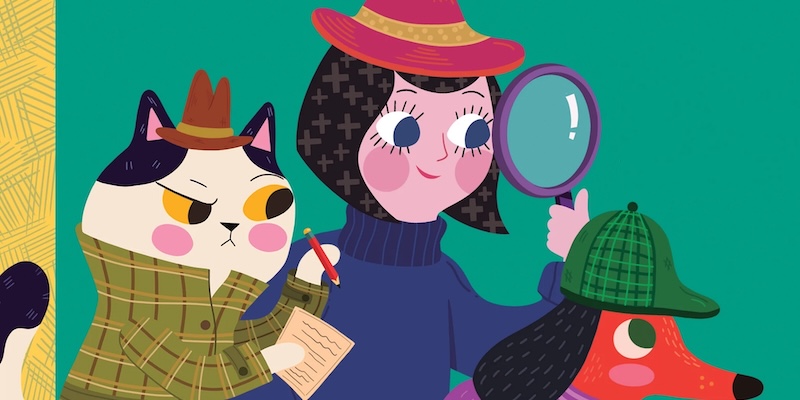
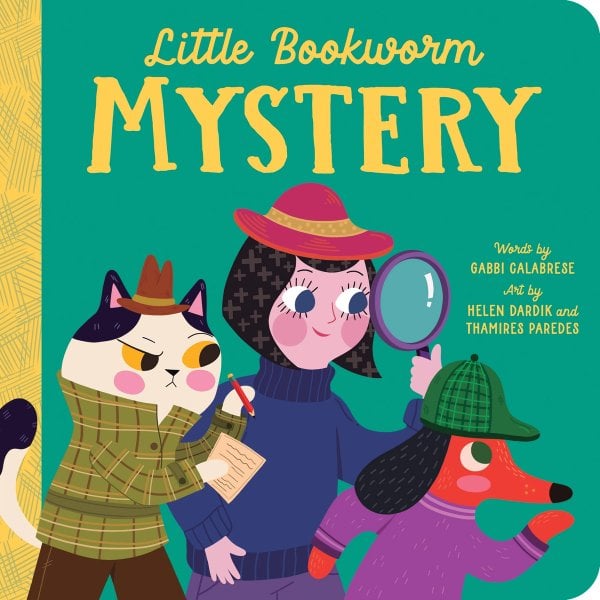
Sure, my outlook might be a bit dire, but I can assure you I’ve never been more optimistic. My book, Little Bookworm: Mystery, is bright and cheerful and whimsical. It is a celebration of the mystery genre, and a gorgeous resource for folks to share the type of media they love with the little ones in their lives in a way that is appropriate for toddlers, that is fun for babies and adults alike. But also, that has an agenda for free thinking.
Don’t get me wrong, I’m not advocating for toddlers to read Agatha Christie or Arthur Conan Doyle—at least, not yet—but encouraging caretakers and loved ones to foster a sense of inquisitiveness in blossoming minds. And what better way to teach the youngsters that than through a medium that is fun and interesting and makes kids forget they are even learning anything.
Plus, it shows that anyone can be a sleuth. All you have to do is ask the right questions.
The thread that wove me together was made of curiosity, but I believe that the fabric of, well, everything relies on curiosity. A future of people who know how to think for themselves, who know how to distinguish human-made art, who know how to wonder.
Mystery books may seem like fun and games, like a silly little story, but they can be so much more than that. Aside from being a way to connect with the young ones, mystery stories can be a learning tool and a shared experience. If we share the joy of mysteries with the littlest readers, we could see benefits we’d never predict. We could see a positive future we could only hope for.
***

Gabbi Calabrese
Gabbi Calabrese is a writer and editor living in Queens, NY. She got her MFA from The New School with a dual concentration in Fiction and Writing for Children and Young Adults. When she isn't reading or writing her own stories, she can be found cooking new recipes, being bad at crafts, and planning her next Halloween costume.