Sinners, Saints and Screenplays: On Jim Thompson and Stanley Kubrick
Kubrick and Thompson were close collaborators. Why did their time together yield so little?
Recently I’ve been watching my former Chelsea, NYC neighbor Ethan Hawke in the cool FX neo-noir series The Lowdown, which is streaming on Hulu. Though I won’t get into the plot of this sizzling southern tale, I was quite surprised (and happy) to see the books of author Jim Thompson get equal screen time alongside actors Keith David, Jeanne Trippehorn and Kyle MacLachian. Hopefully this exposure will lead to another Thompson revival like the one in the 1980s that first brought him to my attention and others not yet born when his grit was fresh.
Back then it was writer/editor Barry Gifford’s stunning Black Lizard reprint series that revised Thompson’s legacy, when books such as After Dark, My Sweet, The Getaway and The Grifters were brought back after years of being out-of-print. Every few months, as they were released, I’d buy a new one at St. Marks Books and hustle home to Harlem where, while gulping coffee and puffing cigarettes, I leapt head first without a helmet into Thompson’s bleak landscapes populated with loose women, black hearted men and sorrowful suckers primed to take a fall.
In the mind of crime fiction aficionados who dug beyond the fictions into the real lives of noir authors, the brooding image of pulp writers from the ‘40s and ‘50s usually resembled a haunting Edward Hopper painting of doomed loners sloughed at a rickety desk inside a dimly lit room knocking out stories for a penny a word. In an effort to keep the bookies at bay, bourbon in their system and the landlord off their backs, rarely were these miserable fellows thought of as family men.
Jim Thompson, on the other scarred hand, was a different kind of literary animal. Although Thompson suffered from legendary bouts with the bottle (when he was a boy, his grandfather gave him whiskey with breakfast), he was also a married man with three children and a house in the suburbs. In the days when aspiring writers still cherished life experience over MFAs, the towering Thompson worked a variety of unglamorous jobs including hotel worker, plumber’s helper, truck driver, pipe-liner and harvest hand before becoming a professional author. “He’d take any job, you know, to earn a living and feed his family,” Thompson’s long-suffering wife Alberta, whom he married in 1931, once told an interviewer.
Until Thompson’s death in 1977 at 70 years old, his wife stood by her man through drunkenness, money woes and sickness. As his friend and former editor Arnold Hano pointed out in 1991, “unhappy endings were his style.” Thompson’s twenty-nine novels were out-of-print when he died, but in 1984 writer and David Lynch collaborator Barry Gifford (Wild at Heart, Lost Highway) teamed-up with the Berkeley based publishers Creative Arts Book Company to create Black Lizard Press.
Featuring gaudy covers by Kirwan, the Black Lizard books reprinted the novels of forgotten authors Charles Willeford, Peter Rabe, Harry Whittington, David Goodis and others, Black Lizard was thrilling and seductive, enticing a brand new generation of crime fiction fans. Today, almost 50-years after Jim Thompson’s death, his brutal novels have influenced a generation of neo-noir writers including S.A. Cosby, Jordan Harper and the late Jerry Rodriguez.
“Jim Thompson created a fictional world which was the dark flipside to this one,” wrote Brit-writer Charles Waring. “As novel after novel reveals, the universe according to Thompson is the literary equivalent of a photographic negative: we see the outlines of people and places but even familiar images are rendered unrecognizable in Thompson’s bleak dystopian vision.”
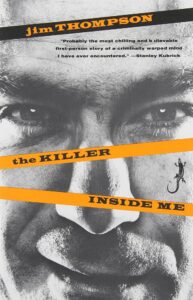
In 1952 his hardboiled novel The Killer Inside Me, one of Thompson’s more disturbing novels, caught the attention of Bronx born filmmaker Stanley Kubrick. In Savage Art, Robert Polito’s brilliant 1995 biography on Thompson, he writes that Kubrick referred to The Killer Inside Me as “probably the most chilling and believable first person account of a criminally warped mind that I have encountered.” In 2010, director Michael Winterbottom adapted the book and shaped an equally disturbing film from Thompson’s material starring Casey Affleck and Kate Hudson.
In 1956, when Stanly Kubrick and producing partner James B. Harris secured the film rights to Lionel White’s caper novel Clean Break, it was Kubrick’s idea to recruit Thompson as his co-writer. “Are you familiar with a guy named Jim Thompson,” he asked Harris. “He’s a terrific writer who’s written some stuff I love.” Living in Sunnyside, Queens at the time, soft-spoken Jim Thompson was soon working with the budding maverick director.
Like most freelance writers, be they family men or soloists, Thompson often had money problems and leapt at the chance to apply his pulp sensibility to the silver screen. Years later, Thompson’s books including The Getaway, The Grifters, and After Dark, My Sweet were made into features, but Clean Break was the writer’s first foray into film.
Slaving their days away in an office on West 57th Street in New York City, Kubrick and Thompson became fast friends despite their twenty-two year age difference. Kubrick sometimes trekked to Queens to visit the Thompson clan. Thompson’s daughter Sharon, whom Polito interviewed, says, “Stanley came out to our place and just drove us all insane. He was a beatnik before beatniks were in. He had long hair and weird clothes.”
Elsewhere in Savage Art, Polito mentioned that Thompson sometimes loaned Stanley a tie if they went out to a restaurant to talk about the script. “They would discuss what each scene was about and how long it should run and then Thompson would write it up.” But, since Thompson was a novice screenwriter and Kubrick was used to working in his own way, turning the racetrack robbery novel into a low-budget picture wasn’t easy.
Literary agent Robert Goldfarb, who represented writer Lionel White and later Thompson, remembered receiving the hulking first draft, “…in a cardboard carton big enough to house a family—and the script was something like 300 pages, legal sized, clipped at the top. The whole thing looked like amateur night.”
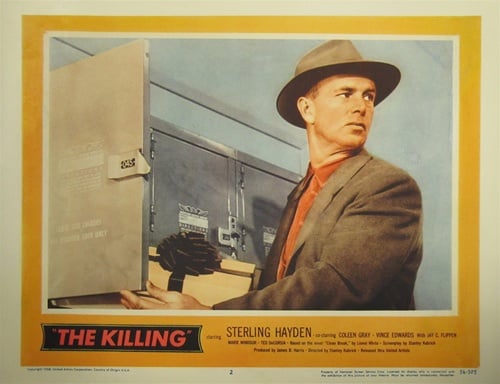
After paring down the script and securing macho man Sterling Hayden to play the lead, the filmmakers received partial funding from United Artists—who insisted on a title change–to make the picture. With a shoestring budget of $320,000, which was small even for 1956, Kubrick made an exquisite heist flick while simultaneously stabbing his co-writer in the back. At a screening Thompson attended with his family, the writer was shocked when the credits on The Killing read: script by Stanley Kubrick and additional dialogue by Jim Thompson.
While many authors have detailed their pitfalls working within the Hollywood system, this was an unexpected blow to Thompson, who thought of the rising auteur as more than a business associate. “My father nearly fell off his chair when he saw that,” remembered his daughter Patricia. Although Thompson tired to save face by telling his family that he would fight Kubrick through Writers Guild arbitration, Polito discovered that wasn’t true. Still, displaying perfect freelance writer behavior, Thompson might’ve been pissed-off, but he didn’t let that stand in the way when Harris-Kubrick offered him the kingly sum of $7,500 to co-write the script for Paths of Glory the following year.
In 1957, when Kubrick and Harris moved to California, the Thompson family relocated to Hollywood Hills to be close to Stanley. Riding into the sun-drenched city on the train, they were met at the station by the director. “The writing of Paths of Glory was essentially a very well-paid part time job for Thompson,” reported biographer Michael McCauley in his 1991 book Sleep With the Devil. “With a burst of spirit and a bust of creativity, he wrote and sold two novels (The Kill-Off and Wild Town) that same year.”
In actuality, Kubrick hired Thompson to rewrite the original draft penned by Calder Willingham. However, when their star Kirk Douglas read Thompson’s rewrite, he was appalled and reportedly threw the script across the room. Demanding that the Willingham’s version be reinstated, the final shooting script was credited to the two writers and director Kubrick.
According to biographer Robert Polito, seven scenes of Thompson’s made the final cut. Although Paths of Glory won the Directors Guild of America Award for best screenplay, with the exception of a few television shows and a failed attempt to adapt his novel The Getaway (star Steve McQueen didn’t like the script), Thompson’s screenwriting career stalled. One last project Kubrick commissioned from Thompson in the late 1950s was the treatment for a New York noir called Lunatic at Large, about a former carnival worker with anger issues and his “psychopathic” girlfriend.
Unfortunately, after Kubrick moved to England in 1962, the only copy of Thompson’s treatment was “lost” amongst the directors many papers and wasn’t located until after his death in 1999. “When Stanley died, he left behind lots of paperwork,” his son-in-law Philip Hobbs told the New York Times in 2006. “We ended up going through trunks of it, and one day we came across ‘Lunatic at Large.’ I knew what it was right away, because I remember Stanley talking about ‘Lunatic.’ He was always saying he wished he knew where it was, because it was such a great idea.” In April 2010, it was announced that Sam Rockwell and Scarlett Johansson were to be cast in the film, which was to be produced by Hobbs, the Kubrick estate and Edward R. Pressman, but thus far, Lunatic at Large hasn’t been made.
More recently, the love and respect of the master crime writer’s work is still very much alive as proven by the recent Library of America release of Jim Thompson: Five Noir Novels of the 1950s & 60s edited by Robert Polito as well as the Netflix announcement that they’re remaking (yet again) The Getaway, to be released in 2027. Certainly, as one bad man said to the other, “It ain’t over until it’s over.”

Michael Gonzales
Harlem native Michael A. Gonzales is a cultural critic, short story scribe and essayist who has written for The Paris Review, The Village Voice, Wax Poetics, The Wire UK, Maggot Brain and Pitchfork. His fiction has appeared in Under the Thumb: Stories of Police Oppression edited by S.A. Cosby, Taint Taint Taint, Dead-End Jobs: A Hit Man Anthology edited by Andrew J. Rausch, Black Pulp edited by Gary Phillips and The Root. Upcoming stories will appear in The Book of Extraordinary Femme Fatale Stories edited by Maxim Jakubowski, Get Up Offa That Thing: Crime Fiction Inspired by James Brown edited by Gary Phillips, Killens Review of Arts & Letters and Obsidian Literature & Arts in the African Diaspora.