
Linwood Barclay on Writing Ordinary Characters in Extraordinary Situations
The author of the thriller Not a Word captures the reactions of the unprepared
A few years ago, sharing the stage at a book festival with another crime writer, there was a question from the audience about what kind of research we did. My fellow author talked about getting a private tour of a “body farm,” where corpses—donated by the deceased, before death, of course—are studied for their rate of decomposition in a natural environment. The author’s main character needed to have this kind of expertise. (The writer was quite proud of herself that she did not throw up during the tour.)
My research seemed bland by comparison. When I’d decided the hero in one of my books was going to be a car salesman—not typically heroic figures—I took two friends who were retired car salesmen to lunch and asked them to tell me all the dirty secrets about their former professions. (I nearly did throw up, by the way.) Got some good anecdotes, too, like the guy who wanted to test drive a pickup truck and when he returned it was clear he’d used the truck to deliver a load of manure.
The thing is, I’ve often found myself more interested in the mundane details of more mundane professions than, say, forensic experts. (It should be noted that the only subject I bailed on in high school was chemistry. I thought Alka-Seltzer was one of the elements in the Periodic Table.) Stories weighed down with technical details bore me. I’m more interested in character.
Other protagonists in my novels have included a teacher, a landscaper, a renovator, a writer (sooner or later, we all seem to fall back on that one), an event planner, a children’s book author. I have had friends who’ve done these jobs. My wife was a teacher, and so was my best friend. I know event planners and contractors. When I give one of these professions to a character, I’m ahead of the game. I know what they do, I know what their jobs is like, and I’m reasonably confident I can present it accurately.
But it’s more than just that. It’s not a case of wanting to avoid research.
I like writing about ordinary people because they are the least well equipped to deal with the extraordinary circumstances I have in store for them. They won’t know what to do. Their first inclination, if they have half a brain, will be to be run away from the threat.
But they can’t, because if they do, well, first of all, I’ll have no story to tell.
So they need to face the threat, and as a writer you have to give them a compelling, believable reason. The stakes must be high. And there’s usually no stake higher than family. A lost child. A murdered spouse. Being accused of a ghastly crime you did not commit.
When Lee Child’s Jack Reacher has a run-in with a gang of knuckle-dragging bad guys, I’m more worried for them than I am for Reacher. Not that I don’t love it when Reacher knocks their heads together and beats the livin’ snot out of them. It’s great fun, and there’s a kind of catharsis, living through Reacher as he sets things right. But now imagine that teacher or car salesman coming up against that same gang. When I write a scene like that, I want you to identify with my hero, to feel that panic, to have no idea what you’re going to do. You want to run, but you can’t.
It’s possible some of this goes back to my lifelong love of Alfred Hitchcock. In many of his movies, the heroes are not cops or private detectives or secret agents. They’re just regular people. Janet Leigh, our star (at least for the first half) of Psycho, works in a real estate office. Her lover runs a hardware store. Neither of them has ever had any dealings with a character like Norman Bates.
Same with Jimmy Stewart in Rear Window (my favorite movie of all time, by the way, and the inspiration for my novel Trust Your Eyes). Stewart’s character may have traveled the world covering wars but he’s never had a personal run-in with someone like Lars Thorwald, who has murdered his wife in the dead of night and scattered her bits all over town. And while Stewart’s character in Vertigo is a retired cop, he’s really an everyman when he is drawn into
Gavin Elster’s elaborate plot to murder his spouse. (Gavin’s plan, by the way, is ludicrously complicated and could have gone wrong at any number of points, but I don’t care.)
I also want to acknowledge here the influence of the late Ross Macdonald, who wrote the Lew Archer series of detective novels, which imprinted themselves on me when I devoured them in my late teens. Archer was, for sure, a professional, but the people into whose lives he inserted himself were not exceptional. Often wealthy and pretty messed up, but not what you’d call extraordinary. Not a Hannibal Lecter among them.
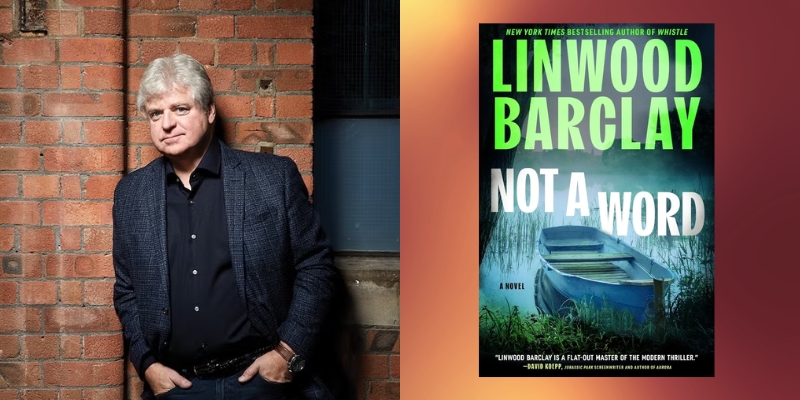
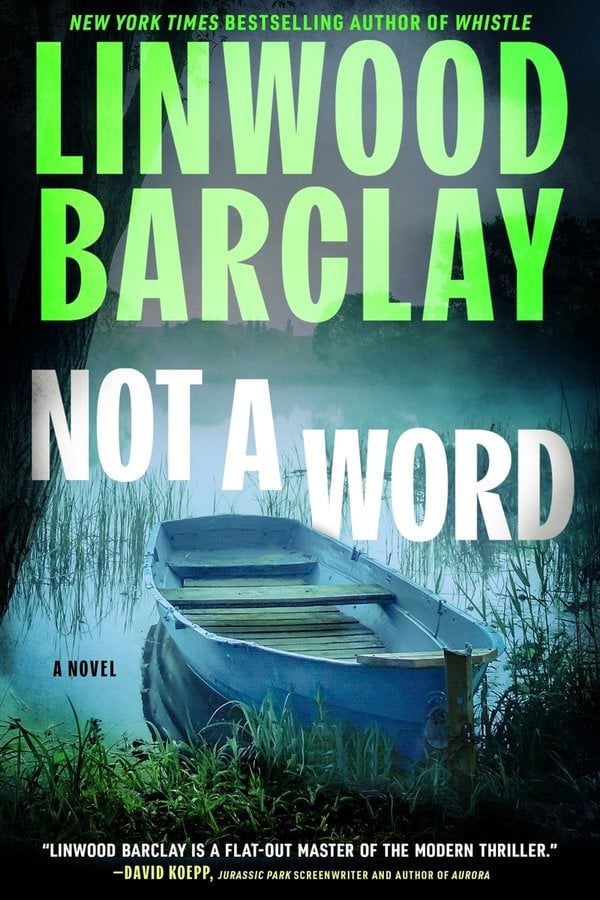
In my new thriller, Not a Word, I’ve again placed at the center of the story someone ill prepared for dealing with what’s coming. Reece’s experience with tragedy and mayhem is limited to his job as a news writer for a nightly TV newscast. But he gets no closer to these events than his keyboard. When a horrific tragedy strikes at his parents’ home, and he starts to learn the truth about his mother and father, the trail will lead to one of my best villains yet, a fixer for an unscrupulous pharmaceutical company.
And the stakes are indeed high for Reece. His family stands to be torn apart by long buried secrets. What was tossed into that pond behind his parents’ home more than two decades ago? What event in childhood has never stopped haunting Reece’s brother?
For some time, I’ve been pondering a book where the main character is a parking enforcement officer – someone who writes out parking tickets. It doesn’t get any more mundane than that.
Although, the more I think about it, that does kind of sound like a villain.
***

Linwood Barclay
Linwood Barclay is the New York Times bestselling author of numerous previous novels and two thrillers for children. His books have been translated into more than two dozen languages. He wrote the screenplay adaptation for his novel Never Saw It Coming and his books The Accident and No Time for Goodbye have been made into TV series in France. No Time for Goodbye was a global bestseller. A native of Connecticut, he now lives in Toronto with his wife, Neetha.