
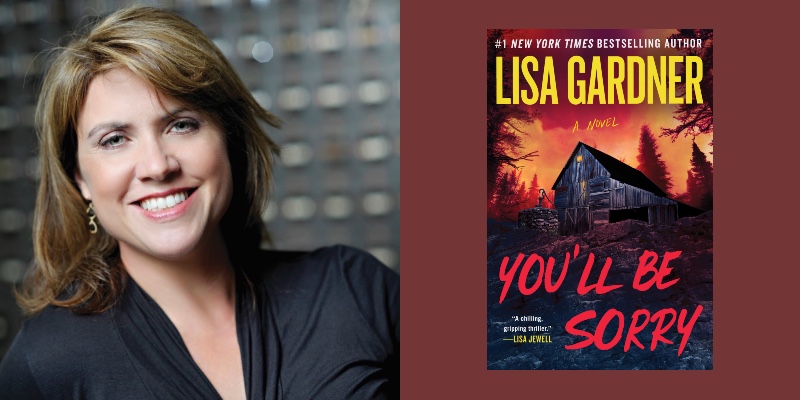
The Rhyme & Reason of Suspense: Lisa Gardner on Her New Standalone, 'You’ll Be Sorry'
Catching up with the best-selling author, gothic enthusiast, and self-professed research junkie.
A little obsession goes a long way in the life and work of a writer.
Lisa Gardner—who wrote more than a dozen romantic suspense novels under the pseudonym Alicia Scott before dropping that name and going darker—knows this to be true. Whether the complexities of character, the precision of plot, or the rigors of research, she has been going down rabbit holes, and turning up carrots, for more than thirty years. Since making her genre debut with 1997’s The Perfect Husband, she has written twenty-six novels, topping the New York Times bestsellers list, earning critical acclaim across the globe, and winning prestigious awards such as Best Hardcover Novel from the International Thriller Writers (for The Neighbor). Her works include the FBI Profiler series as well as books featuring popular protagonists D.D. Warren, Tessa Leoni, and Frankie Elkin.
This summer, the author returns to her roots with You’ll Be Sorry (August 4, 2026; Grand Central Publishing)—her first standalone novel since 2002’s The Survivor’s Club. The book introduces young newlyweds Raquel and Theo Collins, whose unlikely bond is forged through equal parts love and lust. Having just moved to a long-abandoned lodge home in the mountains of remote Shereford, New Hampshire, the couple is intent on restoring the property to its former glory and turning it into a bed and breakfast. Their plans, however, are met with skepticism by the townsfolk, who feel that some things are best left alone. After all, it was once the site of the community’s most enduring mystery: the disappearance of the Dixon family, who seemingly vanished into thin air one August night some thirty years ago, leaving behind nothing but bloodied footprints on the kitchen floor.
When the Collinses—at the behest of an enigmatic dog named Dog—discover skeletal remains in a hidden well on the grounds, the cold case immediately heats up. Enter Police Chief Amanda Grady, whose deceased father was in charge of the initial investigation. Having failed to solve the crime despite exhaustive efforts, he spent the rest of his life obsessed with finding out what happened that fateful night. Now, Amanda has the chance to do what he could not—but her own inquiry into the past uncovers a(nother) mystery that dates back centuries, and to the origins of a schoolyard chant that she still remembers from her own childhood: “Ding dong bell / The witch is in the well …”
Now, Lisa Gardner talks about turning up the dirt in the makings of her bewitching new novel …
John B. Valeri: You’ll Be Sorry is your first standalone novel in nearly twenty-five years. Was it a conscious choice to return to self-contained work or did the story dictate this choice? What creative liberties (or risks) can you take with a standalone that you can’t with a series?
Lisa Gardner: I’ve always loved the gothics. You could argue my first thriller, The Perfect Husband, was heavily influenced by the genre. So You’ll Be Sorry really was a conscious decision to return to my roots—the mysterious couple with hidden secrets, a dilapidated mansion with a horrific past, and an isolated mountain town where everyone thinks they know one another, except they don’t. Honestly, such a blast to write and of course, I had to include a stray dog as major character. Sky’s the limit with a stand-alone and I definitely took advantage.
JBV: The book opens with a prologue that both hints at the story’s climax and introduces two of your main characters, Raquel and Theo Collins. In your opinion, what are the keys to crafting a meaningful preface? How does, or can, beginning a novel in situ enhance the reading experience?
LG: I love writing prologues. My favorite chapter every time. For a thriller, you have to start with a sense of urgency and action. That works well for an in situ scene, as you put it. But a truly great opening generates an emotional response as well. You’re not just meeting a young couple in a moment of crisis, but immediately, you feel for them. You care. And now you’re desperate to know how it’s going to work out. This scene came to me out of nowhere. I had no idea how it was going to tie into the rest of the novel. Nine months later—thank goodness—I figured it out!
JBV: Raquel and Theo have a complicated relationship mired in secrets and sex. How does the uncertainty of their marriage heighten the proverbial stakes? In what ways did their love/lust story take you back to your roots in romantic suspense?
LG: My whole inspiration for Raquel and Theo was a couple caught up in those first punch-drunk days of love, where passion is running hot and none of the real-world details matter. They live in a heady bubble, where everything feels magical and perfect just as long as they don’t look too hard. Now, however, reality has intruded in a terrible way. And all those things they don’t know about each other … How much will it cost them? I didn’t have the answer to that question when I first started to write. But man, I got up every morning and raced to the computer just so I could figure it out. I became completely obsessed with Raquel and Theo, lol, which isn’t a bad way to get a novel done!
JBV: Amanda Grady is Shereford’s police chief, unintentionally following in her (deceased) father’s footsteps. In what ways did his obsession with the unsolved Dixon case rub off on her – and how does her own investigation into the crime(s) reframe her understanding of him?
LG: I was intrigued by the notion of a “legacy” crime. The tiny town of Shereford, NH is one of those places where bad things never happen. Well, you know, except for that one family who disappeared in the middle of the night. The rest of the town might have moved on, but as the daughter of the police chief, Mandy literally grew up in a house with photos of the missing kids plastered on the wall of her father’s study. As she puts it, she might’ve been an only child, but she was raised with the ghosts of four siblings. It seemed fitting then, that she should come into her own re-opening the investigation and determinedly searching for the answers that haunted her father to the grave.
JBV: “Dog the dog” is developed with as much attention and care as his human counterparts. What does he bring to this story that people can’t (or at least not as effectively)? How much of his character is based on dogs you’ve known and loved and why is it meaningful for you to be able to capture their spirit for posterity?
LG: I love all four-legged creatures (well, I also had a three-legged cat.). Animals are a natural source of comfort and joy. The “canine opportunist” in You’ll Be Sorry, is a nice foil for my characters who are navigating very dark developments. Dog provides a bit of lightness with his exuberance, but also is a clever and independent actor in his own right. He helps propel the story with meaningful discoveries, while remaining a bit of a mystery himself. Where did he come from? How does he know so much? I love that all the characters in this novel have secrets—even the local dog.
JBV: You are a self-professed research junkie, which is evident in the many procedural and historical elements at play here. Using just one, forensic anthropology, as a touchstone, tell us how you endeavor to balance entertainment value with information sharing. In what ways does using a colorful character like Debs Mahone as a vehicle for such dissemination factor into the equation?
LG: I had so much fun researching with the FAIR lab—Forensic Anthropology Identification and Recovery—at the University of New Hampshire. I always look for the details you wouldn’t expect. For example, New Hampshire is such a rural state, the experts don’t have access to state-of-the-art equipment. Instead, they go to Home Depot, buy lumber and screens, and build things for themselves. That kind of cool detail—DIY policing!—adds instant authenticity without bogging down pacing. And having an exuberant character happily chattering away helps as well. For the record, Debs enthusiasm was inspired by the team I interviewed, who clearly love their work!
JBV: You make your home in the mountains of New Hampshire and are intimately familiar with physical and proximal considerations that come with such remote living. In what ways do these circumstances pose a challenge to your characters and the procedural necessities of a criminal investigation? Also, tell us how widespread societal issues (such as homelessness) still present themselves, if differently than in urban living conditions.
LG: I love where I live as I’m an avid hiker, so the mountains feel like home. I also prefer areas populated by more deers than people. But yes, small towns present their own dichotomies. Everyone knows everyone, except of course we don’t. My community has experienced shocking crimes, from a teenaged girl kidnapped walking home from school and held prisoner for nine months to various pedophile arrests. No place is safe, not even the ones with charming main streets. If anything, the desire to maintain the façade makes addressing issues such as drug addiction, domestic violence and homelessness that much more difficult. My heart goes out to the social workers in my community. It’s no easy to feat to solve problems no one wants to admit exist.
JBV: There’s a recurrent rhyme throughout the book: “Ding dong bell / The witch is in the well …” What is the import of this seemingly innocuous playground chant and how is it rooted in American Colonialism?
LG: I love the witchy rhyme! I had this idea of a chant local schoolchildren had many reciting for hundreds of years, including the now police chief, Amanda Grady. Never thought anything of it. Until one day, a mysterious dog leads a mysterious young couple to a mysterious boarded up well, and lo’ and behold … Once I realized the full importance of the rhyme, I knew I had to develop the chant in its entirety. Of all the things I’ve written, can I just say a two-hundred-year-old witchy rhyme has been by far the most fun! And you can’t explore the history of New England without talking witches. All the better for a suspense novelist like me.

John B. Valeri
John B. Valeri is a book reviewer, author, and host of the web series “Central Booking.” He has contributed to The Big Thrill, CrimeReads, Crimespree Magazine, Criminal Element, Mystery Scene Magazine, The New York Journal of Books, The Strand Magazine, and Suspense Magazine. Visit him online and watch past episodes of “Central Booking” at JohnBValeri.com.