
Liza Tully on Tragicomedy, Murder Mysteries, and Using Grudges as Plot Devices
The author of The Forty-Year Grudge imagines the narrative possibilities of grievances
Grudge is a funny word.
It looks sort of funny with its crowd of heavy Germanic consonants flanking a little u, while a silent e trails pointlessly behind.
It sounds funny too, if you can say it at all. A person trying to learn English will take one look at dg and confidently explain to you that it is impossible to make any sound out of that combination of consonants. Can you blame them for being stumped? How are they supposed to know that dg is the sound you make when you’re trying to spit out a bramble that’s stuck to the roof of your mouth?
Then there’s the problem of meaning.
The Merriam-Webster Dictionary defines a grudge as “a feeling of deep-seated resentment or ill will.” With all due respect to the good people at Merriam-Webster, that definition is paltry at best. It treats the word merely as a synonym for more ordinary words, capturing none of its rich complexity. In fact, the word grudge contains a boatload of explicit and implied meanings. It virtually shimmers with nuance.
The Cambridge Dictionary does better. It defines a grudge as “a strong feeling of anger and dislike for a person who you feel has treated you badly, especially one that lasts for a long time.” This definition identifies four key attributes of the grudge that are worth examining in greater detail.
- Dislike immediately dials back anger, making room for the possible pettiness of the grudgeholder’s complaint. In my opinion, a whiff of unseriousness should be considered a necessary feature of the grudge. One would never say, for example, that the victim of a violent crime holds a grudge against the perpetrator. That would minimize and mock the serious harm done to the victim. Happily, reserving the word grudge for lower-level grievances does not overly restrict the word’s scope. It can still be applied to a wide range of feelings along the anger spectrum—from bitter rancor to routine animosity to petty disgruntlement, and everything in between.
- The addition of “you feel” does critically important work in the Cambridge Dictionary’s definition of grudge. It makes the rather astonishing claim that a grudge may not be a legitimate complaint grounded in real injury; it could be a figment of the grudgeholder’s imagination. Subtly but unmistakably, this definition holds open the possibility that the grudgeholder is a person of limited capacity—morally undeveloped, flawed in character, or actually delusional. More on that later.
- In specifying that the feeling “lasts for a long time” the Cambridge definition nails what in my opinion is the most prominent and noteworthy feature of a grudge: its long duration. I think we can all agree that until a feeling has been around for a while without noticeable diminution, it cannot be said to have earned the title of grudge. A genuine grudge is a marvelously hardy plant—resistant not only to the passage of time, but to all reasoning and advice, even in some cases to the grudgeholder’s own sincere attempts to make it shrivel and die.
Note: The duration of a grudge is one of its most intriguing aspects. Why does it last so long? What gives it such staying power?
There’s no way for a casual observer to make sense of the grudge’s outsized importance in the grudgeholder’s heart. It’s possible that the grudgeholder himself does not fully understand it. Thus, in addition to being stubborn, an authentic grudge is a mysterious thing.
Finally, the Cambridge definition suggests that a grudge should be specific along three distinct axes.
First, the grudge should belong to the grudgeholder and no one else. It should be deeply personal.
Second, the grudge should be directed at a specific individual. (One would not, for example, have a grudge against the banking system. That would more accurately be called a grievance.)
Third, the grudge should be caused by a specific, identifiable act.
Here’s an example of the three-pronged specificity of a genuine grudge: Ralph (specific person) hosts a neighborhood potluck to celebrate the Fourth of July. Joe (specific person) brings a corn soufflé. At some point toward the end of the celebration, Ralph dumps the untouched corn soufflé in the trash (specific act), without having first offered a paper plate or bit of plastic wrap that Joe might have used to carry the corn soufflé home to his unfed children.
If, a year later, at Ralph’s next Fourth of July potluck, Joe is still so steamed about the lost soufflé that he refuses to attend, we can confidently say that Joe possesses a bona fide grudge.
In other words, the very best grudges are unique.
A new definition of grudge, expanded to suit the special needs of the fiction writer, might go something like this: A person of arguably questionable sanity maintains a feeling of resentment (at any intensity from pique to outrage) at a specific individual for an unimportant (in the grand scheme of things) perceived injury, and this feeling persists for longer than an ordinary person would deem reasonable.
*
The Tragicomic Nature of the Grudge
Given this definition, it’s easy to see that a grudge is excellent plot fodder for comedy. If that was all there was to say about it, we could end the essay here. Grudge as comedy. Done. But here’s what makes a grudge really interesting: it is also the opposite of comic. It is tragic.
Consider that at its core a grudge is a cry for justice. To some degree the grudgeholder senses that the redress he believes he is owed may never arrive. But instead of succumbing to bitterness or despair as others might, he keeps his memory green, keeps the flame of his resentment alive, and continues to chase an ideal of justice that is likely to remain out of reach. In this way, he becomes a kind of tragic hero.
A grudge cruelly betrays its owner by revealing his helplessness and inadequacy.
Why didn’t Joe raise an objection, either before his culinary creation was swept into oblivion or shortly thereafter? Why didn’t he speak to Ralph calmly yet firmly, expressing what had been his wishes for the dish and his disappointment in Ralph’s imperious behavior? Uttering just a few words at the critical juncture might have provided enough satisfaction to have preempted grudge formation.
Yet, during those first moments of hurt and horror, Joe did not effectively express his feelings or clearly state his position on the issue. The grudge itself is proof that he did not. And no amount of dedicated grudge-holding will obscure the fact that, when it mattered, Joe failed to protect himself.
Worse, with each day that passes, Joe forfeits another opportunity to regain his dignity and salvage his relationship with Ralph.
This lack of courage can be considered Joe’s tragic flaw.
Grudges can be isolating. Joe’s family and close friends will probably grant him a minute or two to complain bitterly about the murdered soufflé. If he carries on in this vein too long, however, they may start to judge him as petty, thin-skinned, melodramatic, and petulant.
Even Joe’s life partner can’t be counted on to provide ongoing emotional support. She’s more likely to say that the soufflé wasn’t that important; the kids wanted hot dogs anyway. Joe will know that his wife is adroitly sidestepping the real issue. If he’s a reasonable person, he’ll realize that there’s no point in trying to drag the poor woman into his personal hell. There’s nothing she can do for him anyway. He’s on his own.
A grudge is confusing and a little frightening. Who’s in charge? Does the grudgeholder own the grudge, or does the grudge own him? After several years of faithful grudgeholding, Joe might begin to suspect that his grudge against Ralph goes deeper than the kerfuffle over the soufflé. But how deep does it go? In what direction? If he follows it, where will it lead? Joe has found himself at the closed door of the unconscious mind. If he opens it, will bats fly out?
All this makes Joe an excellent tragicomic hero.
Sure, he is a little ridiculous, but he is also tenacious and idealistic. And there is real practical value to his grudge. If he were to forgive Ralph, what other crimes against himself might he allow? It is precisely by holding on to the affront—despite little chance of redress, despite the likely scorn of his peers and the indifference of those closest to him—that Joe keeps fairness at the forefront of his thoughts.
He will never forget what it felt like to see his beautiful corn soufflé splattered into a trash receptacle. If he is to be a hero worthy of a writer’s time and effort, he will use that memory to prevent further damage to himself and others, especially at future potluck suppers, where he will eighty-six nothing without the chef’s express permission—not the last cup of the unusual salad made with mini-marshmallows and canned pineapple chunks, or the rice dish made with nothing but rice. He will show respect and appreciation for each and every culinary offering, and by extension each and every neighbor.
By virtue of his suffering, he will have become a potluck warrior, and the neighborhood will be a tiny bit better because of it.
*
Conclusion
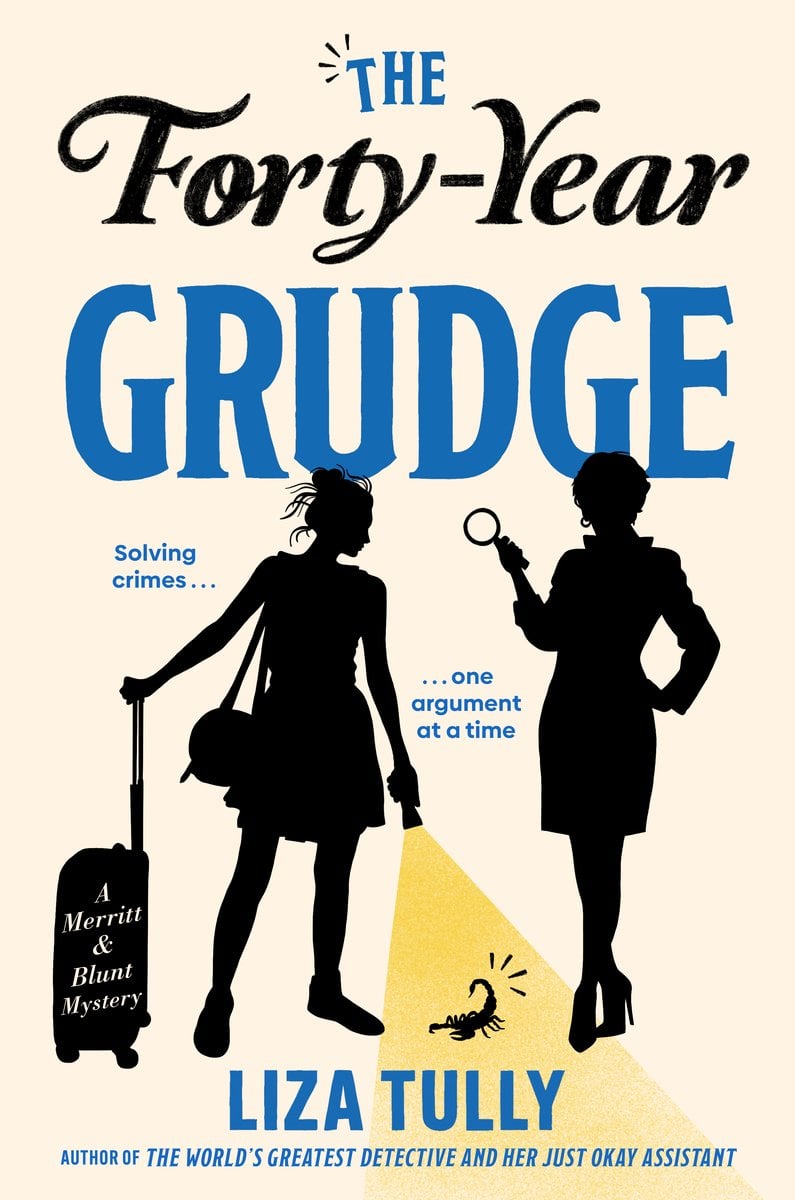
In my new mystery novel, The Forty-Year Grudge, I deal with themes of harm and retribution. I have heard that in real life there are mature, responsible strategies for handling these kinds of issues. I have no idea what those strategies are, nor do I possess any of the professional qualifications that might make my opinion, if I had one, worth listening to.
I only know that a grudge is wonderfully rich territory for a storyteller to explore, and just might be a subject worth considering for your next tragicomic murder mystery.
***

Liza Tully
Liza Tully is a pseudonym for Elisabeth Brink, who writes dark thrillers under the name Elisabeth Elo, as well as literary fiction under the name Elisabeth Panttaja Brink.