
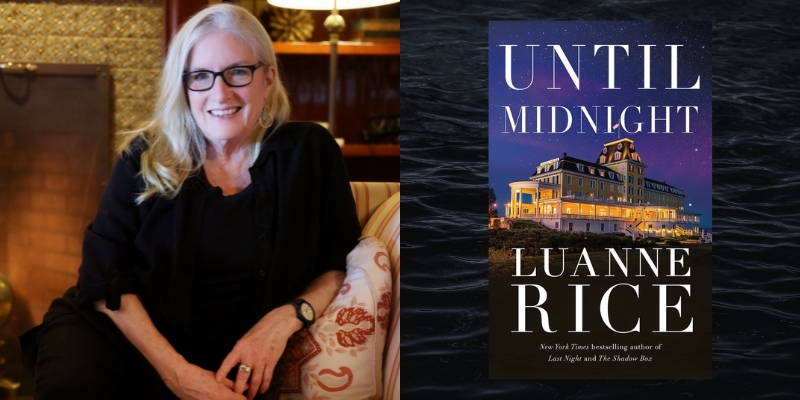
Luanne Rice on Crafting Character-Driven Suspense Set on Rhode Island's Iconic Coast
John B. Valeri in conversation with the author of Until Midnight
“It begins and ends with characters. I am ready to start a new novel when a character speaks to me and tells me her name….”
This is the tried-and-true approach that has sustained Luanne Rice for as many years as it has books. The New York Times bestselling author of some forty novels, her stories have ranged from contemporary fiction and romance to young adult and, more recently, standalone crime thrillers featuring a recurring cast of characters. Her works have been translated into thirty languages and adapted for television across multiple networks.
Regardless of how they have been classified by publishers, Rice—who counts families, nature, and the sea among her biggest inspirations—considers all her books to be unified under a single theme: “the mysteries that take place under every roof.”
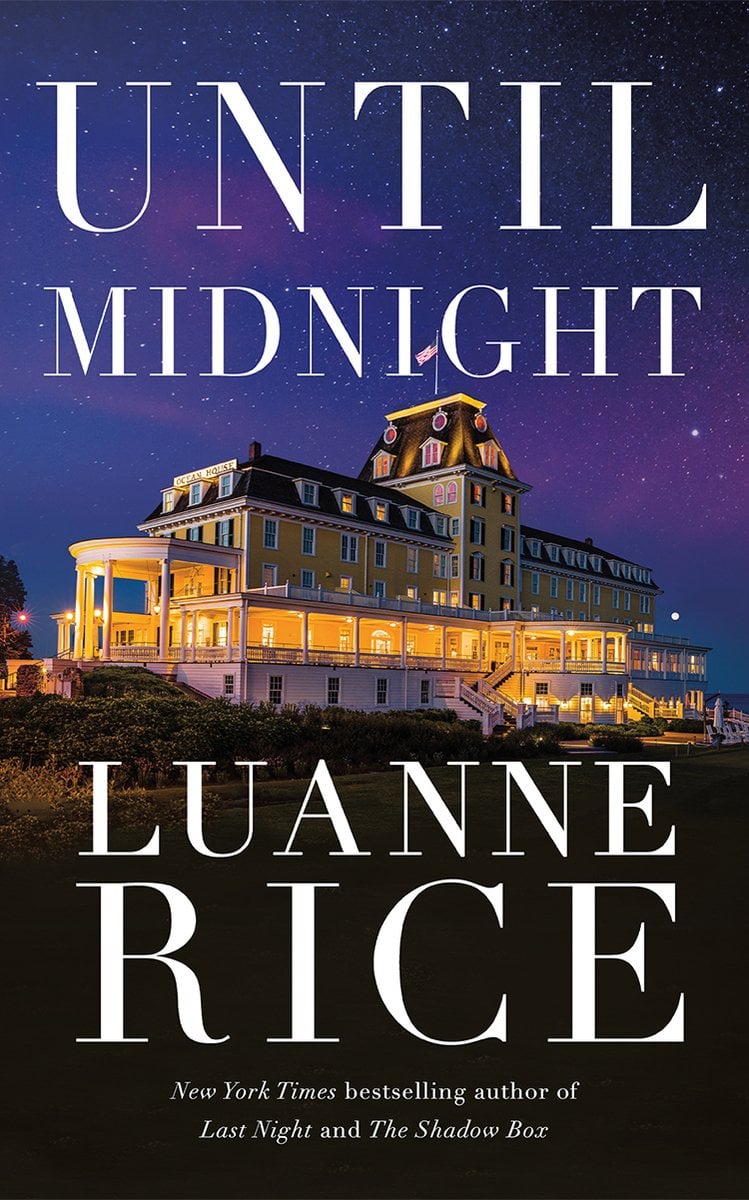
In the author’s newest, Until Midnight (June 30, 2026; Thomas & Mercer), the drama plays out in and around Westerly, Rhode Island’s iconic seaside resort, the Ocean House. Kate Woodward and Conor Reid (first introduced in 2020’s Last Day), having previously gotten engaged there, are now set to marry on the hotel grounds over the July 4th holiday weekend. But their fairytale romance is threatened when a woman from Conor’s past emerges, alleging a betrayal that derails their nuptials. The next morning, her body is discovered in a home across the street, where she has been stabbed and left to bleed out while wearing Kate’s wedding dress.
With their shared future now in question, Kate and Conor must put aside their differences to solve a murder that finds Conor—himself a major crimes detective—under suspicion; further, Kate appears to be a potential target. Why exactly they’re in the crosshairs, and whose, is unknown, but the ensuing investigation reveals a long history of crimes and cover-ups that belie the town’s coastal charm. As past and present collide like waves against rock, the clock ticks down on a happy ending that may never come.
Now, Luanne Rice discusses the mysteries of human hearts and histories, which continue to provide fertile ground for suspenseful storytelling….
*
John B. Valeri: Until Midnight revisits Kate and Conor on the eve of their marriage—an otherwise happy occasion that is interrupted by a figure from Conor’s past. In what ways does this set-up allow you to explore how one’s hope for the future can be threatened by the heartbreak of betrayal and the hazards of somebody else’s (deadly) agenda?
Luanne Rice: It’s the old question: How well do you know a person? Kate and Conor have built a relationship over several years (and four books). It began when Conor investigated the worst thing that had ever happened in Kate’s life—the murder of her sister. Kate was traumatized and closed off, and it took a long time for her to trust him enough to really let him in, to say yes to his proposal. To have come that far, and then to be blindsided by a secret from his past, was shattering to her. But who should she believe? Conor or the person making accusations, when the evidence appears so real?
JBV: The story plays out against the backdrop of the Ocean House in Westerly, Rhode Island (and its surrounding area). Why did you choose to return to this setting and in what ways does your familiarity with its unique atmospheric elements allow you to engage your readers both intellectually and on a sensory level?
LR: I love the Ocean House and have written parts of many books there. It’s a sanctuary on the edge of the Atlantic, and I feel as if the pages of Until Midnight are full of everything I feel, see, and hear there: the bell buoy tolling off the point, the beam of the lighthouse sweeping the sky, waves crashing on the beach and salt spray exploding, the sound of the flag atop the hotel snapping in an east wind, the gentle strains of harp music in the lobby, the excitement and romance of seeing a big white wedding tent set up on the lawn.
The Ocean House is my home away from home—a kind of between-world. Why do people choose to live in hotels? It takes them out the familiar, but then becomes familiar. It’s like walking through a portal into a life where anything can happen.
JBV: The book is dedicated to Deborah Goodrich Royce, who is not only a friend but a fellow writer and co-owner of the Ocean House (which she and her husband rebuilt). How has her friendship enriched you, both personally and professionally – and, more generally, why is it important for creatives to have like-minded individuals to commune with?
LR: Deborah is a brilliant novelist whose books are full of suspense and a deep understanding of the human heart and mind. I’m always intrigued by the way she writes about trauma and its effect on memory. Her settings are so vivid and make me feel that I am there. She is one of the most generous writers I know—she supports and celebrates other writers, showcasing our books on her Friday Reads segments, interviewing us at the Ocean House Author Series, and gathering us together to get to know each other. I am basically a hermit, so I really admire how much she does.
Two years ago, she asked me to co-found (along with Amy Scheibe) the Deer Mountain Writers’ Retreat. It takes place at the magical Deer Mountain Inn, Tannersville, NY. To me, this is quintessential Deborah: she has a vision, she invites writers, we gather, and by the end of the five days (solitude all day until cocktails and dinner) we have pages that we’ve written and a group of new friends. Deborah inspires me in many ways—seeing what she has done with the DMWR is one. We started with one group a year, and now it’s two—both spring and fall.
JBV: The narrative is heavily influenced by an appreciation for art and literature/fairytales. Tell us about the incorporation of these components. How do they elevate the story while also bolstering it thematically?
LR: There are layers to the answer. The Ocean House does have a fairytale air about it. All weddings are fairytales, and whenever I see one of those white tents I mentioned above, I hear “once upon a time.”
Moreover, the hotel is full of art. The works of Ludwig Bemelmans are featured in the Bemelman’s Gallery, including illustrations from his Madeline books. The hallways, and now every single room, contain pieces by SEM, the French caricaturist whose works depict the social fabric of Paris society, the Trouville racing set, and many other aspects of the Belle Époque. So many stories on the walls of the grand hotel.
I created a fictional painting by a real artist—Foggy Night, painted by James Suydam. The painting becomes important to the novel—to Kate and Conor—and holds a key to the mystery.
Another layer: I did use Beauty and the Beast as an inspiration. There are elements of abuse and sex-trafficking in the novel, and I think of how, when going through the horrors of abuse, it is possible to “go somewhere else”…to dissociate, completely block out the experience and travel via imagination to somewhere tolerable. It is a survival mechanism. A dark personal fairytale that I wove into this book.
JBV: Your thrillers are not branded as a series and yet they feature recurring characters. What is your approach to maintaining the narrative momentum of a standalone plot with the continued development of an overarching storyline?
LR: The recurring characters are Kate Woodward and the brothers Conor and Tom Reid. Kate owns an art gallery in Black Hall (Old Lyme), Connecticut. Conor is a Connecticut State Police detective, and Tom is an investigator for the United States Coast Guard. They have appeared in Last Day, The Shadow Box, Last Night, and, now, Until Midnight.
Although they inhabit a fictional world, their stories from book-to-book are mostly unconnected—they don’t build on each other. I purposely wanted the novels to be standalone, so readers could enjoy each without having to refer back to earlier ones.
JBV: Earlier in your career, you wrote contemporary/women’s fiction. Why did you decide to transition to crime novels – and what do you see as the overlap between the two vs. their individual identities? Also, please share any guidance you might have to offer to others who are considering a change of genre.
LR: I have always loved reading suspense novels, starting with Nancy Drew. And I have always loved writing about families who live on the Connecticut and Rhode Island shorelines. Over the years, I have woven those two loves together.
Even before my books were labeled thrillers, I’ve filled them with mysteries—the mysteries that take place under every roof. Every family has them. So even going back to my “general fiction”, you’ll find episodes of darkness and betrayal.
The change to thrillers happened after a murder that affected my family. It became the inspiration for Last Day. I never set out to change genres, but I knew what I had to write. I would encourage any writer to write what interests them, what is calling to them. The same happened when I wrote my first YA novel, The Secret Language of Sisters: the story came to me in a young voice, I listened to it, and wrote it down.
JBV: Knowing all too well the consequences and ripple effects of real-life violence, what do you hope to portray about the essential truths of crime, psychology, and victimology in your books? How do you endeavor to balance a sense of realism with the entertainment value of a good story?
LR: It begins and ends with the characters. I am ready to start a new novel when a character speaks to me and tells me her name. She always has a concern that mirrors mine—something that I am going through—or went through, something that haunts my dreams. She becomes very real to me, and that’s the whole novel. I learn a lot about myself from my characters—they have helped me deal with so many things. They always make me laugh and cry, and I wake up each morning wondering what will happen next. That entertains me, so I hope it entertains my readers too.
JBV: Summer is upon us…which means people are seeking recommendations for the season. Given that you are a great ambassador of books and the people who write (and sell) them, what titles would you suggest? And are there any books that you are particularly excited to crack into in the coming months?
LR: Yes!! Here are just a few:
Best Boy by Deborah Goodrich Royce
Laws of Love and Logic by Debra Curtis
White Ghost Blues by Rick Koster
The Final Score by Don Winslow
You’ll Be Sorry by Lisa Gardner
Whistler by Ann Patchett
This Changes Everything by Lisa Scottoline
Storm Tide by Paul Doiron
The Wash-Ashores by Hannah McKinnon
Summer Light on Nantucket by Nancy Thayer
Blunt Instrument by Amy Bloom
Dolly All the Time by Annabel Monaghan
The Man Who Led a Dream Life by David Handler
The Things We Never Say by Elizabeth Strout
***

John B. Valeri
John B. Valeri is a book reviewer, author, and host of the web series “Central Booking.” He has contributed to The Big Thrill, CrimeReads, Crimespree Magazine, Criminal Element, Mystery Scene Magazine, The New York Journal of Books, The Strand Magazine, and Suspense Magazine. Visit him online and watch past episodes of “Central Booking” at JohnBValeri.com.