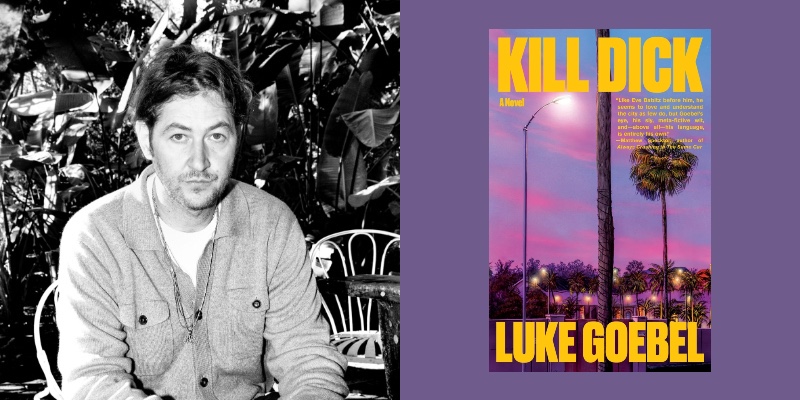
Luke Goebel on Weaponized Fatigue and the Necessity of Violence in His New Novel
"Another tragedy, another victim, another abuser; we masticate it, digest it, feign disbelief at the feast and move on."
To put it plainly, we are not shocked anymore. Not really, not by the current delivery mechanisms that have risen to fill our feeds, our media intakes, etc. We simulate shock. We perform it at parties. We circulate it over dinner. We feel trapped by it in our minds in our condos and offices and Waymos.
Still, nothing knocks us off our feet or shakes our sense of reality. Not like it should, anyway—or maybe we’re completely off our axis all the time now. Maybe we live in shock and we’re in a constant state of shock; PTSD: PERHAPS the gen pop has generalized anxiety run riot. We’re inmates during a prison break. And because we live and breathe like this, nothing truly interrupts the stasis.
Another tragedy, another victim, another abuser; we masticate it, digest it, feign disbelief at the feast and move on.
In that case it is not apathy we suffer from, but a symptom of something much more perverse; shock fatigue.
If any truth exists, it only exists in fragments. This didn’t used to be the case. Life once upon a time was almost certainly simpler. An imaginary community report from the 1400s might read: Bob stole a cow from Alan. Bob is dead. Alan killed Bob. Now the news report would read: Bob’s mom is missing after Bob investigated the disappearance of a cow years ago but stopped because he needed to protect his safety and was warned to stop investigating the missing cow by the news outlet he worked for. Suddenly the missing cow story has renewed relevance as the cow’s death is connected to a ring of pedophiles with connections to the feudal state and the feudal rulers who own the new outlet are reporting on Bob’s missing mother.
Furthermore, Alan’s mother is missing too. Thus it arrives already diluted, already tampered. And the resulting apathy is not due to moral lapse but rather a symptom of a collective nervous system overload.
This is the world my new novel, Kill Dick inhabits.
The string of murders are not simply plot. They are signal. They are an attempt—within the logic of the story—to break through the anesthetic layer that covers everything else. Dead bodies force attention in a way that headlines no longer can. They cut through abstraction. The opioid crisis did not lack information. Purdue Pharma, OxyContin, settlements, internal memos—we know. The names are public. The damage is quantified. Hundreds of thousands dead.
And yet the system persists. Because knowledge alone is no longer enough to produce response.
The same is true of Epstein. The same is true of mass shootings. Repetition drains meaning. Exposure becomes ambient. So what does it take to feel something?
KILL DICK answers: more.
More intensity. More proximity. More consequence. The killings in the novel are a grotesque mirror of the system itself. The system kills at scale, abstractly, through policy, distribution, and financial engineering. The novel renders that violence personal, immediate, undeniable and forces the reader into confrontation.
Susie Vogelman exists inside this machinery. She is not outside observing it. She is saturated by it—chemically, emotionally, socially. The drugs that move through the country move through her. The money that structures the violence shapes her life.
She is both numb and hyper-aware. And this contradiction is the point. Because numbness is not the absence of feeling. It is the overload of feeling without resolution. Everything hits at once and nothing sticks.
So the body adapts. It dulls. It filters. It protects itself. What else can it do? But it doesn’t forget. So that protection comes at a cost. We allow the system to continue and feel guilty for not taking action to really protect ourselves and others. That’s why folks celebrate Luigi Mangioni and Ted Kazinsky. KILL DICK is the artistic version of these men and occupies the female POV. This pushes against the status-quo by escalating the stakes until the buffer breaks. And this is where media enters. Because if fatigue is produced through media saturation, then any attempt to disrupt it must also move through media. You cannot step outside it. You have to hijack it.
The novel understands this. It does not pretend to exist in a pure literary space, separate from the flows of images, headlines, feeds, and spectacle. It leans into them. It weaponizes them back. The book is loud on purpose. Provocative on purpose in that it names things. It pushes connections and honestly it risks excess. Because subtlety disappears in a saturated field. You know that if everything is screaming, you either go silent or you scream differently. KILL DICk chooses the latter. It uses the same channels—violence, sex, money, scandal—but reconfigures them into something that resists easy consumption. It does not let the reader glide past. It creates friction.
This is the only viable strategy in an attention economy built on distraction because you do not compete by being quieter. You compete by being harder to ignore. The hunger for media is part of the system. We consume constantly. We refresh. We scroll. We look for the next thing. KILL DICK exploits that hunger for a freer feed.
It gives the reader what the system has trained them to want—intensity, transgression, access—and then refuses to resolve it cleanly. It traps the reader inside the experience instead of releasing them from it. This is not comfortable. It is not meant to be.
Because comfort is the mechanism that allows fatigue to persist. The goal is interruption. Not permanent, not total, but enough to create a crack in the surface. Enough to make something register again.We are not shocked anymore. So the question is not how to restore shock in its original form. That is gone. The question is how to force attention in a landscape designed to prevent it. KILL DICK answers with escalation, proximity, and saturation turned back on itself. It does not fix the system. It exposes how the system feels from the inside. And in doing so, it creates a moment—brief, unstable, but real—where the blur stops.
Where something lands and the reader cannot immediately move on. That is the function of the violence and the function of the media: Not to resolve and not to explain. But to break the rhythm of forgetting.
***

Luke Goebel
Luke Goebel is an acclaimed author and screenwriter celebrated for his unflinching honesty and innovative storytelling. A recipient of the prestigious Ronald Sukenick Innovative Fiction Prize and the Joan Scott Memorial Fiction Award, his debut novel, Fourteen Stories, None of Them Are Yours, garnered critical acclaim for its innovative and precisely lyrical, profoundly resonant exploration of love, grief, and the restless search for identity. Goebel also co-wrote Eileen, starring Anne Hathaway and McKenzie Thompson, and Causeway, starring Jennifer Lawrence and Brian Tyree Henry (who received an Oscar nomination for his performance). He is known as well as his role as co-editor at The New York Tyrant and work with Tyrant Books. He lives in Pasadena with his wife, fellow author Ottessa Moshfegh.