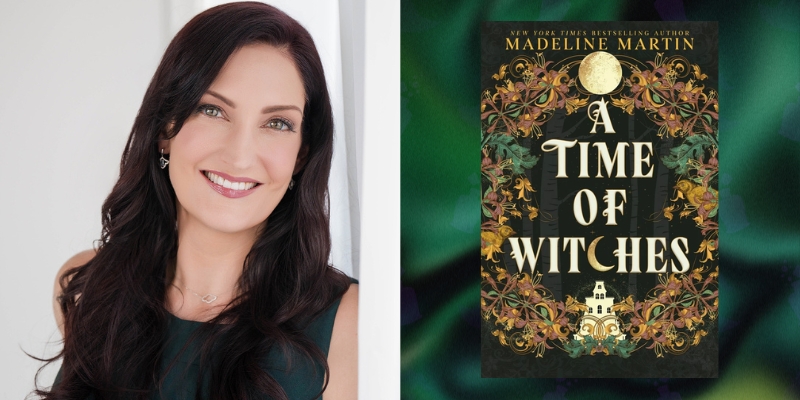
Madeline Martin on Matthew Hopkins and the Deadliest Witch Hunt in England
The author of A Time of Witches shares the sordid history of Britain's Witchfinder General
Ropes swung from the makeshift gallows, hastily erected in Bury St. Edmunds at Thingoe Hill, a popular spot for executions. One that would taste death once more that day on August 27, 1645, when eighteen souls accused of witchcraft would be hanged in England’s largest mass execution for witchcraft.
Sixteen women and two men had pleaded guilty to charges ranging from using their imps to kill cows and murder people to entering into pacts with the devil. Some even confessed to using their powers to kill beloved family members.
But these confessions didn’t come from earnest admissions. The accused were coerced into giving these testimonies after various forms of torture.
What exactly happened to these people to force them to admit to such impossible crimes?
First, we need to delve into the man behind these brutal trials—Matthew Hopkins, the self-appointed Witchfinder General. As the son of a vicar, Hopkins was raised under strict Puritan rules, imbuing him with the foundation to assume himself worthy of identifying, accusing, and helping prosecute suspected witches.
At this particular time, the country was torn apart by civil war, and the traveling court systems (the assizes) remained fearfully at home. England was ripe for a predator like Hopkins, a man puffed up on arrogance and an unapologetic moral high ground.
Dressed dramatically in a long black cape and wide-brimmed Puritan hat, Hopkins swept through England, spreading his fear like the plague, infecting every town he came across. And they welcomed him with open arms.
Hopkins did not perform his duties in hunting down and trying witches for free. No, he was a shrewd witch hunter—one keen on capitalizing on the people he preyed upon. And his prices were not cheap. In a country that had suffered an outbreak of the plague less than a decade before and still suffered from famine, the cost of twenty-three pounds (a little over five thousand dollars in today’s economy) would have been exorbitant for these small towns. To the point, several of them enacted a “witch tax” to help bring Hopkins to their locale to rid them of witches.
Fear is profitable.
Perhaps that is why Hopkins went to such severe measures with those accused of witchcraft. The interrogations were calculated acts of psychological warfare.
He would often deprive people of food and drink, weakening them in preparation for what was to come. Next came sleep deprivation, forcing them to stay awake for days on end. While doing this, he also administered what he called “walking.” The accused would be forced to walk from one side of the room to the other, back and forth, back and forth, back and forth, for days until they collapsed from exhaustion. Or confessed.
What does sleep deprivation do to the body? It can cause hallucinations, false memories, and makes people open to accepted suggestions that are planted in their minds. In such a state, people are especially susceptible to figures of authority repeatedly describing their supposed crimes in detail.
But sometimes even that torture is not enough. Sometimes a person’s willpower is still too strong.
Enter the Prickers.
These were sometimes local women, sometimes professional men trained in witch-pricking, employed for the purpose of stripping a suspected witch down and seeking any “witch’s marks” upon their bodies. These were assumed to be places where a witch would suckle her imp. This could be a mole, scar, birthmark, or any other type of skin irregularity. These “marks” were prodded with a bodkin—a sharp needle-like object, to show it did not bleed as obvious evidence of the accused being a true witch.
If one could not be found, it was not uncommon for an accused witch to be completely shaved of all their body hair in the pursuit of the examination.
What accused witches endured was brutal, exhausting, humiliating, something that broke them down to the base of their humanity. Confessions were dragged out of them and provided no hope of recalling their admissions, despite the fact that the foundation of every confession was fear. Fear of what torment would come next if they did not confess. Fear of what would happen if they did. The understanding that there was no way out.
Because if they still refused to admit to witchcraft and the prickers did not find enough evidence, there was one final test—the swimming test.
The accused would be taken to the edge of a river, where their right thumb would be tied to their left toe, and their right toe would be tied to their left thumb. From there, they were thrown into deep water. If they managed to swim to the surface and save themselves, they were deemed a witch, saved by Satan. If they died, they were exonerated of witchcraft posthumously. It was the ultimate lose-lose scenario.
Ironically, Matthew Hopkins did not view his trials as torture and lauded his own “humane” acts of encouraging confessions.
Now back to August 27, 1645, when sixteen women and two men met their deaths after enduring torture at Hopkins’s hands. These were wives, mothers, members of the community, and even an eighty-year-old vicar who once saved a woman from being tried as a witch decades before. People who had no association with the devil and the only evil they truly knew was at the hands of the Witchfinder General.
Matthew Hopkins continued his reign of terror over East Anglia until 1647, when his growing ambition finally attracted scrutiny and skepticism. But not before his accusations led to approximately two hundred to three hundred innocent lives lost, making up for more than sixty percent of all the witch trial-related deaths in England.
Though he only operated for about three years, his influence stretched beyond England’s shores to the New World in America. Not only through his manifesto, A Discovery of Witches, but also through the power of fear.
After all, fear is what gave confessions more merit than truth. And when fear is valued over truth, society becomes capable of believing almost anything.
History shows just how deadly that can be.
***
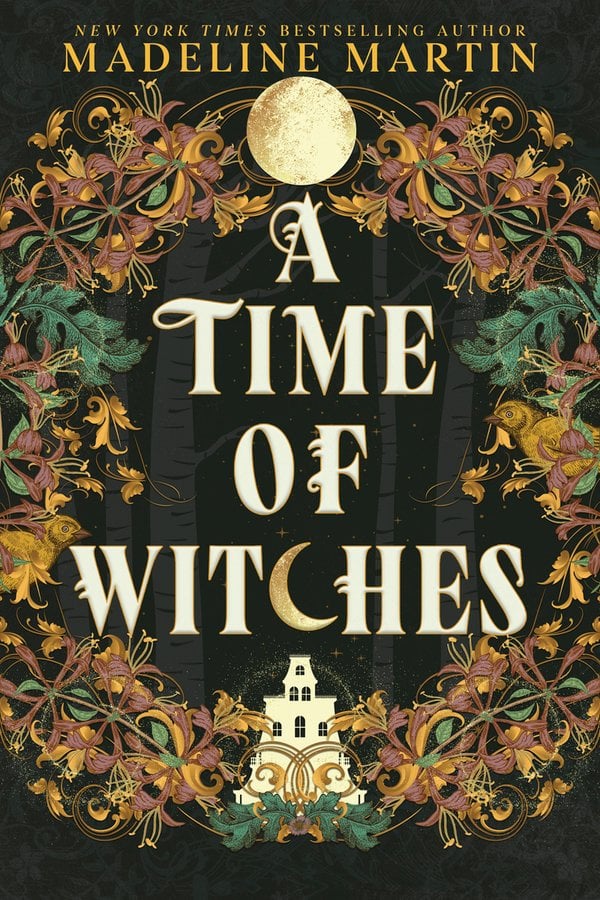

Madeline Martin
Madeline Martin is a New York Times, USA Today, Publisher Weekly, and international bestselling author of historical fiction and historical romance with books that have been translated into over twenty different languages. She lives in St. Augustine, Florida with her family. Visit Madeline online at madelinemartin.com, on Instagram and X @madelinemmartin, on Facebook at MadelineMartinAuthor.