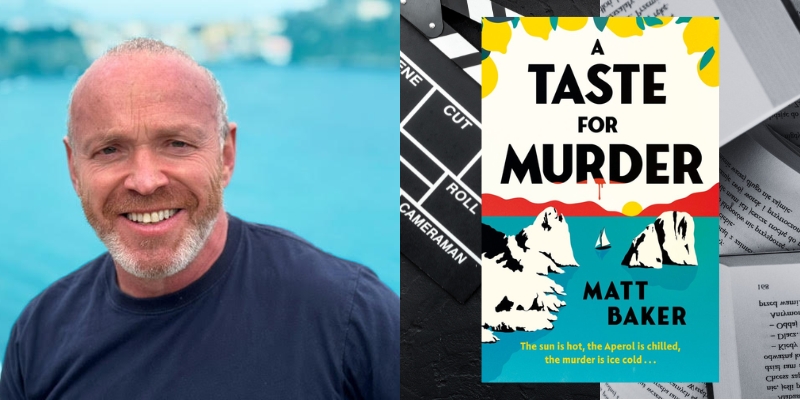
Matt Baker on Screenwriting, Audience Expectations, and Writing His First Detective Novel
The author of A Taste for Murder reflects on the differences between crafting TV and book sleuths
I came to being a “writer” late but I’ve always written for a living. I spent the first decade of my working life in journalism before deserting my fellow hacks to become a ‘flack’ handling communications for large corporates. It was only at the start of the COVID 19 pandemic that I took the plunge, deciding to dedicate myself to writing stories rather than speeches or strategy presentations.
I’ve attempted to write creatively my whole life. Old friends tell amused tales about me coming home from my first job in newspapers to dedicate my evenings to tapping away on a rudimentary word processor—remember that flashing green cursor?—trying to write something. By the time my kids arrived, and family life took over what spare time we had, I was getting up at 5 a.m. to carve out a couple of hours for my literary ambitions.
What was I trying to write? A lot of it (thank goodness) is lost to posterity but it was mainly novels…ambitious, literary ones with grand themes such as love and loss. They all ended up abandoned. Somehow I didn’t trust my “voice,” couldn’t master the art of wrangling my myriad thoughts into a coherent shape. Into a story for goodness sake.
But when I was offered the chance to write for TV for the first time, at the grand old age of fifty-one, everything suddenly fell into place. With my background in journalism, TV felt easier….There was structure (ad breaks, episodic lengths), techniques (misdirect, show don’t tell), even software to format your scripts.
This was particularly true of crime stories, with the logic of an investigation to follow and with an ideal number of red herrings to include. Once you’d learned the rules, it felt manageable, nowhere near as scary as those endless blank pages. In the last six years, I’ve written sixty-five hours of TV for shows including Patience, Professor T and, most recently, A Taste for Murder. I’ve had a lot of catching up to do.
There are many books about screenwriting. What I took from the best is that stories are what make us human and how we tell and receive them goes to the heart of our psychology. As such, there’s an archetypal shape to our storytelling, designed to engage, grip and satisfy us, and this hasn’t changed since we were cavemen and women sitting round a camp fire in the darkness.
In terms of TV, that shape—or narrative arc—doesn’t just apply across the whole, but to every scene as well. Each scene should be a microcosm of the whole reflecting the themes and arc of the wider story. When people watch TV it’s essentially a passive experience, they’re sitting back and expecting to be entertained. A writer has to work to draw them in and keep them engaged, to drag them to the edge of their seat (or rock) and make sure they stay there (that’s Jeopardy, folks!).
Did these insights help me when I finally got to write my first novel…a police procedural, A Taste for Murder, set in Capri, which I’ve also adapted into a six-part TV drama available on BritBox in the U.S.? Well…somewhat. When writing for TV, the majority of your time is spent on planning and preparation…on the creation of “beat-sheets” that plot out every episode scene-by-scene down to its essential details. When I brought the same technique to novel writing, suddenly those blank pages didn’t see quite so scary. I’d found a way to impose a structure on them.
Of course, the basics of a good crime story are the same whether you’re writing for print or TV. You need victim(s) dispatched in grisly circumstances, a healthy dollop of suspects with secrets and credible motives to create red herrings galore and a memorable and preferably flawed “detective” (amateurs may apply) with a skill that allows them to pick a path through the confusion towards a clever and satisfying solve. Oh yes…and a subtle trail of breadcrumbs to allow the viewer or reader to play along at home.
Some aspects of writing for TV, however, can’t prepare you for writing a novel. As a scriptwriter you’re a cog in a machine. Your story reaches an audience through the filter of actors and directors, producers and other members of the crew. Even the intern making the tea may have creative aspirations…and an opinion to go with them.
And that requires the screenwriter to avoid ambiguity as far as possible, which means writing extremely precise stage directions—so the Director of Photography knows when you want them to move the camera, for example–and ironing out possible double meanings from dialogue, unless it’s dramatically necessary. It’s a question of everyone understanding a writer’s intention, so it can be collectively communicated to the audience.
It’s why so many editorial conversations around TV scripts relate to “signposting”: will it be clear enough to the viewer at home? And it’s particularly pertinent for crime drama…if a case is too difficult for those watching at home to follow then they’re likely to disengage and (horror of horrors) switch off and there go those advertising or subscription dollars.
Novels by contrast thrive on ambiguity. And that’s because there’s a fundamental difference in the imagination required to read a story versus watching one on screen. On TV, the images are created for you…you know what the characters look like, how they sound.
But reading a book is an act of creative imagination in its own right, of conjuring up the world the author is inviting you to enter. And because these words haven’t been translated by someone into pictures, books allow us to go deeper into human psychology, to explore those hard to fathom and even harder to communicate interior worlds.
Reading is thinking with someone else’s mind, to precis Schopenhauer. It requires a degree of intellectual effort. And that’s a boon for crime novelists, compared to their small screen counterparts, because if something is complex and not immediately obvious, we can rely on a reader to think about it, maybe even to pause and read back over something, in a way that people less commonly do when watching TV.
I’m not saying I think crime stories necessarily work better on the page than on TV. There are many incredible TV detective series and a whole heap of forgettable crime novels. And vice versa.
If you’re lucky enough, like me, to have the opportunity to write both then you should learn a little from each: from TV, a desire never to let the drama drop and ensure every scene and exchange either advances the plot or enhances our understanding of character i.e. a bit of physical description is fine to help readers shape a picture but don’t lose them in the detail; from books, not spoon feeding your audience but trusting them to do a little intellectual light lifting, to read between the lines, to parse subtext, to not require the significance of every plot point or clue to be underlined in red pen in case they missed it!
***
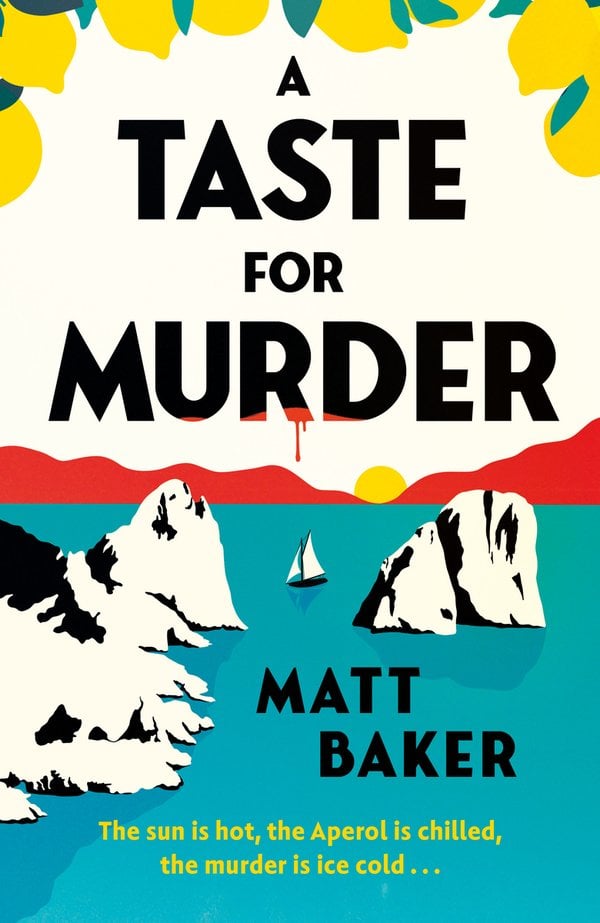

Matt Baker
Matt Baker is a television screenwriter best known for creating the ITV series Hotel Portofino. He cowrote and adapted the series Professor T, Suspect, and Before We Die and is the lead writer on Channel 4 series Patience, which aired in January 2025 and attracted an average audience of more than four million viewers across its run. He is the author of A Taste for Murder.