
Matthew Gavin Frank on Kim Wall and the Ethics of Sensationalistic True Crime
How a story about submersible enthusiasts morphed into a study of human depravity
In August 2017, the Swedish journalist, Kim Wall, was brutally assaulted and murdered by the amateur submersible builder, Peter Madsen, while onboard his sub, UC3 Nautilus, off the coast of Copenhagen, Denmark.
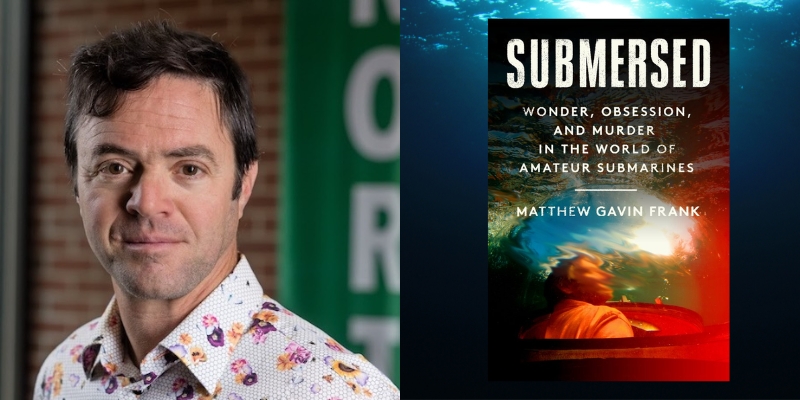
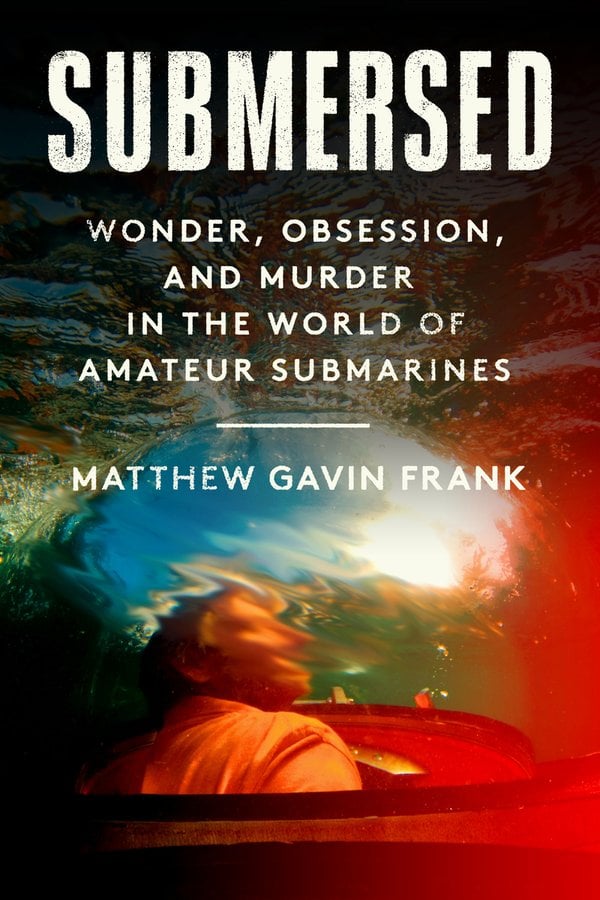
In my book, Submersed, I did not want to write about the murder of Kim Wall. I did not plan on writing about this. I wanted to engage the eccentric micro-community of DIY submersible folks, and to scratch at their obsessions and their actions for some kind of larger—if elusive or illusory—meaning; some kind of sly microcosmic comment on the human condition and on human longing.
I wanted to write about the flights of fancy and motivations of the PSUBS (or “personal submersibles”) collective—a group of self-proclaimed free spirits, who identify first and foremost as “amateur submarine builders and underwater explorers.” I wanted to write about coral beds, and about bioluminescence.
But, in my research, I kept bumping up against violence, misogyny, the murder of Kim Wall. What is it with my own malign and fraught compulsion to sink to these depths, the ethics of inquiring into and interacting with—in book form and other art forms—real-life atrocity?
“As news organizations grapple with shrinking budgets, they increasingly rely on freelancers [like Wall],” says journalist Sruthi Gottipati, “who cost less and are often willing to take on the attendant risks reporting in places they wouldn’t send their staff to. Even against this backdrop, the competition is fierce to place stories and female freelancers work hard to ensure their gender isn’t calculated as a liability. So they clam up about the dangers they face…”
And I realize that, even before the details of Wall’s murder began attending, like metal flakes to a magnet, my investigations into, and obsessions with the personal submersible community, my particular cage of skin lent me the sort of privilege that mitigated the sorts of dangers that Wall and Gottipati had to consider, negotiate, face. I had the privilege to be less complicatedly excited about diving to depth with one of these PSUBS guys, who is, in part I suppose, a guy like Peter Madsen, or a guy akin to who a journalist may have thought Peter Madsen was—a hobbyist eccentric—before the murder occurred. An admission: I revised this previous sentence. It once ended, “…a hobbyist eccentric—before the unthinkable occurred.” To whom, I had to ask, was the threat of murder unthinkable? To me, I’m both privileged and ashamed to admit. In this world, such an outcome may have been quite thinkable to Kim Wall. It must now be devastatingly thinkable to Gottipati, and most likely every female journalist.
“[T]he world has a way of knocking down women who are sharp, funny and bold,” Gottipati says, “It has a habit of strangling the voices who dare to speak up, of humiliating the women who step outside their comfort zones, of crushing the ones who break the rules. After traveling and reporting in Africa, Asia and the Caribbean, it was in her native Scandinavia, a supposed bastion of gender parity, in which Kim has disappeared. It’s a chilling reminder that women’s safety can’t be shrugged off as a problem specific to developing countries, as if the west is immune to misogyny.”
I can only hope—however inadequately, and perhaps in moments even infuriatingly—to draw inspiration from Wall’s own work as I negotiate the threads of my own. “As the empathetic reporter she is,” Gottipati says of Wall, “she writes with nuance and gives her characters, however downtrodden or peculiar or disenfranchised, agency. I wish we lived in a world that does the same for her.”
I share this wish, but also recognize the shortcomings of my own attempts to empathize with experiences that are not, and can not be my own, as such attempts are bound up in my very particular network of experiences moving through this world, in the ferment and fracas of the chemicals in my brain, which sometimes fools itself into thinking it is righteous, as if the way I wish to see myself is what I actually am.
The fact may very well be that my unbridled chasing of my own obsessions into the personal submersible world, and the seemingly ancillary threads that attend that chase, is itself an ethically unsound act. I am sinking through, at great speed, with blinders on, alternately attracted to and repelled by the subjects with which I collide, but, regardless, I can’t stop moving forward, or down.
I’m not sure what this tells me about myself as a writer, or about my ability to truly empathize with my subjects, lend them the agency they deserve. What is it then to engage this thread of “true crime” from this vantage? To realize that an engagement is ethically unsound, but to be unable to stop oneself from pursuing it, is to acknowledge that (to simplify) I’m not a very good person.
And even if one attempts to de-sensationalize the gristly (which, of course, is not innately sensational, but only becomes so if passed through the lurid portal of a particular breed of reportage), is one’s initial draw to the subject matter rooted in part in the sensational? If one strips the varnish off a doorknob, the thing that compelled them to do so is often the varnish itself.
In pursuing this story, I haven’t been eating well. I’ve been sleeping poorly, and when I when I do sleep, it’s ornamented with nightmares. I’ve been waking up screaming. My heart seems to be racing all the time. I’m worried I’m doing more harm than good. The ghosts seem to be warning me away, but I’m stubbornly ignoring them. This is hokey, sure: but I feel as if I’ve sunk too deep. And still, I can’t stop until I’ve found out where the crush depth is.
Is this draw to the true crime story “bad for us?” wonders journalist Phoebe Lett. No matter the answer, it seems such a draw has been with us for quite some time, prompting some to debate whether such an attraction is innate or learned.
In seventeenth-century England, the masses flocked to theaters to watch the performances of “conjurors”—early magicians and jugglers who, it was widely believed, achieved their powers of trickery by making deals with the Devil. They represented manifestations of evil in human form, and the more evil a conjuror was perceived to be, the more popular they were, the more tickets they sold. The masses couldn’t look away, and, as ever, they continually sought a darker, more devilish show.
One of the more popular conjurors was a man who took the stage name Hocus-Pocus, a bastardization of the Latin phrase, Hoc est corpus (“This is the body”), the very phrase a priest would intone during Mass at the moment of transubstantiation. Hocus-Pocus, in adopting this name, was blasphemously implying that the changing of the bread and the wine into the body and blood of Christ was yet another conjuring trick—rhetoric that was seen to have come straight from the Devil itself. (The word hoax shares this derivation).
And so, establishing himself as the greatest blasphemer on Conjurors Row, he filled his theater seats with the greatest number of butts. People couldn’t resist, even as they cringed.
“Before the Enlightenment, many thought human nature was inherently depraved,” says historian Joy Wiltenburg, “and the most sinister threat was the devil inside you, not an assailant around the corner. But there has long been a thrill to witness morally transgressive behavior and a desire to protect oneself from harm.”
But the “thrill to witness” eventually dovetails with elements of fear—the sort of which affect the ways in which we move through the world. The writer (and stabbing survivor) Emma Berquist argues that the popularity of the genre has made us—especially women—”inappropriately paranoid,” compelling us into a “state of hyper-awareness” and distrustfulness that can become unhealthy, unsustainable. Such “hypervigilance,” as aggravated by the ubiquity of so-called true-crime entertainment, Berquist says, “is a common symptom of PTSD, a trauma response that constantly puts your body into fight-or-flight mode.”
Conversely, professor of criminology Dawn Cecil, believes that the genre can help people “deal with their trauma…[and] live in a society that is still violently misogynistic.” But, Berquist says, “So many true-crime shows advise women to trust their instincts, but how can we trust instincts that have been hijacked by [the] anxiety…induced [by the shows themselves]?”
The popularity of the genre has also inspired a greater vigilantism among the public, wherein viewers can feel empowered to self-deputize, cast aside any notion of due process, and sometimes perpetuate crimes of their own in the name of virtue. “We’re a nation of crime experts now,” says Jean Murley, a true-crime scholar at Queensborough Community College. In some cases, when a person is convicted of a crime in the court of public opinion, that person has turned up dead, only to have evidence exonerate them posthumously.
Law professor Lindsey Webb also believes that the true-crime genre often perpetuates stories that serve to entrench white people’s fear of people of color and of immigrants, and further enshrine the racism inherent in our criminal justice systems. “We can both see the power of the narrative and get why this is compelling… and also say, ‘Wait a second, what are we perpetuating here?'” Webb says.
“Crime stories are a fundamentally conservative way of looking at the world,” Berquist seconds.
Suburban crime paranoia is as old as the suburbs themselves—hell, it’s why they exist to begin with….I see women on Twitter…instructing others to rip out strands of hair to leave in cabs for DNA evidence in case the driver murders you….Be aware of your surroundings and don’t trust strangers is not particularly helpful advice for avoiding the one scenario in which women are most likely to actually be murdered: by their partner. It’s victim blaming dressed up in empowerment.
I can’t help but think of Kim Wall’s parents; Ingrid and Joachim Wall’s tireless campaign to launch systems to empower female journalists in the aftermath of their daughter’s death, rather than sow fear, no matter how appropriate that fear may be.
The true-crime genre, historically, has depended on turning up the heat and the light on that fear, not only fostering an imbalance within a particular story, but swallowing entire aspects of it for making the fear splashier, addictive in its technicolor and the arousal of noradrenaline, norepinephrine, dopamine, and phenylethylamine—yes: those very same chemicals elicited when we fall, and fall in love, and go mad.
As the genre evolves, perhaps it can do better than this. The writer Elon Green feels that the genre has finally opened itself up to telling stories in new ways, highlighting voices that have been traditionally subsumed. In Green’s view, true crime has potential in its increasing willingness to de-lionize the police and other investigators, and to focus on overarching systems that have allowed violence to be perpetuated onto the bodies of marginalized factions of our populace. “The fact that people are even asking these questions,” he says, “is new.”
In spite of this newness, I worry about the fabric of the genre within which I find myself drifting, its mercurial nature, and what it needs to tell itself in order to sustain itself.
What I need to tell myself….Even if I scrupulously try to avoid the ugly luridness of much of the coverage of the Wall/Madsen case, even if I try to highlight new truths about it by focusing on the peripheral ephemera dancing around it, drawing a chalk outline around it, I am still likely doing some kind of harm to the victims—to Wall’s family—in simply refusing to not engage it, stitched to a rabid and pathological sort of curiosity that I’m convinced makes me a bad person—not only capable of doing harm, but continuing to do harm, even when I come to recognize that what I’m doing may be harmful.
Tucking this kind of hedonism into the confines of the essay does not excuse the rottenness of the hedonism itself. I cannot excuse myself, I cannot sleep, but I also cannot stop. I have this need to explore how things seem to attend one another—how the story of Wall’s murder kept linking itself to my investigation into the amateur submersible community; and how one can tell us something about the other, help to contextualize the other—again, however implicitly, inadequately, elusively.
Knowledge of the probable and malign side-effects of this exploration are speed-bumps that I find myself speeding over. I am complicit in perpetuating these side-effects of true crime. I didn’t want to write about this. I don’t want to write about this. I am writing about this. I don’t know where the surface is. I’m afraid that when I find it, I won’t emerge the same as when I sunk. Fuck me for being afraid. Fuck my particular fear. It’s nothing in the face of the sea. Fuck me for writing that too.
I can’t shirk this: The act of engaging—perhaps even artfully—a real-life murder is ethically unsound. To do so involves an act of conjuring, of making the wind and weather and clouds that obliviously encase horror.
Good god, why is it so difficult to stop fixating on the sky, the horizon, the temperature of the air and the things visible and invisible threading through it? Gnats and birds, cumulus and cirrus, breeze and calm, the waves, the waves. What good are any of these things? How can they be anything but inadequate lenses through which to examine the act of one person’s body harming another person’s body?
What good are the paper plates once heaped with food at Kim Wall’s final dinner party with her friends along the Copenhagen quayside? Why is it so difficult to stop fixating on the plates, the thin smears of ketchup and barbecue sauce soaked into the Styrofoam, some of which were smeared by the forefingers of the guests, the friends, the people who did not yet know what was to come, who were about to have their capacities for surprise and despair stretched out into, perhaps, something that resembled—however ephemerally—another translucent circle?
***

Matthew Gavin Frank
Matthew Gavin Frank is the author of the nonfiction books Flight of the Diamond Smugglers, The Mad Feast, Preparing the Ghost, Pot Farm, Submersed, and Barolo, as well as the poetry books The Morrow Plots, Warranty in Zulu, and Sagittarius Agitprop. His work has appeared in The Kenyon Review, The Paris Review, Guernica, The New Republic, Iowa Review, Salon, Conjunctions, The Believer, and The Best Travel Writing and Best Food Writing anthologies. He’s a professor of creative writing in the Masters of Fine Arts Program at Northern Michigan University, where he is also the Nonfiction/Hybrids Editor of the literary magazine, Passages North.