Will Another ‘Miami Vice’ Remake Have Anything to Say?
Whatever your feelings about the original TV show and 2006 movie, they reflected their times.
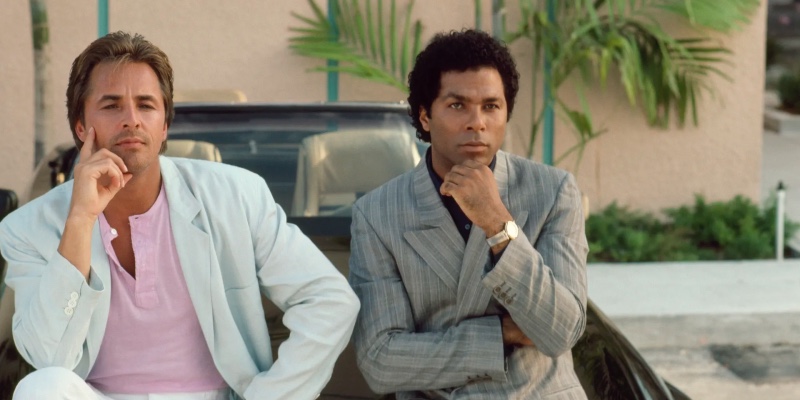
In the 1980s, of course, we had the original TV show starring Don Johnson and Philip Michael Thomas as hip Miami detectives “Sonny” Crockett and “Rico” Tubbs. As exhaustively detailed by roughly a million pop-culture essays, that show’s hip stylings and cinematic filming—shepherded, initially by auteur Michael Mann—helped define Miami as a sexy, dangerous place.
For better or worse, “Miami Vice” became synonymous with the image of the ‘80s as a decade of excess: big shoulder-pads, big hair, big money, big guns. But many of the episodes offered as realistic a view into Miami crime as a prime-time network TV series of the era could allow, and there’s a significant amount of grit beneath the pastel facades—something that’s easy to forget. Mann wasn’t afraid to embrace the same kind of tactical realism he’d later employ so effectively in movies like “Heat” and “Collateral”:
In 2006, Mann got a chance to remake the property as a movie. This was a post-9/11 world, and a more globalized one; huge swaths of the action would take place in locales beyond Miami, including Cuba and Ciudad del Este. The onscreen criminals were similarly transnational: Aryan Nation thugs collaborating with South American drug kingpins on drugs, guns, murder.
I still remember seeing the first trailer for “Miami Vice” in a crowded theater. For two minutes, the audience was quiet and attentive as Colin Farrell and Jamie Foxx (as Crockett and Tubbs, respectively) growled tough-guy dialogue, flew planes, and fired pistols—but when the title card popped up at the end, they burst into derisive laughter.
After the movie was over, I walked out thinking that if “Miami Vice” had been subbed out for any generic cop-movie title—“Hard Impact,” “Tropical Death,” whatever—everyone would have been more receptive. But in the Mid-aughts, the 1980s were still a target of cultural mockery, just as the ‘70s had been in the ‘90s. And perhaps nothing represents a certain version of ‘80s culture more succinctly than the original “Miami Vice” with its neon lights, cocaine, and pulsing synth soundtrack.
Studio executives were probably banking on that very nostalgia, at least among the Baby Boomers, when they gave Mann a reported $150 million budget for the film. And why not? Hollywood’s relentless mining of yesteryear’s IP had begun in earnest by that point; a few years before, movies based on “Starsky & Hutch” and “Charlie’s Angels” had rolled out. Perhaps those executives thought Mann would turn in something similar to those other remakes of bygone-era TV shows: broadly comedic, colorful, teetering on the edge of parody.
Instead, Mann decided to make a version of “Miami Vice” that almost played like a documentary of the drug trade, shot in grainy digital video and filled with menacing men shouting cop and trafficker lingo. No matter what people thought of it at the time (and it underperformed at the box office), in retrospect it’s the perfect movie for that era: suspicious and mean, with concepts like truth and justice dissolving into pixelated shadows and ear-shattering gunfire. The ending is borderline-nihilistic, suggesting that the main villains will continue to get away with it—even if you’re on the side of the angels, the best you can do is to drop your fugitive girlfriend on a boat and head into the office for another day of lies and death:
At the time, I was traveling for work to some of the same places portrayed in the movie, or region-adjacent—Havana, Managua, the DR, various “economic zones”—and the messiness of U.S. interventions was all too visible in the bullet-blasted walls of tiny villages, the landing strips cut into the jungle, the slogans painted on buildings and roadblocks. When the “Miami Vice” TV show debuted, the Ronald Reagan’s wars on drugs and communism were white-hot, shredding countries apart; when the movie hit theaters, there was a sense those wars had been lost, and everyone left to deal with the wreckage.
Twenty years later, yet another remake is reportedly booting up, with Mann replaced by Joseph Kosinski, most famous for directing “Top Gun: Maverick” and “F1.” Supposedly, Austin Butler will play Crockett, while Michael B. Jordan will step in as Tubbs (provided the money works out), and Tom Cruise may assume a villain role for the second time in his career, after Mann’s “Collateral.” Kosinski has stated it’ll take place in 1985.
All of which begs the question: why this remake, especially without Mann, and why now? The simplest answer is we’re trapped in a remake super-cycle at the moment, with studios digging up all kinds of properties in hopes of scoring something that plays well to a Boomer and Millennial audience without boring the Gen Z’ers. For example, “Cape Fear,” originally made as a movie with Robert Mitchum in 1962 and then remade with Robert De Niro in 1991, is becoming an Apple TV mini-series with a (terrifying) Javier Bardem in the lead role; so is “Man on Fire,” a revenge thriller made into movies in 1987 (with Scott Glenn) and 2004 (with Denzel Washington; far superior), now a Netflix series starring Yahya Abdul-Mateen II.
A “Miami Vice” remake falls into that same pattern of IP strip-mining. The title is recognizable to a broad swath of the population, the 2006 movie has become something of a cult classic among cinephiles, and it’s an opportunity to slap a pair of up-and-coming male stars (Farrell and Foxx; Butler and Jordan) onscreen together. But there’s also the risk that the new version, unlike its predecessors, will fail to capture a cultural or geopolitical moment—that it’ll be nothing but a flashy cover of yesteryear’s hits.

Nick Kolakowski
Nick Kolakowski is the author of "Maxine Unleashes Doomsday" and "Boise Longpig Hunting Club" (both from Down & Out Books) as well as the Love & Bullets trilogy of novellas (Shotgun Honey). His noir fiction has appeared in Tough, ThugLit, Mystery Tribune, Plots With Guns, and various anthologies.